
Car Wheel Speed Sensor Diagnostics & Replacement in Daytona Beach, FL
Wheel speed sensors tell the Anti-lock Braking System how fast each wheel is rotating. The ABS control module continuously compares these signals and uses them for anti-lock braking, traction control, and electronic stability-control functions.
When a wheel speed sensor or its circuit fails, the ABS light may illuminate along with traction-control or stability-control warnings. But a wheel-speed-related trouble code does not automatically mean the sensor itself needs replacement. Wiring damage, connector problems, a damaged tone ring or magnetic encoder, excessive wheel-bearing play, contamination, or an incorrect sensor gap can produce similar faults.
Jimmy’s Mobile Care provides car wheel speed sensor diagnostics and replacement in Daytona Beach, FL. We use ABS trouble codes and live wheel-speed information along with electrical and physical inspection to determine why the signal is missing, erratic, or inaccurate before replacing the sensor.
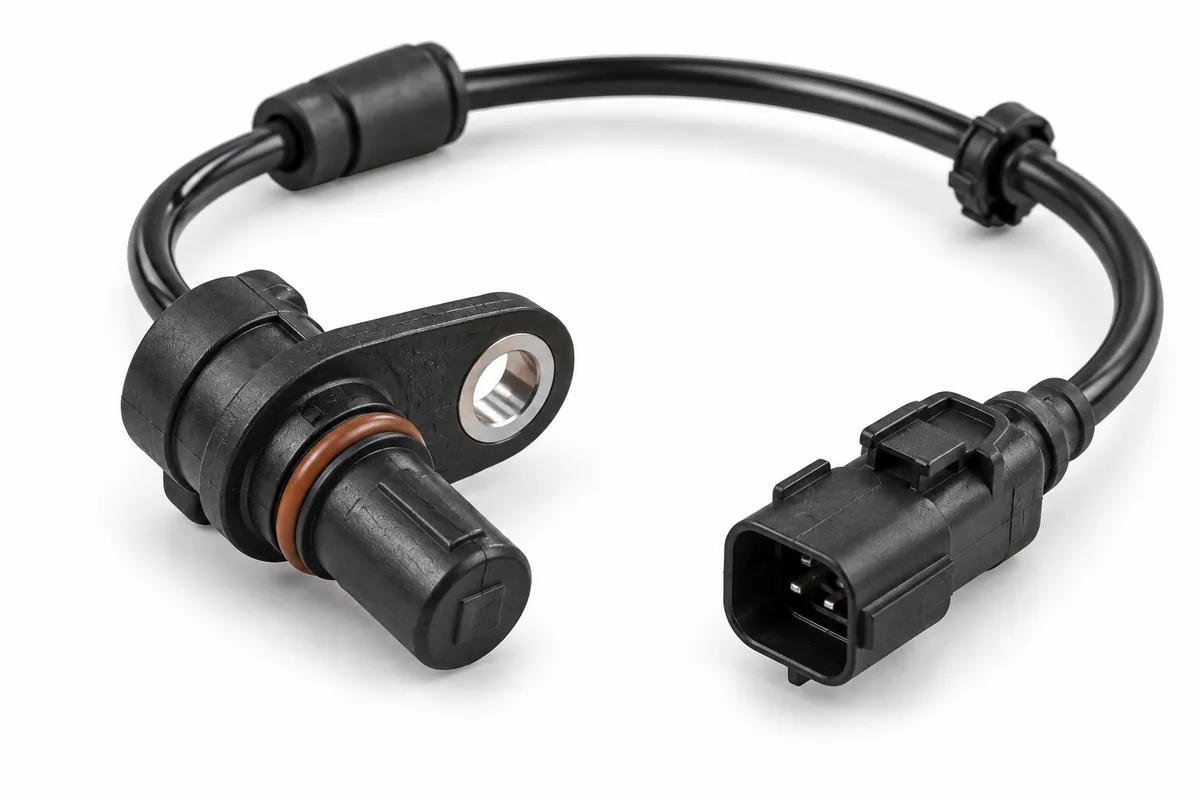
Mobile Wheel Speed Sensor Diagnostics in Daytona Beach
A wheel speed sensor is a relatively small component, but diagnosing one correctly can require more than finding which wheel appears in an ABS trouble code.
The complete signal path can include:
- Wheel speed sensor
- Sensor wiring
- Electrical connector
- Sensor mounting point
- Tone ring or reluctor
- Magnetic encoder
- Wheel bearing or hub assembly
- ABS control module
The specific arrangement varies by vehicle.
Our goal is to determine where the wheel-speed signal is being lost or distorted rather than automatically replacing the sensor named in a trouble code.
What Does a Wheel Speed Sensor Do?
Each wheel speed sensor measures wheel rotation and sends that information to the ABS control module.
The controller can compare the wheels hundreds or thousands of times during a drive and recognize when one wheel is behaving differently from the others.
During hard braking, for example, a rapidly decreasing wheel-speed signal can indicate that a tire is approaching lockup.
The ABS system can then use its hydraulic controls to adjust brake pressure.
Wheel-speed information can also be used by:
- Traction control
- Electronic stability control
- Hill-start or related driver-assistance functions
- All-wheel-drive systems on some vehicles
- Other vehicle control systems depending on the application
A bad signal can therefore affect more than the ABS warning light.
Wheel Speed Sensor vs. ABS Sensor
The terms wheel speed sensor and ABS sensor are often used to describe the same wheel-mounted sensor.
The sensor measures wheel rotation and supplies that information to the ABS system.
It should not be confused with the ABS module, which is the electronic controller that receives and processes those signals.
A simple way to distinguish them is:
Wheel speed sensor: measures what an individual wheel is doing.
ABS module: receives the wheel-speed information and decides how the ABS system should respond.
Jimmy’s Mobile Care services these as separate diagnostic categories because a failed wheel sensor and a failed ABS controller are very different problems.
Signs of a Bad Wheel Speed Sensor
Possible symptoms of a wheel speed sensor or wheel-speed-signal problem include:
- ABS warning light
- Traction-control warning light
- Stability-control warning light
- Multiple brake-system warning messages
- ABS activating when it shouldn't
- Traction control activating unexpectedly
- Loss of ABS operation
- Loss of traction-control functions
- Intermittent warning lights
- Speed-related trouble codes
- One wheel showing an incorrect speed on diagnostic data
The exact symptoms depend on the vehicle and the way its control systems use wheel-speed information.
ABS Trouble Codes and Wheel Speed Sensors
When the ABS module detects an abnormal wheel-speed signal, it can store a diagnostic trouble code.
The code may identify:
- Left front wheel
- Right front wheel
- Left rear wheel
- Right rear wheel
- Signal circuit
- Electrical fault
- Implausible signal
- Intermittent signal
- Missing wheel-speed information
The code gives us a diagnostic direction.
It does not necessarily tell us which part to replace.
If a code identifies the right-front wheel-speed circuit, for example, the problem could be the sensor, wiring, connector, encoder, tone ring, wheel bearing, or another condition affecting the signal.
Live Wheel Speed Data
One of the most useful tools for wheel speed sensor diagnosis is live ABS data.
Instead of looking only at stored trouble codes, we can observe what the ABS module says each wheel is doing.
When the vehicle is moving, the wheel speeds should generally agree with one another under normal straight-line driving.
A problem may appear as:
- One wheel remaining at zero
- One wheel dropping suddenly to zero
- A wheel reporting a different speed
- An intermittent signal
- An erratic wheel-speed reading
- A signal that fails only at low speed
- A signal that changes as steering or suspension moves
Comparing all four wheel speeds can quickly show which corner of the vehicle requires closer inspection.
Intermittent Wheel Speed Sensor Problems
Not every wheel speed sensor fails completely.
Some problems occur only:
- At certain vehicle speeds
- During turns
- Over bumps
- After the vehicle warms up
- When wiring moves
- During wet conditions
- At very low speeds
An intermittent sensor may therefore appear normal while the vehicle is sitting in the driveway.
Stored trouble codes, live data, wiring inspection, and the circumstances under which the warning light appears can all help identify these faults.
Wheel Speed Sensor Electrical Testing
Depending on the sensor design and the fault being diagnosed, electrical testing may be appropriate.
Wheel speed sensor systems can use different electrical designs, so testing procedures aren't identical for every vehicle.
Diagnosis may involve checking:
- Sensor power supply
- Ground
- Signal circuit
- Circuit continuity
- Shorts to power or ground
- Connector condition
- Signal response
The sensor type needs to be identified before interpreting electrical measurements.
Applying the wrong testing assumptions to a modern active sensor can lead to an incorrect diagnosis.
Active and Passive Wheel Speed Sensors
Automotive wheel speed sensors don't all operate the same way.
Older and some conventional systems use passive variable-reluctance sensors. Many newer vehicles use active electronic sensors.
Passive Wheel Speed Sensors
A passive sensor generally produces its own alternating electrical signal as the tone ring rotates past the sensor.
Signal strength can change with wheel speed and sensor-to-tone-ring relationship.
Active Wheel Speed Sensors
Active sensors require an electrical supply and electronically produce wheel-speed information.
These sensors may work with magnetic encoder rings rather than conventional visible toothed reluctors.
Because the two designs operate differently, their testing methods can also differ.
Wheel Speed Sensor Wiring Inspection
The sensor is mounted close to a moving wheel and suspension assembly, making its wiring vulnerable to conditions that many other vehicle sensors don't experience.
We inspect applicable wiring for:
- Broken conductors
- Damaged insulation
- Chafing
- Stretching
- Incorrect routing
- Loose retainers
- Corrosion
- Water intrusion
- Previous repairs
- Damage near suspension components
A sensor can be perfectly functional while a broken wire prevents its signal from reaching the ABS module.
Wiring That Fails When the Wheel Turns
Front wheel speed sensor wiring has to accommodate steering and suspension movement.
If the harness is damaged internally or routed incorrectly, the circuit can sometimes open or short only when the steering is turned or suspension position changes.
That can create an intermittent ABS warning that is difficult to reproduce with the vehicle stationary.
When symptoms suggest a movement-related electrical fault, the sensor harness and routing become particularly important.
Wheel Speed Sensor Connectors
The electrical connector between the sensor and vehicle wiring must remain clean and secure.
Connector problems can include:
- Corroded terminals
- Bent terminals
- Loose pins
- Water intrusion
- Broken locks
- Poor terminal contact
- Dirt or contamination
- Damaged connector housings
Replacing a sensor without correcting a poor electrical connection can leave the same ABS fault present afterward.
Wheel Speed Sensor Tone Rings
Many wheel speed sensors read a rotating tone ring, also called a reluctor ring.
A traditional tone ring contains evenly spaced teeth or windows that pass the sensor as the wheel rotates.
That creates the repeating pattern the system interprets as wheel speed.
If the ring becomes:
- Cracked
- Rusted
- Damaged
- Misaligned
- Contaminated
- Physically distorted
the sensor may produce an irregular signal even though the sensor itself still works.
This can create a wheel-speed-related ABS code without requiring sensor replacement.
Magnetic Wheel Speed Encoder Rings
Many newer wheel-bearing and hub assemblies use a magnetic encoder instead of a visibly toothed tone ring.
The encoder contains alternating magnetic poles that the wheel speed sensor detects as the wheel rotates.
Because the magnetic pattern may not be visible to the eye, a damaged encoder can be less obvious than a broken conventional tone ring.
Encoder problems can occur from:
- Physical damage
- Bearing failure
- Contamination
- Incorrect bearing installation
- Installing a bearing with the encoder facing the wrong direction
- Damage to the magnetic surface
The sensor and encoder work together. Either one can cause an incorrect wheel-speed signal.
Wheel Bearings and Wheel Speed Sensor Problems
The wheel bearing or hub assembly can sometimes be directly involved in a wheel-speed fault.
Depending on the vehicle, the tone ring or magnetic encoder may be built into the bearing or hub.
A worn bearing can also create excessive movement between the sensor and the rotating target.
Possible clues include:
- Wheel bearing noise
- Excessive wheel play
- Intermittent wheel-speed signal
- ABS warning after bearing replacement
- Sensor code accompanied by hub or bearing symptoms
If the wheel-speed target is part of the bearing assembly, replacing the sensor alone will not correct a damaged encoder.
ABS Light After Wheel Bearing Replacement
If an ABS warning appears immediately after wheel-bearing or hub work, the recent repair history matters.
Possible causes can include:
- Damaged wheel speed sensor
- Disconnected sensor
- Damaged wiring
- Incorrectly installed bearing
- Magnetic encoder facing the wrong direction
- Incorrect hub or bearing
- Damaged tone ring
That is why we consider what happened immediately before the ABS problem began.
A new warning light after wheel-end work doesn't automatically mean an unrelated sensor happened to fail at the same time.
Wheel Speed Sensor Air Gap
The sensor must maintain the correct relationship with the tone ring or encoder.
If the gap becomes excessive or irregular, signal quality can be affected.
Conditions that can change the sensor relationship include:
- Rust beneath the sensor mounting surface
- Debris
- Incorrect sensor installation
- Damaged mounting point
- Wheel-bearing movement
- Incorrect replacement parts
On systems where sensor gap is relevant, mounting condition needs to be checked before assuming the electronics have failed.
Rust Under a Wheel Speed Sensor
Corrosion at the sensor mounting point can sometimes lift the sensor slightly away from its intended position.
Even a small change in position can matter on certain sensor designs.
This can be particularly troublesome at low speeds, where a weak or irregular signal may cause the ABS controller to think one wheel is slowing faster than the others.
The sensor itself may test normally when removed.
Inspecting the mounting surface can therefore be an important part of diagnosing certain wheel-speed faults.
ABS Activates at Low Speed
One particularly confusing wheel-speed problem occurs when ABS activates just before the vehicle stops even though the road is dry and none of the wheels are actually locking.
This can happen if one wheel-speed signal drops out prematurely at low speed.
The ABS controller sees one wheel apparently stopping while the others are still rotating and interprets that as impending wheel lock.
Possible causes include:
- Weak sensor signal
- Excessive sensor gap
- Rust at the sensor mounting surface
- Damaged tone ring
- Cracked reluctor
- Magnetic encoder problem
- Wheel-bearing movement
Live wheel-speed data at low speed can be especially useful in diagnosing this condition.
Front Wheel Speed Sensors
Front wheel speed sensors operate in an environment with considerable movement.
The wiring must accommodate:
- Steering
- Suspension travel
- Wheel movement
- Vibration
Depending on the vehicle, the sensor may mount in the steering knuckle, hub assembly, or another wheel-end location.
When diagnosing a front sensor fault, we inspect both the sensor and the harness routing because wiring damage can occur where the harness repeatedly flexes.
Rear Wheel Speed Sensors
Rear sensor arrangements vary considerably.
A rear wheel speed sensor may be:
- Mounted at the wheel hub
- Installed in the rear knuckle
- Associated with a wheel bearing
- Reading a magnetic encoder
- Reading a conventional tone ring
The exact design depends on the vehicle.
We identify the system before determining whether the sensor can be replaced independently or whether another wheel-end component is involved.
Wheel Speed Sensor vs. Vehicle Speed Sensor
A wheel speed sensor and a vehicle speed sensor are not necessarily the same component.
Wheel speed sensors measure individual wheel rotation for systems such as ABS, traction control, and stability control.
A vehicle speed sensor may measure transmission or drivetrain speed for functions involving vehicle speed, transmission operation, or the speedometer, depending on the vehicle.
Because searches for “speed sensor” can refer to either component, the actual trouble code and sensor location need to be identified before parts are ordered.
This page specifically covers ABS wheel speed sensors.
Wheel Speed Sensor Replacement
Once diagnosis confirms that a wheel speed sensor has failed, replacement varies by vehicle but can include:
- Scanning the ABS system. We retrieve the stored wheel-speed-related trouble codes.
- Comparing live wheel-speed data. When appropriate, we determine how the affected wheel's signal differs from the others.
- Inspecting the wiring and connector. We make sure an external circuit problem isn't being mistaken for sensor failure.
- Checking the tone ring or encoder. The rotating target used by the sensor is evaluated when relevant.
- Inspecting the sensor mounting area. Corrosion, damage, or debris can affect sensor position.
- Removing the failed sensor. The sensor is disconnected and removed from its mounting location.
- Preparing the mounting surface. Applicable corrosion or debris is addressed so the replacement sensor can sit correctly.
- Installing the replacement sensor. The correct sensor is fitted and secured.
- Routing the wiring correctly. The harness is positioned so steering, suspension, and wheel movement do not damage it.
- Connecting the electrical circuit. The connector is secured and checked.
- Clearing applicable ABS trouble codes. Stored faults are cleared when appropriate.
- Verifying wheel-speed information. The system is rechecked to confirm the sensor is reporting properly.
The repair isn't complete simply because a new sensor has been bolted to the wheel.
The replacement signal needs to make sense to the ABS controller.
Why a New Wheel Speed Sensor May Not Fix the ABS Light
Replacing the sensor without diagnosing the complete wheel-speed circuit can leave the original problem unchanged.
An ABS light can remain on after sensor replacement because of:
- Broken sensor wiring
- Connector problems
- Damaged tone ring
- Damaged magnetic encoder
- Wheel bearing problem
- Excessive sensor gap
- Incorrect sensor
- Improper installation
- Another ABS fault
- Stored codes requiring further diagnosis
If a new sensor doesn't correct the problem, repeatedly replacing the sensor isn't the solution.
The signal path needs to be diagnosed.
Does a Wheel Speed Sensor Need Programming?
Most conventional replacement wheel speed sensors do not require programming simply because the sensor has been replaced.
The sensor supplies wheel-speed information to the existing ABS controller.
However, vehicle-specific procedures can vary, and some repairs involving other integrated components or related systems may require initialization, calibration, or additional diagnostic steps.
The service procedure should be based on the actual vehicle rather than assuming every wheel-speed system is identical.
Do Wheel Speed Sensors Need to Be Replaced in Pairs?
Normally, a wheel speed sensor does not need to be replaced simply because the sensor on the opposite side failed.
Each sensor provides information for its own wheel.
If diagnosis confirms one failed sensor and the others are operating correctly, replacement can generally be limited to the failed component.
If another sensor has its own fault, it should be diagnosed separately.
We replace the component the evidence identifies rather than automatically replacing sensors in pairs.
Can a Wheel Speed Sensor Be Cleaned?
Sometimes contamination around a sensor or its mounting area can contribute to a signal problem, but cleaning is not a universal repair for an ABS warning light.
If the sensor has an internal electrical failure, cleaning it will not restore operation.
Likewise, cleaning a sensor won't repair:
- Broken wiring
- Failed connector
- Cracked tone ring
- Damaged magnetic encoder
- Failed wheel bearing
The reason for the signal problem needs to be identified first.
How Much Does Wheel Speed Sensor Replacement Cost?
Wheel speed sensor replacement cost varies depending on the vehicle and sensor design.
Factors can include:
- Vehicle year, make, and model
- Front or rear location
- Sensor accessibility
- Corrosion around the sensor
- Sensor integrated into another component
- Wiring or connector damage
- Hub or bearing involvement
- Tone-ring or encoder damage
- Diagnostic time required to isolate an intermittent fault
A readily accessible standalone sensor is a very different repair from a wheel-speed problem caused by a damaged encoder built into a hub or bearing assembly.
Call Jimmy’s Mobile Care at (386) 308-2509 with your vehicle information, warning lights, and symptoms so we can discuss the appropriate diagnostic service.
Why Diagnose the Wheel Speed Sensor Before Replacing It?
Wheel-speed trouble codes can be caused by more than the sensor.
Diagnosis helps answer the questions that determine the correct repair.
Which Wheel Has the Abnormal Signal?
ABS trouble codes and live data help identify the affected wheel or circuit.
Is the Sensor Producing a Valid Signal?
A missing, intermittent, or implausible reading can be compared with the other wheels.
Is the Wiring Damaged?
A broken wire can eliminate the sensor signal even when the sensor itself is good.
Is the Connector Making Reliable Contact?
Corrosion or loose terminals can create intermittent electrical faults.
Is the Tone Ring or Encoder Damaged?
The sensor cannot produce correct wheel-speed information if the rotating target it reads is defective.
Is the Wheel Bearing Involved?
Some bearings contain the magnetic encoder, while bearing movement can also alter the sensor relationship.
Is the Problem Actually in the ABS Module?
If sensor inputs and circuits are correct but the controller cannot process them properly, diagnosis can move farther into the ABS system.
Following the signal from the wheel toward the ABS controller helps prevent unnecessary sensor replacement.
Mobile Wheel Speed Sensor Replacement in Daytona Beach
Jimmy’s Mobile Care brings wheel speed sensor diagnostics and replacement directly to your Daytona Beach location.
If your ABS, traction-control, or stability-control warning light is on, we can scan the ABS system and determine whether a wheel-speed signal is missing or behaving abnormally.
When diagnosis confirms a failed wheel speed sensor and the repair can be performed safely on-site, we can replace the sensor, inspect its mounting area and related signal components, route the wiring correctly, and verify that the ABS controller is receiving wheel-speed information again.
Schedule Wheel Speed Sensor Diagnostics & Replacement in Daytona Beach
A wheel-speed-related ABS code doesn't automatically mean the sensor needs replacement. The sensor, wiring, connector, tone ring, magnetic encoder, mounting condition, and wheel bearing can all affect the signal reaching the ABS controller.
Jimmy’s Mobile Care diagnoses the wheel-speed circuit first so the failed component can be identified before parts are replaced.
Call Jimmy’s Mobile Care at (386) 308-2509 to schedule car wheel speed sensor diagnostics and replacement in Daytona Beach, FL. Call today and we'll come to your location.