
Car Alternator Diagnostics & Replacement in Daytona Beach, FL
The alternator keeps your vehicle’s electrical system operating while the engine is running and replenishes the battery after startup. When alternator output becomes weak, unstable, or stops completely, the vehicle may develop a battery warning light, dim lights, electrical malfunctions, repeated dead batteries, or eventually stall.
Jimmy’s Mobile Care provides car alternator diagnostics and replacement in Daytona Beach, FL. We test the charging system before replacing the alternator so a weak battery, loose belt, damaged cable, blown fuse, poor ground, or vehicle charging-control problem is not mistaken for alternator failure.
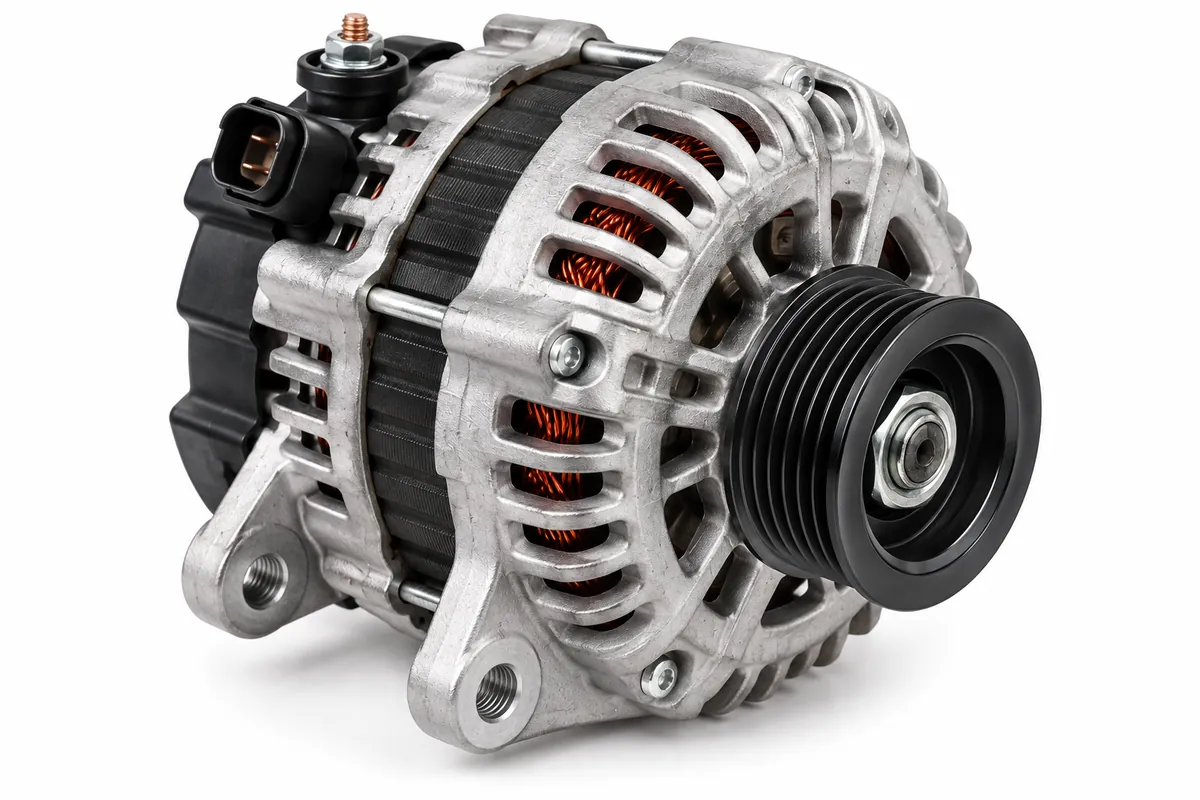
Mobile Alternator Diagnostics in Daytona Beach
A dead battery does not automatically mean the alternator is bad.
Depending on the vehicle and symptoms, alternator diagnostics can include checking:
- Battery state of charge
- Battery condition
- Charging voltage
- Alternator current output
- Alternator command and response
- AC ripple
- Battery warning light
- Serpentine belt
- Belt tensioner
- Alternator pulley
- Main charging cable
- Battery terminals
- Engine and chassis grounds
- Charging-system fuse or fusible link
- Electrical connectors
- Voltage drop
- Stored charging-system trouble codes
- Smart charging data where supported
The goal is to determine whether the alternator itself has failed or whether another part of the charging circuit is preventing normal operation.
What Does a Car Alternator Do?
The alternator converts mechanical energy from the running engine into electrical energy.
It supplies power for systems such as:
- Engine controls
- Fuel injection
- Ignition
- Lighting
- Blower motor
- Audio system
- Cooling fans
- Heated accessories
- Electronic modules
It also recharges the battery after the battery supplies the large amount of current needed to start the engine.
Without adequate alternator output, the vehicle eventually begins operating only on the electricity stored in the battery.
Once that energy is depleted, the engine may shut off.
Alternator vs. Battery
The battery and alternator have different jobs.
Battery
Stores electrical energy and supplies high current for starting.
Alternator
Produces electrical power after the engine starts and replenishes the battery.
A weak battery can make a good alternator appear suspicious.
A failed alternator can also repeatedly discharge a good battery.
For that reason, both systems should be considered when diagnosing charging problems.
Signs of a Bad Alternator
Possible alternator symptoms include:
- Battery warning light
- Charging-system warning
- Dim headlights
- Flickering lights
- Repeated dead battery
- Slow electrical accessories
- Engine stalls while driving
- Electrical systems shutting down
- Alternator whining or bearing noise
- Burning smell
- Low charging voltage
- High or unstable charging voltage
These symptoms can point toward an alternator problem, but testing should confirm the cause.
Battery Light on the Dashboard
The battery-shaped warning light is primarily a charging-system warning, not simply a battery-condition light.
It may illuminate because of:
- Alternator failure
- Broken or slipping belt
- Charging-circuit problem
- Wiring fault
- Voltage-regulator fault
- Control-system problem
If the battery light remains on while the engine is running, the charging system should be tested promptly.
Battery Light Comes On While Driving
If the charging warning appears while driving, the alternator may no longer be supplying enough electrical power.
The vehicle can continue running temporarily on battery reserve.
As battery voltage falls, you may begin noticing:
- Dim lights
- Warning messages
- Power steering warnings on some vehicles
- ABS or stability-control warnings
- Transmission warnings
- Instrument cluster problems
- Engine stalling
The amount of driving time remaining cannot be reliably predicted.
Repeated Dead Battery
If a battery repeatedly goes dead, possible causes include:
- Weak battery
- Alternator not charging properly
- Parasitic electrical drain
- Loose battery terminal
- Charging-cable resistance
- Vehicle left unused
- Electrical accessory left on
Repeatedly replacing or jump-starting the battery without testing the charging system can miss the real problem.
Car Starts With a Jump but Dies Again
A vehicle that starts after a jump and later dies can indicate inadequate charging.
However, possible causes include:
- Alternator failure
- Weak battery
- Loose battery connection
- Charging cable fault
- Broken belt
- Electrical control issue
The alternator output should be measured rather than diagnosed from the jump-start behavior alone.
Car Dies When Jumper Cables Are Removed
Older advice sometimes suggested disconnecting the battery while the engine runs to “test the alternator.”
This should not be used as a modern diagnostic method.
Disconnecting the battery from a running vehicle can cause voltage spikes and potentially damage electronic modules.
Charging-system output should be tested with appropriate electrical equipment instead.
Alternator Voltage
Alternator voltage varies according to:
- Vehicle design
- Battery state of charge
- Temperature
- Electrical load
- Charging strategy
Traditional charging systems often operate somewhere above normal resting battery voltage while the engine is running.
However, modern computer-controlled charging systems can intentionally raise or lower charging voltage under different operating conditions.
A single voltage number should therefore be interpreted according to the specific system.
What Should Alternator Voltage Be?
There is no single voltage that applies to every modern vehicle at every moment.
On many conventional systems, running voltage may commonly be in the general range of approximately 13.5 to 14.8 volts.
But smart charging systems can operate outside that range temporarily as part of normal strategy.
The more important question is whether the vehicle is charging according to its intended specifications and responding correctly to electrical load.
Low Alternator Voltage
Low charging voltage may result from:
- Weak alternator
- Belt slipping
- Poor alternator connection
- High cable resistance
- Bad ground
- Fusible-link problem
- Battery condition
- Smart charging command
A low reading at the battery does not automatically prove that the alternator itself is defective.
Voltage should also be evaluated directly at relevant points in the charging circuit.
Alternator Overcharging
An alternator or charging-control problem can also produce excessive voltage.
Possible symptoms include:
- Battery damage
- Strong sulfur odor
- Bulging battery
- Electronics behaving abnormally
- Lights unusually bright
Overcharging can result from:
- Voltage-regulator failure
- Control-circuit problem
- Incorrect sensor input
- Wiring fault
Excessive charging voltage should be corrected promptly.
Alternator Current Output
Alternators are rated by how much electrical current they can produce.
Output is measured in amps.
The available output depends on factors such as:
- Alternator design
- Engine speed
- Temperature
- Electrical load
A charging system can sometimes show acceptable voltage while the alternator still struggles to supply sufficient current under heavier electrical demand.
Alternator Amp Output
Alternator amperage varies widely by vehicle.
Modern vehicles may use higher-output alternators because they operate numerous electrical loads.
Testing may involve evaluating the alternator while electrical systems such as these are operating:
- Headlights
- Blower motor
- Rear defroster
- Cooling fan
- Heated accessories
A weak alternator may appear acceptable at idle with minimal load but fail once demand increases.
Alternator Load Testing
A charging-system load test evaluates whether the alternator can maintain proper output as electrical demand increases.
This can help expose:
- Weak alternator
- Poor cable connection
- Voltage drop
- Belt slip
The alternator should be evaluated under realistic load rather than only at idle with accessories turned off.
Weak Alternator
An alternator does not always fail completely at once.
A weak alternator may:
- Charge adequately at higher RPM
- Charge poorly at idle
- Fail under electrical load
- Work when cold but fail when hot
- Produce intermittent voltage
This can lead to difficult-to-reproduce electrical problems.
Alternator Works Sometimes
Intermittent charging can result from:
- Worn internal brushes
- Heat-sensitive electronic regulator
- Loose connector
- Damaged wiring
- Internal alternator fault
- Belt or tensioner problem
Testing while the failure is occurring is especially useful.
Alternator Stops Charging When Hot
Some failing alternators operate normally when cold and lose output as internal temperature rises.
Possible causes include:
- Voltage regulator failure
- Internal winding fault
- Diode failure
- Brush or slip-ring problem
If charging voltage changes dramatically after warm-up, the alternator should be tested under hot operating conditions.
Alternator Works Only When Revving Engine
If charging improves significantly when engine speed increases, possible causes include:
- Weak alternator
- Slipping belt
- Poor belt tension
- Internal alternator wear
- High resistance in charging circuit
Alternator output normally changes with rotational speed, but a healthy system should still provide appropriate charging at normal idle.
Alternator Diodes
Alternators generate alternating current internally.
Diodes rectify that output into direct current suitable for the vehicle electrical system.
A failed diode can cause:
- Reduced charging output
- AC ripple
- Electrical interference
- Battery drain in some cases
- Warning light
Diode problems may not always show up as a simple low-voltage reading.
Alternator AC Ripple
The vehicle electrical system should receive relatively smooth DC voltage.
A failing alternator diode can allow excessive AC voltage to remain in the charging output.
Possible effects include:
- Flickering lights
- Electrical interference
- Electronic-module problems
- Poor battery charging
An AC ripple test can help identify diode or internal alternator faults.
Alternator Whining Noise
A whining sound can come from:
- Alternator bearing
- Internal electrical load
- Belt
- Idler pulley
- Tensioner
- Other accessory
Noise should be isolated before replacing the alternator.
Electrical alternator whine can also sometimes be heard through an audio system if charging ripple or grounding problems are present.
Alternator Grinding Noise
Grinding or rough mechanical noise may indicate:
- Worn alternator bearing
- Damaged pulley
- Internal rotor contact
Nearby belt-driven accessories can create similar sounds, so the source should be confirmed.
Alternator Bearing Failure
Alternator bearings support the rotating shaft.
Bearing wear can cause:
- Grinding
- Growling
- Rough rotation
- Pulley play
- Excessive heat
A severely damaged bearing can eventually seize and damage the serpentine belt.
Alternator Pulley
The alternator pulley transfers belt motion to the alternator.
Depending on the vehicle, the pulley may be:
- Solid
- Overrunning
- Clutched
- Decoupling
A pulley problem can create charging or belt-drive symptoms even when the electrical portion of the alternator remains functional.
Overrunning Alternator Pulley
Some alternators use an overrunning or decoupler pulley designed to reduce belt vibration.
A failed pulley can cause:
- Belt flutter
- Tensioner movement
- Noise
- Charging problems
- Pulley seizure
The pulley should be considered when diagnosing unusual belt behavior around the alternator.
Alternator and Serpentine Belt
Most alternators are driven by the serpentine belt.
A belt problem can prevent a good alternator from producing normal output.
Possible belt-related problems include:
- Broken belt
- Loose belt
- Glazing
- Contamination
- Incorrect routing
- Weak tensioner
Charging-system diagnosis should include the mechanical drive system.
Broken Serpentine Belt and Alternator
If the serpentine belt breaks, the alternator stops turning.
The battery warning light will usually appear.
Depending on engine design, the same belt may also drive:
- Water pump
- Power steering pump
- AC compressor
If the water pump is belt-driven, continuing to drive can also cause overheating.
Alternator Belt Squeal
A squealing belt near the alternator can result from:
- Slipping belt
- Weak tensioner
- Alternator pulley problem
- Seized alternator bearing
- Contamination
Replacing the alternator without checking the belt drive can miss the actual cause.
Alternator Voltage Regulator
The voltage regulator controls alternator output.
On many modern alternators, the regulator is built into the alternator assembly.
A regulator failure can cause:
- Low voltage
- High voltage
- Intermittent charging
- Battery warning light
On some systems, charging control is shared between the alternator electronics and the vehicle’s engine or body control modules.
Smart Alternator
Many newer vehicles use computer-controlled or “smart” charging systems.
The control module may adjust alternator output based on:
- Battery state of charge
- Electrical load
- Temperature
- Fuel-economy strategy
- Deceleration
- Battery sensor data
Charging voltage may intentionally rise and fall.
This means that older charging-system rules cannot always be applied directly to modern vehicles.
Battery Current Sensor
Some smart charging systems use a battery current sensor, often mounted near a battery terminal.
The sensor helps the control module determine:
- Battery charging current
- Electrical load
- Battery state
A faulty sensor or connection can affect alternator command even if the alternator itself is functional.
Alternator Field Control
Some modern alternators receive a control signal that regulates field current and therefore alternator output.
Diagnosis may involve checking:
- Commanded alternator output
- Actual charging voltage
- Control circuit
- Communication
- Stored diagnostic trouble codes
A missing command should not automatically be interpreted as an alternator failure.
Alternator Communication Fault
Certain alternators communicate with vehicle modules over dedicated control circuits or data networks.
A communication fault can result from:
- Wiring problem
- Connector problem
- Alternator electronics
- Control-module issue
These systems may set charging-system diagnostic codes that help narrow the fault.
Alternator Fuse
The alternator output circuit may be protected by:
- High-amperage fuse
- Fusible link
- Mega fuse
If this protection opens, the alternator can produce power that never reaches the battery.
The charging fuse should be checked when alternator output appears normal at the alternator but battery voltage remains low.
Alternator Fusible Link
A fusible link protects the high-current charging circuit.
It can fail because of:
- Short circuit
- Incorrect jump-starting
- Electrical repair error
- Severe alternator fault
Replacing the alternator will not restore charging if the main charging path remains open.
Alternator Wire
The alternator generally has:
- Large output cable
- Smaller control or sense wiring
Problems can include:
- Loose terminal
- Corrosion
- Heat damage
- Broken wire
- Damaged connector
Charging-system wiring should be inspected before the alternator is condemned.
Alternator Output Cable
The main charging cable carries substantial current from the alternator toward the battery and electrical system.
Excessive resistance can cause:
- Low battery charging
- Hot cable
- Voltage drop
- Charging warning
A cable can look normal externally while having significant internal corrosion.
Alternator Voltage Drop Testing
Voltage-drop testing checks how much voltage is being lost across the charging circuit while current is flowing.
Testing can identify resistance in:
- Positive charging cable
- Battery terminals
- Ground straps
- Connections
- Fusible links
This helps distinguish alternator failure from a wiring problem.
Alternator Ground
The alternator usually grounds through its housing and engine block.
The engine then needs a good electrical path back to the battery.
Poor grounds can cause:
- Low charging voltage
- Electrical instability
- Starting problems
- Excessive voltage drop
Engine and battery grounds should be checked when charging performance is questionable.
Bad Ground vs. Bad Alternator
A poor ground can make a perfectly good alternator appear weak.
Possible clues include:
- Charging voltage differs between alternator and battery
- Electrical components behave erratically
- Cables or ground straps become warm
- Voltage-drop test is excessive
The ground circuit should be tested under load.
Alternator and Battery Terminals
Loose or corroded battery terminals can interfere with both:
- Starting
- Charging
A charging system should not be judged until the battery connections are secure enough to carry current properly.
Alternator and Weak Battery
A severely weak or internally damaged battery can affect charging-system test results.
The alternator may be forced to operate at high output trying to recover a battery that cannot store energy properly.
Battery condition should therefore be evaluated along with alternator performance.
Can a Bad Battery Damage an Alternator?
A chronically weak or internally defective battery can place excessive demand on the charging system.
While alternators are designed to recharge the battery after normal starting, they are not intended to serve as an unlimited battery charger for a severely depleted or failing battery.
Correcting the battery problem can help prevent unnecessary stress on a replacement alternator.
Can a Bad Alternator Damage a Battery?
Yes.
A failed alternator can damage a battery by:
- Repeatedly undercharging it
- Allowing deep discharge
- Overcharging it
After alternator failure, the battery should be checked rather than assumed to be unaffected.
Alternator and Parasitic Battery Drain
A dead battery after sitting does not necessarily mean the alternator failed to charge it.
The vehicle may have a parasitic electrical drain.
However, a defective alternator diode can sometimes contribute to key-off battery drain.
If charging tests are normal but the battery continues going dead overnight, parasitic draw testing may be necessary.
Alternator and Headlights
Headlights that become noticeably brighter when the engine is revved can sometimes indicate weak charging at idle.
However, modern lighting systems and charging strategies can affect brightness in different ways.
Voltage testing provides better evidence than visual judgment alone.
Flickering Lights
Flickering lights may result from:
- Alternator diode problem
- Loose charging connection
- Poor ground
- Voltage-regulator instability
- Battery connection
Charging voltage and AC ripple should be evaluated when lighting flicker occurs.
Electrical Problems From a Failing Alternator
Low or unstable system voltage can cause multiple electronic symptoms, including:
- Warning lights
- Instrument cluster resets
- Radio shutting off
- Blower speed changing
- Power windows slowing
- Engine-control faults
- Transmission warnings
- ABS warnings
These secondary symptoms can disappear once normal charging voltage is restored.
Can an Alternator Cause the Engine to Stall?
Yes.
Once alternator output stops, the vehicle operates from battery reserve.
When voltage falls too low to support:
- Engine computer
- Fuel system
- Ignition
- Electronic throttle
the engine can stall.
The vehicle may then fail to restart.
Alternator and Engine Misfire
Extremely low or unstable system voltage can sometimes contribute to poor engine operation or multiple electrical fault codes.
However, an engine misfire should not automatically be attributed to the alternator.
Charging voltage should be measured before making that connection.
Alternator Smell or Burning Odor
A burning smell near the alternator can come from:
- Overheated electrical winding
- Slipping belt
- Failing bearing
- Hot electrical connection
Any strong electrical or rubber-burning odor should be investigated promptly.
Alternator Gets Hot
Alternators naturally become warm during operation because they handle substantial electrical current.
Abnormal overheating may result from:
- Internal electrical fault
- Excessive load
- Weak battery
- Poor connection
- Failing bearing
Heat should be considered alongside charging performance and current output.
Alternator Replacement
Once testing confirms alternator failure, replacement can generally include:
- Confirm the charging-system fault. We verify that the alternator is responsible rather than the battery, belt, cable, fuse, ground, or control system.
- Check battery condition. A severely discharged or damaged battery can affect the new alternator.
- Disconnect the battery where appropriate.
- Gain access to the alternator. Covers, intake components, brackets, or other parts may need to be moved.
- Relieve serpentine-belt tension.
- Remove the belt from the alternator pulley.
- Disconnect the main charging cable.
- Disconnect alternator control wiring.
- Remove alternator mounting hardware.
- Remove the failed alternator.
- Inspect mounting points and wiring.
- Compare the replacement unit. Connector, pulley, mounting points, amperage specification, and physical configuration are verified.
- Install the replacement alternator.
- Reconnect electrical terminals securely.
- Reinstall the serpentine belt.
- Verify belt routing and tensioner position.
- Reconnect the battery.
- Start the engine and test charging voltage.
- Apply electrical load and verify charging response.
- Check for warning lights, belt noise, or abnormal operation.
The job is not complete until the charging system is verified after installation.
Alternator Replacement and Battery Charging
If the battery became deeply discharged because the alternator failed, it may need to be properly recharged before the vehicle returns to normal service.
The replacement alternator should not be expected to rapidly recover a severely depleted battery by itself.
A proper battery charger is better suited to restoring a deeply discharged battery.
Alternator Replacement and Battery Testing
After alternator failure, the battery should be evaluated because repeated low-voltage operation can weaken it.
Possible battery conditions include:
- Fully recoverable
- Low but rechargeable
- Reduced capacity
- Internally failed
Replacing the alternator without considering battery condition can result in continued starting problems.
Alternator Replacement and Serpentine Belt
The belt should be inspected during alternator replacement.
Replacement may be appropriate if the belt shows:
- Cracking
- Fraying
- Glazing
- Missing ribs
- Contamination
A good belt does not need automatic replacement merely because the alternator has failed.
Alternator Replacement and Belt Tensioner
The tensioner should also be inspected for:
- Weak spring force
- Bearing noise
- Excessive movement
- Misalignment
- Binding
A weak tensioner can reduce alternator drive and shorten belt life.
Alternator Replacement and Pulley Type
The replacement alternator should have the correct pulley configuration.
Differences can include:
- Pulley diameter
- Number of grooves
- Overrunning clutch
- Decoupler design
Installing an alternator with the wrong pulley can create belt or charging problems.
New vs. Remanufactured Alternator
Alternators may be available as:
- New
- Remanufactured
The best choice depends on:
- Vehicle application
- Availability
- Component quality
- Warranty
- Cost
A quality remanufactured alternator can be appropriate for many vehicles, while other applications may be better served by a new unit.
Rebuilt Alternator
A rebuilt or remanufactured alternator may have worn internal components replaced or reconditioned.
Quality can vary considerably.
Important replacement considerations include:
- Correct amperage
- Correct pulley
- Correct connector
- Proper regulator compatibility
- Warranty
Price alone should not determine the replacement unit.
High-Output Alternator
High-output alternators are commonly used on vehicles with unusually high electrical demand, such as:
- Large aftermarket audio systems
- Specialized equipment
- Commercial accessories
A higher-amperage alternator is not automatically an upgrade for every vehicle.
Compatibility with:
- Wiring
- Charging control
- Belt drive
- Battery system
must be considered.
Can You Install a Higher Amp Alternator?
Sometimes, but only when the vehicle and electrical system can support it.
A higher-output alternator may require consideration of:
- Main charging cable capacity
- Fusing
- Battery configuration
- Belt load
- Computer-controlled charging
A physically fitting alternator is not necessarily electrically appropriate.
Alternator Programming
Most conventional alternators do not require programming simply because they are replaced.
However, some modern charging systems may require:
- Fault-code clearing
- Adaptation
- Battery monitoring reset
- System initialization
depending on the vehicle.
The exact procedure is application-specific.
Does Alternator Replacement Require Battery Registration?
Alternator replacement itself usually does not require battery registration.
However, certain vehicles require battery registration when the battery is replaced.
If alternator failure also damaged the battery and a new battery is installed, the battery procedure should follow the vehicle’s requirements.
Alternator Replacement Cost
Alternator replacement cost depends on factors including:
- Vehicle year, make, and model
- Alternator output rating
- Alternator location
- Accessibility
- Serpentine-belt arrangement
- New vs. remanufactured alternator
- Battery condition
- Cable or connector damage
- Smart charging system
- Required electronic procedures
A readily accessible alternator can be much different from one mounted beneath other engine components.
Call Jimmy’s Mobile Care at (386) 308-2509 with your vehicle information and charging symptoms so we can discuss the appropriate diagnostic service.
Why Diagnose an Alternator Before Replacing It?
Several different faults can produce the same symptoms as a failed alternator.
Is the Battery Actually Bad?
A battery with poor capacity may repeatedly go dead even if charging output is normal.
Is the Belt Driving the Alternator?
A broken or slipping belt can stop a good alternator from charging.
Is the Charging Cable Good?
High resistance can prevent alternator output from reaching the battery.
Is the Main Charging Fuse Open?
The alternator can work while the battery remains isolated from its output.
Are the Grounds Good?
Poor engine or battery grounds can cause low charging voltage.
Is the Alternator Producing Enough Current Under Load?
A weak alternator may pass a simple voltage check but fail when electrical demand rises.
Does the Alternator Have Excessive AC Ripple?
A bad diode can create electrical problems even when average voltage appears reasonable.
Is a Smart Charging System Intentionally Reducing Voltage?
Modern charging behavior should be interpreted according to the vehicle’s control strategy.
Testing these areas first helps prevent replacing a functional alternator.
Mobile Alternator Diagnostics in Daytona Beach
Jimmy’s Mobile Care provides mobile car alternator diagnostics in Daytona Beach for vehicles experiencing:
- Battery warning light
- Repeated dead battery
- Dim or flickering lights
- Low charging voltage
- Electrical problems
- Charging-system warning
- Alternator noise
- Vehicle stalling after battery voltage drops
We test the charging system to determine whether the alternator itself has failed or whether the problem lies elsewhere.
Mobile Alternator Replacement in Daytona Beach
When diagnostics confirm alternator failure and the repair is appropriate for mobile service, Jimmy’s Mobile Care can replace many alternators at your Daytona Beach location.
After replacement, we verify:
- Charging voltage
- Charging response under load
- Belt operation
- Electrical connections
- Battery condition
- Warning-light status
Some alternators are located in areas requiring substantial disassembly, and certain modern charging systems may require additional diagnostic or electronic procedures depending on the vehicle.
Schedule Car Alternator Diagnostics & Replacement in Daytona Beach
A dead battery or battery warning light does not automatically mean the alternator needs replacement.
The cause could be a weak battery, broken belt, damaged charging cable, blown fuse, poor ground, or computer-controlled charging problem.
Jimmy’s Mobile Care tests the charging system first so the alternator is replaced only when the evidence supports it.
Call Jimmy’s Mobile Care at (386) 308-2509 to schedule car alternator diagnostics and replacement in Daytona Beach, FL. Call today and we'll come to your location.