
Car Water Pump Diagnostics & Replacement in Daytona Beach, FL
The engine water pump keeps coolant circulating through the engine, radiator, and related cooling-system passages. If the pump begins leaking, develops bearing or pulley play, stops circulating coolant properly, or fails electrically on vehicles with an electric water pump, the engine can overheat quickly.
Jimmy’s Mobile Care provides car water pump diagnostics and replacement in Daytona Beach, FL. We diagnose the cooling system before replacing the pump so a radiator restriction, thermostat problem, coolant leak, hose failure, trapped air, cooling-fan problem, or another fault is not mistaken for a bad water pump.
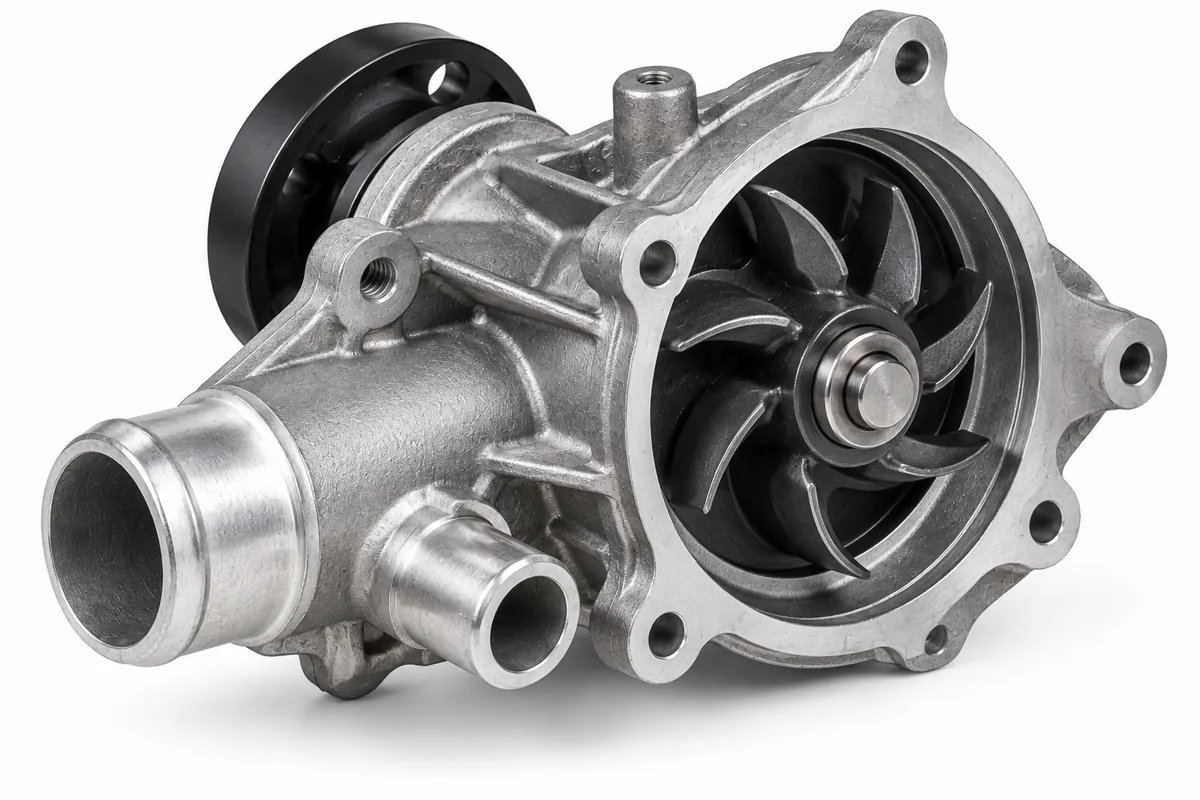
Mobile Water Pump Diagnostics in Daytona Beach
A vehicle that overheats does not automatically need a water pump.
Depending on the vehicle and symptoms, water pump diagnostics can include checking:
- Coolant level
- Visible coolant leaks
- Water pump housing
- Water pump weep hole
- Pump shaft and bearing condition
- Pulley play
- Pulley alignment
- Drive belt condition
- Timing-belt drive where applicable
- Coolant circulation
- Engine temperature
- Radiator temperature
- Upper and lower hose temperatures
- Thermostat operation
- Cooling-fan operation
- Coolant condition
- Cooling-system pressure
- Electrical power and control on electric pumps
- Stored diagnostic trouble codes where applicable
The goal is to determine whether the water pump itself has actually failed and whether another cooling-system problem contributed to the failure.
What Does a Car Water Pump Do?
The water pump circulates coolant through the engine cooling system.
Depending on vehicle design, coolant travels through components such as:
- Engine block
- Cylinder head
- Heater circuit
- Thermostat
- Radiator
- Coolant hoses
The pump maintains coolant movement so heat absorbed by the engine can eventually be transferred to the radiator and released into the surrounding air.
Without proper circulation, engine temperature can rise rapidly.
Where Is the Water Pump Located?
Water pump location varies significantly by engine design.
It may be mounted:
- On the front of the engine
- Behind the serpentine belt
- Behind a timing cover
- Inside a timing-belt system
- Near the side of the engine
- Low in the engine compartment
- Separately as an electric pump
Some pumps are easy to see.
Others require substantial disassembly just to access them.
Mechanical Water Pumps
Traditional water pumps are mechanically driven by the engine.
They may be driven by a:
- Serpentine belt
- Accessory belt
- Timing belt
- Timing chain on certain designs
A rotating impeller inside the pump circulates coolant through the engine.
Mechanical pumps can fail through:
- Bearing wear
- Shaft-seal failure
- Impeller damage
- Pulley problems
- Housing or gasket leaks
Electric Water Pumps
Some modern vehicles use electrically driven engine water pumps.
These pumps do not depend on a belt for operation.
An electric water pump can be controlled according to factors such as:
- Engine temperature
- Engine load
- Vehicle operating mode
- Climate-control demand
Possible electric-pump failures include:
- Electric motor failure
- Internal pump failure
- Power-supply problem
- Ground problem
- Control or communication fault
- Pump electronics failure
Diagnosing an electric pump therefore involves electrical testing in addition to checking coolant circulation.
Main Water Pump vs. Auxiliary Water Pump
Some vehicles contain more than one coolant pump.
The main water pump primarily circulates coolant through the engine cooling system.
An auxiliary water pump may be used for functions such as:
- Heater circulation
- Turbocharger cooling
- Cooling after engine shutdown
- Hybrid-system thermal management
- Specific secondary cooling circuits
A failed auxiliary pump should not automatically be confused with failure of the primary engine water pump.
Signs of a Bad Water Pump
Possible symptoms include:
- Engine overheating
- Coolant leaking near the pump
- Coolant loss
- Grinding or growling noise
- Pump pulley wobble
- Bearing play
- Steam
- Temperature fluctuations
- Poor coolant circulation
- Overheating under load
- Electric water pump fault codes
- Cooling fan running excessively because engine temperature remains high
These symptoms should be diagnosed before replacement because several other cooling-system problems can look very similar.
Water Pump Coolant Leak
A water pump may leak from:
- Weep hole
- Shaft seal
- Housing gasket
- O-ring
- Pump housing
- Coolant connection
The exact leak location matters.
Coolant running down from another component can make the water pump appear to be leaking when the actual source is:
- Thermostat housing
- Coolant outlet
- Hose
- Pipe
- Reservoir connection
The leak should be traced to its source before the pump is replaced.
Water Pump Weep Hole
Many mechanical water pumps include a weep hole near the pump shaft.
The hole provides a path for coolant to escape if the internal shaft seal begins failing.
Evidence around the weep hole can include:
- Fresh coolant
- Dried coolant residue
- Staining
- Crusty deposits
A persistent leak from the pump weep hole usually indicates internal pump-seal deterioration.
Is a Small Amount of Coolant at the Weep Hole Normal?
A persistent coolant leak from the weep hole is not something that should simply be ignored.
A small trace after a recent installation can sometimes require interpretation according to the specific pump design, but continuing fluid loss generally indicates that the pump seal is not maintaining the cooling system properly.
The area should be cleaned and rechecked when necessary to confirm active leakage.
Water Pump Bearing Failure
The pump shaft is supported by bearings.
As the bearings wear, possible symptoms include:
- Grinding
- Growling
- Roughness
- Pulley wobble
- Shaft play
- Belt noise
A failing bearing can eventually allow the shaft seal to fail as well, creating a coolant leak.
In severe cases, the pump can seize.
Water Pump Pulley Wobble
A mechanical water pump pulley should rotate smoothly and remain properly aligned.
Visible wobble can indicate:
- Worn pump bearing
- Bent pulley
- Loose mounting
- Shaft damage
Pulley movement should be checked carefully because a loose or failing pump can damage the drive belt.
Water Pump Shaft Play
Excessive movement at the pump shaft can indicate bearing wear.
Depending on access, shaft play may be detected through:
- Pulley movement
- Rough rotation
- Visible wobble
Not every pump design allows the shaft to be checked directly without removing the belt or other components.
Water Pump Grinding Noise
A worn water pump bearing can produce a grinding or rough mechanical noise.
However, several nearby belt-driven components can make similar noises, including:
- Alternator
- Idler pulley
- Belt tensioner
- AC compressor
- Power steering pump
The sound should be isolated before the water pump is condemned.
Water Pump Squealing Noise
A squeal near the water pump can result from more than pump failure.
Possible causes include:
- Slipping serpentine belt
- Coolant on belt
- Seized or binding pump
- Tensioner problem
- Misaligned pulley
The drive system needs to be inspected along with the pump.
Water Pump and Serpentine Belt
Many engine water pumps are driven by the serpentine belt.
If the belt:
- Breaks
- Slips
- Comes off
- Loses tension
the water pump may stop circulating coolant.
On engines where the water pump depends on the serpentine belt, continued driving after belt failure can cause rapid overheating.
Can a Bad Water Pump Break the Serpentine Belt?
Yes.
A seized or badly worn mechanical water pump can create enough resistance or pulley misalignment to damage the belt.
Possible results include:
- Belt squeal
- Belt shredding
- Belt coming off
- Complete belt failure
If a serpentine belt has failed, the driven accessories and pulleys should be checked before another belt is installed.
Water Pump Driven by the Timing Belt
Some engines use the timing belt to drive the water pump.
In these engines, water pump replacement can require removal of:
- Timing covers
- Timing belt
- Tensioner components
- Engine mounts on some applications
Because the timing belt controls camshaft-to-crankshaft synchronization, correct service procedures are critical.
This type of water pump replacement can be considerably more involved than replacing an externally mounted belt-driven pump.
Timing Belt and Water Pump Replacement
On engines where the water pump is located behind the timing belt, it is common to evaluate whether the timing belt and related components should be serviced at the same time.
This is because much of the same labor may be required to access:
- Water pump
- Timing belt
- Tensioner
- Idler pulleys
The correct decision depends on:
- Vehicle maintenance interval
- Timing-belt age
- Mileage
- Component condition
- Service history
A water pump located outside the timing system does not create the same situation.
Timing Belt Kit With Water Pump
Some replacement packages include:
- Timing belt
- Water pump
- Tensioner
- Idler pulleys
- Seals or hardware
These kits are designed for applications where the timing system and pump share significant service access.
The correct parts and replacement procedure depend on the specific engine.
Timing Chain Water Pumps
Some engines position the water pump inside or behind timing-chain components.
These repairs can require much more disassembly than an external pump.
Depending on engine design, access may involve:
- Timing cover removal
- Chain components
- Engine supports
- Cooling-system components
A timing-chain-driven or internally mounted pump needs to be evaluated for repair suitability based on the specific vehicle.
Water Pump Impeller
The impeller is the part of the pump that physically moves coolant.
Impellers can be made from:
- Metal
- Composite
- Plastic
An impeller can sometimes:
- Crack
- Erode
- Loosen from shaft
- Lose blades
- Spin improperly
A pump can therefore fail to circulate coolant even without an obvious external leak.
Water Pump Not Circulating Coolant
A water pump can fail internally while remaining externally dry.
Possible causes include:
- Damaged impeller
- Loose impeller
- Shaft failure
- Electric pump failure
- Drive-system failure
Poor circulation can cause overheating even though no coolant puddle is present.
How Do You Know if a Water Pump Is Circulating Coolant?
Diagnosis depends on system design.
Possible indicators can include:
- Engine temperature behavior
- Radiator inlet and outlet temperatures
- Heater performance
- Hose temperatures
- Scan-tool temperature data
- Electric pump command and response
- Cooling-system flow characteristics
Simply removing a cap and looking for coolant movement is not appropriate or conclusive on every vehicle.
Cooling systems differ widely.
Water Pump vs. Thermostat
The water pump and thermostat perform different jobs.
Water Pump
Moves coolant.
Thermostat
Controls when and how coolant is directed through the cooling circuit according to temperature.
A thermostat stuck closed can cause overheating even if the water pump is functioning normally.
A failed pump can cause overheating even with a good thermostat.
The two should be diagnosed separately.
Water Pump vs. Radiator Problem
A radiator removes heat from the coolant.
A water pump circulates the coolant.
A restricted radiator can cause overheating even when the pump has strong flow.
Likewise, a perfectly good radiator cannot cool the engine effectively if coolant is not reaching it properly.
Both coolant circulation and heat transfer need to be considered.
Water Pump vs. Cooling Fan Problem
The water pump moves coolant through the engine.
The cooling fan moves air through the radiator.
A vehicle that overheats mainly:
- At idle
- In traffic
- While stopped
may have an airflow or fan problem.
A vehicle with poor coolant circulation may overheat under a wider range of operating conditions.
The symptom pattern helps narrow the cause.
Water Pump vs. Radiator Hose Problem
A leaking or collapsed radiator hose can create symptoms that may resemble water pump failure.
A hose can cause:
- Coolant loss
- Restricted flow
- Overheating
The hoses should therefore be inspected before a pump is replaced.
Water Pump vs. Coolant Leak From Above
Coolant often runs downward.
A thermostat housing, coolant outlet, pipe, or hose located above the water pump can leak and coat the pump with coolant.
This can create a false diagnosis of a leaking pump.
The highest visible point of fresh coolant should be identified whenever possible.
Water Pump and Engine Overheating
A failed water pump can cause overheating because coolant is no longer circulating properly.
But overheating itself does not prove water pump failure.
Other possible causes include:
- Low coolant
- Thermostat problem
- Radiator restriction
- Cooling-fan failure
- Collapsed hose
- Trapped air
- Pressure-cap problem
- Internal engine problem
The pump should be diagnosed within the complete cooling system.
Water Pump and Overheating at Highway Speed
A circulation problem can become particularly noticeable during sustained engine load.
Possible causes include:
- Weak or damaged water pump
- Restricted radiator
- Thermostat problem
- Low coolant
- Collapsing hose
- Internal engine problem
Highway overheating does not identify the pump by itself, but it makes coolant circulation an important part of diagnosis.
Water Pump and Overheating at Idle
A water pump can contribute to overheating at idle, but cooling-fan operation deserves particular attention when the symptom occurs mainly while stopped.
A vehicle that cools down once moving may have inadequate airflow rather than a pump failure.
Both should be checked.
Temperature Gauge Fluctuation
Unstable temperature readings can occur with:
- Low coolant
- Air trapped in system
- Poor coolant circulation
- Thermostat problems
- Temperature-sensor issues
A failing water pump is one possibility, but the complete cooling system should be considered.
Water Pump and Heater Performance
The cabin heater depends on hot coolant circulating through the heater core.
If coolant circulation is poor, symptoms can sometimes include:
- Heater blowing cold
- Heat changing with engine speed
- Heat disappearing during overheating
These symptoms can also occur from low coolant or air trapped in the system.
They should not be used alone to diagnose a water pump.
Coolant Leak From Front of Engine
Coolant near the front of the engine may come from:
- Water pump
- Thermostat housing
- Radiator hose
- Coolant pipe
- Engine outlet
- Radiator
- Reservoir hose
The front of the engine can contain several cooling-system components close together.
The exact source needs to be located.
Coolant Leak Near the Belt
A water pump leak can sometimes contaminate the serpentine belt.
Coolant on the belt may cause:
- Squealing
- Slippage
- Deterioration
- Belt tracking problems
If the belt becomes significantly contaminated, its condition should be evaluated as part of the repair.
Water Pump Gasket Leak
A pump may seal to the engine using:
- Gasket
- O-ring
- Formed seal
A leak from the mounting surface can occur because of:
- Seal deterioration
- Corrosion
- Improper previous installation
- Damaged sealing surface
The mating surface should be inspected when the pump is removed.
Water Pump Housing Leak
Some water pumps incorporate a housing, while other vehicles use a separate pump mounted into a larger coolant housing.
Leaks can occur because of:
- Cracks
- Corrosion
- Damaged sealing surfaces
- Warping
If the housing itself is damaged, replacing only a seal may not correct the problem.
Plastic Water Pump Housing
Some modern pumps and cooling assemblies use composite or plastic housings.
These can become brittle after repeated heat cycles.
Possible failures include:
- Cracking
- Warping
- Broken hose connections
- Seal distortion
The complete assembly may require replacement depending on the design.
Electric Water Pump Failure
An electric water pump can fail without:
- Belt noise
- Pulley wobble
- Traditional bearing symptoms
Possible symptoms include:
- Overheating
- Reduced coolant circulation
- Warning messages
- Diagnostic trouble codes
- Fan running at high speed
- Electric pump not responding to commands
Electrical diagnosis is important before replacement.
Electric Water Pump Power and Ground
An electric pump requires a reliable electrical supply.
Testing can include checking:
- Battery voltage
- Power circuit
- Ground
- Fuse
- Wiring
- Connector condition
A pump cannot operate correctly if its power or ground circuit is defective.
Electric Water Pump Control
Modern electric water pumps may communicate with or receive commands from a control module.
Diagnosis can involve:
- Reading trouble codes
- Viewing command data
- Checking pump response
- Inspecting communication circuits where applicable
A control or wiring problem can imitate pump failure.
Electric Water Pump Fault Codes
Certain vehicles can set cooling-system codes when the electric water pump does not perform as expected.
A trouble code may indicate:
- Pump performance problem
- Communication fault
- Electrical circuit problem
- Coolant-temperature control issue
A code should guide diagnosis rather than automatically trigger pump replacement.
BMW-Style Electric Water Pump Systems
Some vehicles, including a number of BMW applications, use electronically controlled electric water pumps rather than conventional belt-driven pumps.
These systems may require:
- Scan-tool evaluation
- Pump activation tests
- Electrical testing
- Specific bleeding procedures after replacement
They should be serviced according to the specific vehicle's system design rather than treated like a mechanical belt-driven pump.
Turbocharger Water Pumps
Certain engines use an auxiliary electric coolant pump to circulate coolant through a turbocharger or secondary cooling circuit.
A turbo coolant pump is not necessarily the main engine water pump.
Symptoms and diagnostic procedures depend on which cooling circuit is affected.
Water Pump Pressure Testing
Cooling-system pressure testing is especially useful when a water pump is suspected of leaking.
Pressure can reveal leakage around:
- Pump seal
- Gasket
- Housing
- Coolant connections
However, pressure testing may not detect an impeller or electrical failure because those faults affect circulation rather than sealing.
Pressure Test Is Good but Water Pump May Still Be Bad
Yes.
A pressure test primarily evaluates the system's ability to retain pressure.
A pump can have:
- Damaged impeller
- Failed electric motor
- Poor circulation
while the cooling system remains completely sealed.
Leak testing and circulation diagnosis answer different questions.
Water Pump Replacement
Once diagnosis confirms pump failure, replacement procedure depends heavily on pump location and drive design.
A typical externally mounted mechanical water pump replacement can include:
- Confirm the pump failure. We verify the leak, bearing problem, circulation fault, or other pump failure.
- Allow the engine to cool. A hot cooling system should never be opened while pressurized.
- Drain coolant as required.
- Gain access to the water pump. Covers, intake components, fans, brackets, or other parts may need removal.
- Remove the drive belt where applicable.
- Remove the pump pulley where required.
- Disconnect applicable hoses or coolant connections.
- Remove the water pump mounting bolts.
- Remove the old pump.
- Inspect the mounting and sealing surface.
- Remove old gasket or seal material appropriately.
- Compare the replacement pump. Housing, impeller, mounting points, pulley arrangement, and connections are verified.
- Install the correct new gasket or O-ring.
- Install and secure the replacement pump.
- Reinstall the pulley and belt where applicable.
- Restore removed components.
- Refill the cooling system with the correct coolant.
- Bleed trapped air according to vehicle procedure.
- Bring the engine to operating temperature.
- Check the pump and surrounding connections for leaks.
- Verify stable engine temperature and coolant circulation.
Timing-driven and electric pumps can require additional procedures.
Timing-Belt Water Pump Replacement
For a timing-belt-driven pump, replacement may require:
- Engine support
- Accessory removal
- Timing covers
- Timing-belt removal
- Timing-mark alignment
- Tensioner service
- Correct belt-tension procedure
Because incorrect camshaft or crankshaft timing can cause serious engine problems, this is a substantially different repair from an external pump replacement.
Mobile suitability depends on the exact vehicle and required procedures.
Electric Water Pump Replacement
Replacing an electric water pump can involve:
- Confirming electrical and hydraulic failure.
- Disconnecting battery power as appropriate.
- Draining coolant.
- Gaining access to pump.
- Disconnecting electrical connector.
- Disconnecting coolant hoses.
- Removing pump.
- Installing correct replacement.
- Reconnecting electrical and cooling-system connections.
- Refilling cooling system.
- Performing required bleeding procedure.
- Clearing or checking applicable fault codes.
- Activating pump where supported.
- Verifying coolant circulation and engine temperature.
Some vehicles use an automated electric bleeding procedure after replacement.
Coolant Refill After Water Pump Replacement
Replacing a water pump opens the cooling system and normally results in coolant loss.
The system needs to be refilled using coolant meeting the correct vehicle specification.
Coolant selection should not be based on color alone.
Different vehicles can require different:
- Coolant chemistry
- Concentration
- Additive package
Using the correct coolant protects both the replacement pump and the rest of the cooling system.
Bleeding the Cooling System After Water Pump Replacement
Air trapped after water pump replacement can prevent normal coolant circulation.
Possible symptoms include:
- Overheating
- Heater blowing cold
- Temperature fluctuations
- Gurgling
- Coolant level dropping after first heat cycle
Depending on the vehicle, bleeding may involve:
- Bleeder screws
- Specific fill procedures
- Vacuum filling
- Electric-pump activation
- Warm-up and cool-down cycles
The correct procedure is important.
Electric Water Pump Bleeding Procedure
Some electric-pump vehicles can circulate coolant with the engine off during a manufacturer-defined bleeding procedure.
The process may involve a specific sequence using:
- Ignition
- Climate controls
- Accelerator pedal
- Scan tool
The exact procedure varies by vehicle and should not be generalized across all electric-pump systems.
Water Pump Replacement and Coolant Flush
A complete cooling-system flush is not automatically required every time a water pump is replaced.
However, additional cleaning or fluid service may be appropriate if the coolant is:
- Contaminated
- Incorrect
- Heavily rusted
- Mixed with incompatible fluids
- Filled with debris from another failure
The condition of the system determines whether additional service is warranted.
Water Pump Replacement After Overheating
If the pump failure caused severe overheating, the vehicle should be checked for evidence that the engine suffered additional damage.
Severe overheating can potentially affect:
- Head gasket
- Cylinder head
- Engine seals
- Other cooling-system components
Installing a new pump may restore circulation but cannot reverse damage already caused by extreme heat.
Should the Thermostat Be Replaced With the Water Pump?
Not automatically.
The thermostat should be replaced when:
- It has failed
- Testing indicates a problem
- The service procedure or maintenance plan reasonably calls for it
A bad water pump does not automatically mean the thermostat is bad.
Likewise, a thermostat failure does not necessarily damage the pump.
Should the Serpentine Belt Be Replaced With the Water Pump?
Not automatically.
The belt should be inspected for:
- Cracking
- Fraying
- Glazing
- Missing ribs
- Coolant contamination
If a leaking water pump has saturated the belt with coolant or the belt is already worn, replacement may be appropriate.
A good belt does not have to be discarded solely because the pump is being replaced.
Should the Belt Tensioner Be Replaced With the Water Pump?
Not automatically.
The tensioner should be checked for:
- Weak tension
- Bearing noise
- Wobble
- Binding
- Misalignment
A worn tensioner can affect pump drive and belt life, but replacement should be based on its condition rather than automatically added to every water pump job.
Should the Timing Belt Be Replaced With the Water Pump?
When a timing-belt-driven water pump requires removal of the timing belt for access, replacing aging timing components at the same time may make practical sense.
The decision depends on:
- Timing-belt service interval
- Mileage
- Age
- Prior replacement history
- Condition
The vehicle's actual maintenance requirements should guide the recommendation.
Can a Water Pump Be Repaired?
Modern automotive water pumps are generally replaced as complete assemblies when their:
- Bearing
- Seal
- Impeller
- Electric motor
- Housing
has failed.
Internal pump rebuilding is usually not the typical repair approach for ordinary passenger vehicles.
New vs. Remanufactured Water Pump
Replacement pumps may be available as:
- New
- Remanufactured
depending on application.
Important considerations include:
- Correct fitment
- Pump design
- Impeller type
- Seal quality
- Bearing quality
- Warranty
The pump must match the specific engine and cooling-system design.
Mechanical vs. Electric Replacement Cost
Water pump replacement cost can vary dramatically depending on pump design.
An external mechanical pump may require relatively straightforward access.
A pump located:
- Behind a timing belt
- Under an intake manifold
- Inside a timing assembly
- Deep in the engine compartment
can require substantially more labor.
Electric pumps can also carry higher component costs and may require additional electronic procedures.
Water Pump Replacement Cost
The cost of replacing a water pump depends on factors including:
- Vehicle year, make, and model
- Mechanical vs. electric pump
- Pump location
- Serpentine-belt vs. timing-belt drive
- Required disassembly
- Coolant type and quantity
- Timing components
- Belt condition
- Additional cooling-system leaks
- Required bleeding or scan-tool procedures
A readily accessible external pump is a very different job from a timing-belt-driven or electronically controlled pump.
Call Jimmy’s Mobile Care at (386) 308-2509 with your vehicle information and cooling-system symptoms so we can determine the appropriate diagnostic service.
Why Diagnose a Water Pump Before Replacing It?
Several cooling-system problems can imitate water pump failure.
Is the Water Pump Actually Leaking?
Coolant may be running down from a thermostat housing, pipe, or hose.
Is the Pump Bearing Failing?
Noise may actually be coming from an idler pulley, tensioner, alternator, or another accessory.
Is Coolant Circulating?
A pump can fail internally without leaking.
Is the Thermostat Opening?
A closed thermostat can produce overheating with a good pump.
Is the Radiator Restricted?
Poor heat transfer can resemble inadequate circulation.
Are the Cooling Fans Working?
Overheating at idle may be an airflow problem.
Is the System Low on Coolant?
Low coolant itself can create circulation and temperature problems.
Is Air Trapped in the System?
Air pockets can imitate a circulation problem.
Does an Electric Pump Have Power and a Valid Control Command?
A wiring or control fault can disable a good electric pump.
Answering these questions helps establish whether the pump itself needs replacement.
Mobile Water Pump Diagnostics in Daytona Beach
Jimmy’s Mobile Care provides mobile car water pump diagnostics in Daytona Beach for vehicles experiencing:
- Overheating
- Coolant leaking near the pump
- Water pump noise
- Pulley wobble
- Coolant loss
- Temperature fluctuations
- Suspected circulation problems
- Electric water pump faults
We evaluate the pump along with the cooling-system components necessary to identify the true cause of the problem.
Mobile Water Pump Replacement in Daytona Beach
When diagnostics confirm water pump failure and the repair is appropriate for mobile service, Jimmy’s Mobile Care can replace many automotive water pumps at your Daytona Beach location.
After replacement, we can verify:
- Leak-free installation
- Correct belt operation where applicable
- Proper coolant level
- Removal of trapped air
- Coolant circulation
- Stable engine temperature
Water pumps requiring extensive timing-system disassembly, major engine access, or specialized procedures may require a different repair environment depending on the vehicle.
Schedule Car Water Pump Diagnostics & Replacement in Daytona Beach
An overheating engine or coolant leak near the front of the engine does not automatically mean the water pump has failed.
The cause may be a thermostat, radiator, hose, cooling fan, coolant fitting, trapped air, or another cooling-system problem.
Jimmy’s Mobile Care diagnoses the cooling system before replacement so the pump is replaced only when the evidence supports it.
Call Jimmy’s Mobile Care at (386) 308-2509 to schedule car water pump diagnostics and replacement in Daytona Beach, FL. Call today and we'll come to your location.