
Car Coolant Leak Diagnostics & Repair in Daytona Beach, FL
A coolant leak can start as a small seep and turn into a serious overheating problem if the cooling system loses enough fluid. Coolant may leak from a radiator, hose, water pump, thermostat housing, reservoir, coolant outlet, heater circuit, pipe, seal, or another part of the system.
Jimmy’s Mobile Care provides car coolant leak diagnostics and repair in Daytona Beach, FL. We locate the actual source of the leak before recommending repair so coolant running down from another component is not mistaken for a bad radiator, hose, or water pump.
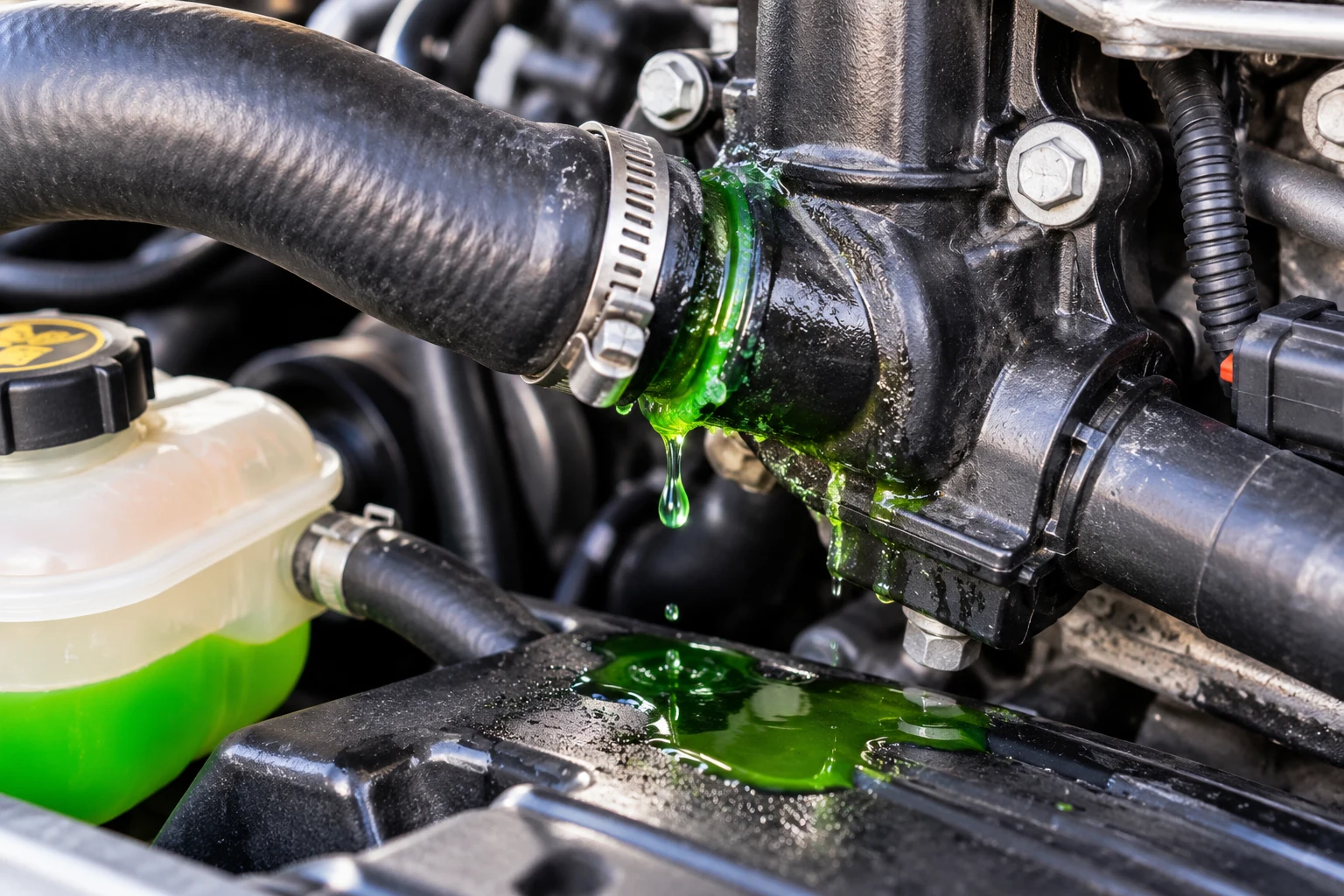
Mobile Coolant Leak Diagnostics in Daytona Beach
Coolant leaks are not always obvious.
Depending on the symptoms, diagnostics can include checking:
- Coolant level
- Radiator
- Radiator hoses
- Hose connections
- Water pump
- Thermostat housing
- Coolant reservoir
- Coolant pipes
- Coolant outlets
- Heater hoses
- Heater-core connections
- Pressure cap
- Bleeder screws
- Sensors and fittings
- Freeze plugs where accessible
- Dried coolant residue
- Cooling-system pressure
- Signs of internal coolant loss
The objective is to determine where the coolant is going and why before parts are replaced.
What Is Engine Coolant?
Engine coolant, often commonly called antifreeze, circulates through the engine and cooling system to control temperature.
It helps:
- Absorb heat from the engine
- Transfer heat to the radiator
- Protect against freezing
- Raise boiling protection
- Reduce corrosion
- Lubricate certain cooling-system components
The cooling system is designed to remain sealed.
If the coolant level repeatedly drops, there is usually a reason that should be identified.
Coolant Leak vs. Antifreeze Leak
These terms generally describe the same type of problem.
Antifreeze refers to the concentrated fluid used in the cooling system.
Coolant generally refers to the prepared fluid circulating through the engine, whether premixed or diluted to the correct concentration.
Customers may describe the problem as:
- Coolant leak
- Antifreeze leak
- Radiator-fluid leak
- Engine-coolant leak
The important issue is identifying the source of the loss.
Signs of a Coolant Leak
Possible symptoms include:
- Coolant puddle under the vehicle
- Low coolant warning
- Repeatedly low reservoir
- Engine overheating
- Sweet odor
- Steam from under the hood
- Visible dripping
- Dried colored residue
- Coolant around engine components
- Heater suddenly blowing cold
- Temperature gauge fluctuating
- Coolant disappearing without an obvious puddle
A leak should be investigated before repeated coolant loss causes overheating.
Coolant Leaking Under the Car
The location of a puddle can provide clues, but it does not always identify the failed component.
Coolant can travel along:
- Engine surfaces
- Splash shields
- Subframes
- Hoses
- Wiring
- Brackets
before reaching the ground.
A puddle under the front of the vehicle may have originated much higher in the engine compartment.
The leak should be traced back to its source rather than diagnosed only by where the coolant lands.
Coolant Leaking From the Bottom of the Car
If coolant appears to be leaking from the bottom of the engine or vehicle, possible sources can include:
- Radiator
- Lower radiator hose
- Water pump
- Thermostat housing
- Coolant pipe
- Engine block fitting
- Reservoir hose
- Heater hose
- Drain fitting
Splash shields can make the apparent leak location especially misleading.
Small Coolant Leak
A small coolant leak may leave:
- No obvious puddle
- Occasional odor
- Dried residue
- Gradual coolant loss
- Intermittent low coolant warning
Small leaks can still become significant.
A connection that seeps when cold may leak more heavily when the cooling system becomes hot and pressurized.
Large Coolant Leak
A major cooling-system failure can release coolant rapidly.
Possible causes include:
- Split radiator hose
- Cracked radiator tank
- Broken coolant fitting
- Failed water-pump seal
- Detached hose
- Broken plastic housing
- Ruptured coolant pipe
Rapid coolant loss can cause the engine to overheat quickly.
A vehicle that has lost most or all of its coolant should not continue to be driven simply because the engine still runs.
Coolant Leak Only When Engine Is Hot
Some leaks appear only after the engine reaches operating temperature.
As the engine warms:
- Coolant expands
- Cooling-system pressure rises
- Plastic components expand
- Metal components expand
- Rubber hoses become hotter
A marginal seal, seam, crack, or fitting may remain dry when cold and begin leaking only under hot operating conditions.
Coolant Leak Only When Car Is Cold
Cold leaks can also occur.
Temperature contraction can sometimes affect:
- Hose connections
- O-rings
- Plastic housings
- Seals
A vehicle may leave a puddle after sitting overnight but appear dry once fully warmed.
The timing of the leak can be useful during diagnosis.
Cooling-System Pressure Testing
Pressure testing is one of the primary methods used to locate external coolant leaks.
The cooling system is pressurized within the appropriate test range while components are inspected.
Pressure may reveal leakage from:
- Radiator
- Hose connections
- Water pump
- Thermostat housing
- Reservoir
- Coolant outlet
- Heater hoses
- Pipes
- Fittings
A pressure test helps reproduce some of the pressure the system experiences when hot without necessarily waiting for the engine to reach full operating temperature.
What a Pressure Test Can and Cannot Tell Us
A pressure test is very useful, but it does not guarantee that every leak will appear immediately.
Some leaks may depend on:
- Heat expansion
- Engine movement
- Water-pump rotation
- Combustion pressure
- Very specific operating conditions
A system that holds pressure during a short test can still have an intermittent coolant-loss problem.
The test results need to be considered together with the vehicle’s symptoms and physical evidence.
UV Dye for Coolant Leak Detection
UV-compatible dye can sometimes be used to help locate difficult coolant leaks.
After the dye circulates through the cooling system, a UV inspection can reveal traces around the leak source.
This can be useful when:
- The leak is very small
- Coolant evaporates on hot surfaces
- Residue is difficult to distinguish
- The leak occurs intermittently
Dye is a diagnostic aid, not a repair.
Dried Coolant Residue
Coolant does not always remain wet long enough to see active dripping.
A small leak can evaporate and leave residue around:
- Hose fittings
- Radiator seams
- Water-pump area
- Thermostat housing
- Plastic coolant fittings
- Reservoir seams
Depending on coolant type, residue may appear:
- White
- Pink
- Orange
- Green
- Blue
- Crusty or chalky
Residue can help identify the source even when the system is currently dry.
Radiator Coolant Leak
Radiators can leak from:
- Plastic tanks
- Tank-to-core seams
- Aluminum tubes
- Hose necks
- Drain fittings
- Cooler fittings
A leaking radiator can cause gradual or rapid coolant loss depending on the failure.
Coolant near the radiator should still be traced carefully because a leaking hose above it can make the radiator appear defective.
Cracked Radiator
A cracked plastic radiator tank is a common source of coolant loss on aging vehicles.
Cracks can develop from:
- Heat cycling
- Age
- Pressure
- Vibration
- Physical damage
A structural crack in the radiator usually calls for radiator replacement rather than repeatedly attempting temporary external sealing.
Radiator Seam Leak
The joint between the radiator core and tank can eventually lose its seal.
Typical evidence includes:
- Coolant along the radiator edge
- Dried residue
- Wet tank seam
- Slow coolant loss
A seam leak is different from a leaking radiator hose connection and should be identified before either component is replaced.
Radiator Hose Leak
Radiator hoses can leak from:
- Cracked rubber
- Split hose
- Clamp area
- Quick-connect fitting
- Molded connection
- Damaged seal
A hose can also deteriorate without visibly leaking by becoming:
- Swollen
- Soft
- Hardened
- Internally damaged
The hose and adjoining fitting should both be inspected.
Upper Radiator Hose Leak
The upper radiator hose commonly connects the engine or thermostat area to the radiator.
A leak near either end may come from:
- Hose
- Clamp
- Radiator neck
- Thermostat housing
- Coolant outlet
The connection needs to be inspected closely because coolant can run down the hose and disguise its actual source.
Lower Radiator Hose Leak
The lower radiator hose may connect the radiator to the water-pump or engine inlet side of the cooling circuit.
Possible leakage can occur at:
- Hose body
- Clamp
- Quick connector
- Radiator connection
- Engine-side connection
Because the hose sits lower in the engine compartment, coolant from another component can also collect around it.
Heater Hose Leak
Heater hoses carry coolant between the engine and heater circuit.
Leaks may occur from:
- Hose deterioration
- Plastic fittings
- Quick connectors
- Clamps
- Heater-control components
- Heater-core connections
A leaking heater hose can cause the same low-coolant and overheating symptoms as a radiator hose.
Coolant Reservoir Leak
The coolant reservoir or expansion tank can develop leaks from:
- Cracked plastic
- Tank seam
- Hose connection
- Filler neck
- Pressure-cap area
Plastic tanks can become brittle after years of heat exposure.
A small reservoir crack may leak only when the coolant expands and the system becomes pressurized.
Coolant Reservoir Keeps Going Empty
If the reservoir repeatedly becomes empty, coolant is leaving the system somewhere.
Possible causes include:
- External leak
- Faulty cap
- Overflow due to overheating
- Internal engine leak
Adding coolant repeatedly without finding the cause can allow the underlying problem to become more serious.
Thermostat Housing Coolant Leak
Many vehicles use a thermostat housing made from:
- Aluminum
- Composite
- Plastic
A leak can develop from:
- Housing crack
- Gasket
- O-ring
- Hose connection
- Mating surface
Plastic thermostat housings can become brittle and distort from repeated heating and cooling.
Plastic Coolant Outlet Leak
Modern engines often use molded plastic coolant outlets or flanges.
These can eventually:
- Crack
- Warp
- Split
- Leak around O-rings
- Break near hose connections
Coolant can run down the engine from the outlet and make another component appear to be leaking.
Water Pump Coolant Leak
A water pump can leak from:
- Shaft seal
- Weep hole
- Housing
- Gasket
- O-ring
A pump leak may appear only while the engine is running or after the engine reaches operating temperature.
Coolant residue near the water-pump area is an important diagnostic clue.
Water Pump Weep-Hole Leak
Many mechanical water pumps have a weep hole designed to provide an escape path if the internal shaft seal begins failing.
Coolant at the weep hole can indicate water-pump seal failure.
The leak should be distinguished from coolant running onto the pump from:
- Thermostat housing
- Hose
- Pipe
- Nearby fitting
before the pump is replaced.
Coolant Pipe Leak
Some engines use rigid coolant pipes made from:
- Metal
- Aluminum
- Plastic
Pipes can leak because of:
- Corrosion
- Cracks
- O-ring failure
- Damaged fittings
A coolant pipe may run under an intake manifold or through areas that make the leak difficult to see directly.
Coolant Pipe O-Ring Leak
Coolant pipes commonly seal into housings or engine components with O-rings.
An O-ring can:
- Harden
- Flatten
- Tear
- Lose elasticity
A small seal failure can produce a slow leak even when the pipe itself remains structurally sound.
Coolant Leak Under the Intake Manifold
Some engines route:
- Coolant pipes
- Thermostat housings
- Coolant outlets
- Seals
under or near the intake manifold.
Leaks in these areas may collect in the engine valley or run down the rear or side of the engine before reaching the ground.
These leaks can be difficult to identify without careful inspection.
Coolant Temperature Sensor Leak
A coolant-temperature sensor or switch may thread into a coolant passage or housing.
Coolant can leak from:
- Sensor seal
- O-ring
- Threads where applicable
- Cracked housing around the sensor
A leak at the sensor should be distinguished from an electrical sensor failure.
Bleeder Screw Coolant Leak
Some cooling systems use bleed screws to release trapped air.
The screw or surrounding housing can leak if:
- Seal is damaged
- Screw is cracked
- Threads are damaged
- Housing is cracked
- Screw was overtightened
Plastic bleed screws can become especially brittle with age.
Radiator Drain Plug Leak
Some radiators contain a drain fitting or petcock.
Leakage can develop from:
- Damaged seal
- Cracked fitting
- Loose plug
- Damaged radiator tank around the fitting
A leak low on the radiator should not automatically be assumed to come from the radiator core.
Pressure Cap Leak
Depending on vehicle design, the cooling-system pressure cap may be located on:
- Radiator
- Expansion tank
The cap helps regulate system pressure.
A faulty cap may allow:
- Coolant seepage
- Premature boiling
- Overflow
- Poor recovery
Residue around the cap or filler neck should be investigated.
Coolant Overflowing From the Reservoir
Coolant coming out of the reservoir is not always caused by a cracked tank.
Possible causes include:
- Overfilled system
- Overheating
- Bad pressure cap
- Trapped air
- Combustion gases entering cooling system
The reason coolant is being pushed out should be determined before the reservoir is blamed.
Freeze Plug Coolant Leak
Engine blocks may use core plugs commonly called freeze plugs.
These can sometimes leak because of:
- Corrosion
- Age
- Improper installation
Depending on location, a freeze-plug leak may appear to come directly from the side or rear of the engine.
Accessibility can vary significantly.
Heater Core Coolant Leak
The heater core is a small heat exchanger located inside or near the HVAC housing.
Possible symptoms of a heater-core leak include:
- Sweet smell inside vehicle
- Fogging windshield
- Oily film on windshield
- Damp carpet
- Coolant loss
- Poor heater performance
A heater-core leak may not create a visible puddle under the engine compartment.
Antifreeze Smell Inside the Car
A sweet coolant odor inside the cabin may point toward:
- Heater core
- Heater-hose connection
- Coolant leaking near the HVAC intake
However, odor alone does not confirm the source.
Coolant spilled during previous service can also leave a temporary smell.
Coolant Leaking Inside the Car
Coolant inside the passenger compartment is particularly suggestive of the heater circuit.
Possible evidence includes:
- Wet carpet
- Colored fluid
- Sweet odor
- Windshield film
The heater core and its connections should be checked.
Coolant Leak With No Visible Puddle
A vehicle can lose coolant without leaving an obvious puddle.
Possible explanations include:
- Small leak evaporating on a hot engine
- Leak only under pressure
- Leak while driving
- Heater-core leak
- Internal engine leak
- Coolant being expelled from overflow
The absence of a puddle does not prove the cooling system is sealed.
Coolant Disappearing but No Leak Found
Repeated coolant loss without visible external leakage requires broader diagnosis.
Possible causes can include:
- Very small external leak
- Heater-core leak
- Pressure-cap problem
- Internal engine leak
- Coolant entering combustion chamber
- Coolant mixing with engine oil in some failures
Additional testing may be necessary when standard external leak inspection does not identify the source.
Internal Coolant Leak
An internal coolant leak means coolant is escaping into an area where it should not go rather than leaking onto the ground.
Possible locations include:
- Combustion chamber
- Engine oil
- Intake path on certain engine designs
Internal leaks can be more serious than ordinary hose or radiator leaks and may require engine-level repair.
Head Gasket and Coolant Loss
A damaged head gasket can sometimes allow coolant to:
- Enter a combustion chamber
- Mix with oil
- Escape externally
- Allow combustion pressure into cooling system
Possible signs can include:
- Repeated overheating
- Coolant loss without obvious external leak
- Excessive cooling-system pressure
- White exhaust vapor after warm-up
- Misfire during cold start
- Coolant contamination
These symptoms should be tested rather than assuming every unexplained coolant loss is a head-gasket failure.
Combustion Gases in the Cooling System
Combustion pressure entering the cooling system can produce:
- Rapid pressure buildup
- Coolant pushed from reservoir
- Hard hoses shortly after cold startup
- Repeated overheating
- Persistent bubbles
Testing may be needed when an internal engine problem is suspected.
A radiator, hose, or reservoir replacement will not correct combustion gases entering the system.
Coolant in Engine Oil
Certain internal failures can allow coolant to contaminate engine oil.
Possible evidence can include:
- Milky contamination
- Rising oil level
- Abnormal residue
However, condensation can sometimes create light residue under an oil cap without proving a major internal leak.
The complete symptom pattern needs to be evaluated.
White Smoke and Coolant Leak
Persistent white exhaust vapor after the engine is fully warm can sometimes indicate coolant entering a combustion chamber.
But visible exhaust moisture during cold startup can be normal condensation.
White exhaust alone is not enough to diagnose an internal coolant leak.
Coolant Leak and Engine Overheating
A coolant leak can cause overheating when enough fluid is lost.
Low coolant can lead to:
- Poor circulation
- Air pockets
- Hot spots
- Unstable temperature readings
- Loss of heater output
The leak should be repaired before repeated overheating damages the engine.
Coolant Leak and Heater Blowing Cold
If the heater suddenly stops producing warm air while the engine is overheating, the cooling system may be low enough that hot coolant is no longer circulating normally through the heater core.
This can be a warning sign of significant coolant loss.
The engine should not simply be kept running while coolant level continues to fall.
Coolant Leak and Temperature Gauge Fluctuation
A fluctuating temperature gauge can occur when:
- Coolant level is low
- Air is trapped around the temperature sensor
- Coolant circulation is inconsistent
The gauge may move suddenly as liquid coolant and air pass around the sensor.
This condition deserves immediate attention if coolant loss is also present.
Steam From Under the Hood
Steam can occur when leaking coolant contacts hot engine or exhaust components.
Possible causes include:
- Burst hose
- Radiator leak
- Water-pump leak
- Broken housing
- Major fitting failure
Steam can also indicate severe overheating.
A hot cooling system should not be opened while pressurized.
Coolant Leak After Parking
A leak that appears after shutdown can occur because heat continues to build temporarily after the engine stops.
This is called heat soak.
Cooling-system pressure can remain elevated, allowing a weak seal or connection to continue leaking after the vehicle is parked.
Coolant Leak While Driving but Not Parked
Some leaks appear mainly while driving because of:
- Increased pressure
- Engine movement
- Water-pump rotation
- Airflow carrying coolant away
By the time the vehicle is parked, very little evidence may remain except dried residue.
Coolant Leak After Recent Repair
A leak following cooling-system work may involve:
- Loose clamp
- Pinched O-ring
- Damaged fitting
- Improperly seated quick connector
- Bleeder screw
- Incorrect hose routing
- Previously weak adjacent component disturbed during service
The repaired area and surrounding connections should be checked carefully.
Coolant Leak After Radiator Replacement
A new radiator does not eliminate the possibility of leakage from another cooling-system component.
Leaks after radiator replacement can occur at:
- Hose connections
- Drain fitting
- Cooler fittings
- Reservoir hose
- Pressure cap
- Adjacent aging hose
The exact leak source should be confirmed rather than assuming the replacement radiator is defective.
Coolant Leak After Water Pump Replacement
Possible post-repair leak sources can include:
- Gasket
- O-ring
- Housing
- Hose connection
- Thermostat assembly
- Improper sealing surface preparation
Some water pumps may also show minor temporary seepage characteristics depending on design, but persistent coolant loss should be investigated.
Coolant Leak After Thermostat Replacement
If coolant appears near a recently replaced thermostat, possible causes include:
- Housing crack
- Misplaced seal
- Pinched O-ring
- Damaged gasket surface
- Hose connection
The new thermostat itself is not necessarily the source.
Coolant Leak and AC Condensation
Clear water under a vehicle after running the AC is usually normal condensation.
This is different from engine coolant.
Coolant may have:
- Distinct color
- Slippery feel
- Sweet odor
But fluid identification should be made carefully.
In Daytona Beach humidity, the AC system can produce a substantial amount of clear condensate under a properly operating vehicle.
Coolant vs. Water Under the Car
Not every puddle is a cooling-system leak.
Possible fluids include:
- Clear AC condensate
- Engine coolant
- Engine oil
- Transmission fluid
- Washer fluid
Color alone is not always reliable because coolant formulations vary.
Location, odor, texture, and system level help identify the fluid.
Can Coolant Evaporate?
Coolant can evaporate when a small leak contacts hot engine components.
This can make a leak difficult to find because the fluid never reaches the ground.
Evidence may remain as:
- Dried residue
- Staining
- Odor
Pressure testing or UV dye can sometimes help locate these small leaks.
Can a Coolant Leak Stop on Its Own?
A leak may appear to stop temporarily, but that does not mean the failed component repaired itself.
Leak rate can change with:
- Temperature
- Pressure
- Vehicle position
- Engine movement
A marginal seal may leak one day and appear dry the next.
Intermittent coolant loss should still be investigated.
Coolant Stop-Leak Products
Cooling-system sealants are marketed as a way to reduce certain leaks.
They are not equivalent to physically repairing a failed:
- Hose
- Radiator tank
- Water pump
- Housing
- Pipe
- Gasket
Sealant products can also circulate through small passages in the cooling system.
Depending on the product and vehicle, this can create service complications or restrictions.
The better approach is to locate and repair the actual source whenever practical.
Can Coolant Stop-Leak Clog a Radiator?
Some sealing products can leave deposits in small cooling-system passages.
Possible areas affected can include:
- Radiator
- Heater core
- Small coolant passages
Whether a particular product causes a problem depends on many factors, but repeated use should not be treated as a substitute for repairing the leak.
Fixing a Coolant Leak
There is no single repair for every coolant leak.
The correct repair depends entirely on the source.
Examples include:
- Replace damaged hose
- Replace O-ring
- Replace thermostat housing
- Replace cracked reservoir
- Replace radiator
- Replace water pump
- Repair damaged wiring connector only if a sensor fitting is involved
- Replace coolant pipe
- Repair or replace heater-system component
The diagnosis determines the repair.
Coolant Leak Repair Process
A proper coolant-leak repair can generally involve:
- Confirm the coolant loss. Coolant level and visible evidence are checked.
- Inspect the system. Hoses, radiator, pump, housings, reservoir, pipes, and fittings are examined.
- Pressure-test where appropriate. The system is pressurized to help reproduce the leak.
- Trace the leak to its source. Coolant is followed to the highest or most direct point of leakage rather than assuming the lowest wet component is defective.
- Use additional detection methods when necessary. UV dye or further operating-condition testing may be used for difficult leaks.
- Determine whether the leak is external or potentially internal.
- Allow the engine to cool before opening the system.
- Drain or recover coolant as necessary for the repair.
- Remove the failed component or seal.
- Inspect mating surfaces and adjoining components.
- Install the replacement component, gasket, O-ring, hose, or fitting as appropriate.
- Use the correct coolant specification.
- Refill the cooling system.
- Bleed trapped air according to vehicle procedure.
- Bring the engine to operating temperature.
- Recheck the repaired area for leakage.
- Verify stable coolant level and engine temperature.
The repair is not complete until the system has been refilled, bled, and rechecked under operating conditions.
Why the Cooling System Must Be Cold Before Repair
The cooling system can remain hot and pressurized after the engine has been shut down.
Removing a:
- Radiator cap
- Reservoir cap
- Hose
- Sensor
- Housing
while the system is hot can release scalding coolant and steam.
Cooling-system service should begin only after the system has cooled sufficiently.
Coolant Refill After Leak Repair
Repairing a coolant leak often requires replacing some of the lost coolant.
The correct fluid depends on the specific vehicle.
Coolant types vary in:
- Chemistry
- Additive package
- Concentration
- Manufacturer specification
Color alone should not be used to determine which coolant belongs in the vehicle.
Bleeding Air After Coolant Leak Repair
Air enters the cooling system when coolant is lost or components are opened.
After repair, trapped air can cause:
- Overheating
- Temperature fluctuations
- Poor heater output
- Gurgling
- Low coolant after the first heat cycle
Depending on vehicle design, proper filling may require:
- Bleeder screws
- Specific fill sequence
- Heater settings
- Vacuum filling
- Additional warm-up and cool-down checks
The correct procedure matters.
Why Coolant Level Can Drop After a Repair
A small coolant-level change after the first complete heat cycle can occur if remaining air works its way out of the system.
However, continued coolant loss should not simply be dismissed as normal.
The system should be rechecked if the level continues to fall.
Can Different Coolants Be Mixed?
Different coolant formulas are not automatically compatible.
Mixing unsuitable coolant types can affect:
- Corrosion protection
- Service life
- Deposit formation
The replacement coolant should meet the vehicle’s required specification.
Water vs. Coolant
Plain water can transfer heat, but the vehicle cooling system is generally designed to operate with the correct coolant mixture.
Proper coolant provides:
- Corrosion inhibitors
- Boiling protection
- Freeze protection
- Water-pump lubrication support
Repeatedly topping off with plain water can alter the intended mixture.
Driving With a Coolant Leak
Whether the vehicle can safely be moved depends on:
- Leak rate
- Coolant level
- Engine temperature
- Distance
- Severity of the failure
A vehicle with:
- Rapid coolant loss
- Steam
- Overheating
- Empty reservoir
- Burst hose
should not continue driving.
Severe overheating can turn a relatively simple cooling-system repair into major engine damage.
What Happens If All the Coolant Leaks Out?
Without sufficient coolant, the engine can no longer control temperature properly.
Possible consequences include:
- Severe overheating
- Cylinder-head distortion
- Head-gasket damage
- Engine seizure
- Other major engine damage
If a large coolant leak occurs, shutting the engine down promptly is far less expensive than continuing to drive until it overheats severely.
Can a Small Coolant Leak Damage the Engine?
Yes, if it is ignored long enough.
A small leak can gradually lower the coolant level until the engine develops:
- Air pockets
- Localized hot spots
- Overheating
The leak does not have to be dramatic to become harmful.
Coolant Leak Repair Cost
Coolant leak repair cost varies widely because “coolant leak” describes a symptom, not a single component.
Cost can depend on whether the leak is from:
- Hose
- Clamp
- O-ring
- Radiator
- Water pump
- Thermostat housing
- Reservoir
- Coolant pipe
- Heater core
- Internal engine component
Other factors include:
- Vehicle year, make, and model
- Component accessibility
- Coolant required
- Diagnostic time
- Additional damaged components
A leaking hose connection can be very different from a water pump, heater core, or internal engine repair.
Call Jimmy’s Mobile Care at (386) 308-2509 with your vehicle information and coolant-loss symptoms so we can determine the appropriate diagnostic service.
Why Diagnose a Coolant Leak Before Replacing Parts?
Coolant travels easily, making visual diagnosis misleading.
Is the Radiator Really Leaking?
Coolant may be running onto it from a hose above.
Is the Hose Really Bad?
The radiator neck, housing, fitting, or O-ring may be leaking instead.
Is the Water Pump Actually the Source?
Coolant from another component can run down around the pump.
Is the Reservoir Cracked?
Or is excessive cooling-system pressure forcing coolant out?
Is the Leak External?
If no external leak can be found, internal coolant loss may need investigation.
Is More Than One Leak Present?
An aging cooling system can have multiple weak components.
Finding the exact source prevents unnecessary replacement and helps ensure the repair actually stops the coolant loss.
Multiple Coolant Leaks
It is possible for a vehicle to have more than one cooling-system leak.
For example:
- A hose may seep at one connection
- A reservoir may also be cracked
- A water pump may begin leaking independently
After repairing one obvious leak, the system should be pressure-checked again when appropriate so another leak is not missed.
Mobile Coolant Leak Diagnostics in Daytona Beach
Jimmy’s Mobile Care provides mobile car coolant leak diagnostics in Daytona Beach for vehicles experiencing:
- Coolant puddles
- Low coolant warnings
- Antifreeze odor
- Repeated coolant loss
- Steam
- Overheating
- Dried coolant residue
- Coolant leaking from underneath the vehicle
- Coolant disappearing without an obvious source
We inspect and test the cooling system to identify where the coolant is actually escaping.
Mobile Coolant Leak Repair in Daytona Beach
Once the leak source has been identified, many cooling-system repairs can be performed at your location when appropriate.
Depending on the failure, repair may involve:
- Radiator hose replacement
- Coolant fitting replacement
- Thermostat housing replacement
- Reservoir replacement
- Radiator replacement
- Water-pump replacement
- Coolant pipe or seal replacement
- Other accessible cooling-system repairs
Some leaks involving extensive engine disassembly, heater-core access, or internal engine damage may require repair procedures beyond a straightforward mobile cooling-system service.
We can determine what is involved after diagnosis.
Schedule Car Coolant Leak Diagnostics & Repair in Daytona Beach
A coolant puddle tells you the system is losing fluid, but it does not tell you which component has failed.
Jimmy’s Mobile Care traces the leak to its actual source before recommending repair so you do not replace a radiator, hose, water pump, or housing simply because coolant happened to collect nearby.
Call Jimmy’s Mobile Care at (386) 308-2509 to schedule car coolant leak diagnostics and repair in Daytona Beach, FL. Call today and we'll come to your location.