
Car AC Condenser Inspection & Replacement in Daytona Beach, FL
The AC condenser is the heat exchanger mounted near the front of your vehicle that removes heat from high-pressure refrigerant after it leaves the compressor. Airflow across the condenser allows that refrigerant to release heat before continuing through the rest of the air-conditioning system.
Because the condenser sits at the front of the vehicle, it is exposed to road debris, insects, corrosion, impact damage, bent fins, and contamination. It can also develop internal restrictions or refrigerant leaks.
Jimmy’s Mobile Care provides car AC condenser inspection and replacement in Daytona Beach, FL. We inspect the condenser itself, check for physical damage and refrigerant leakage, evaluate airflow across it, and determine whether the condenser actually needs replacement.
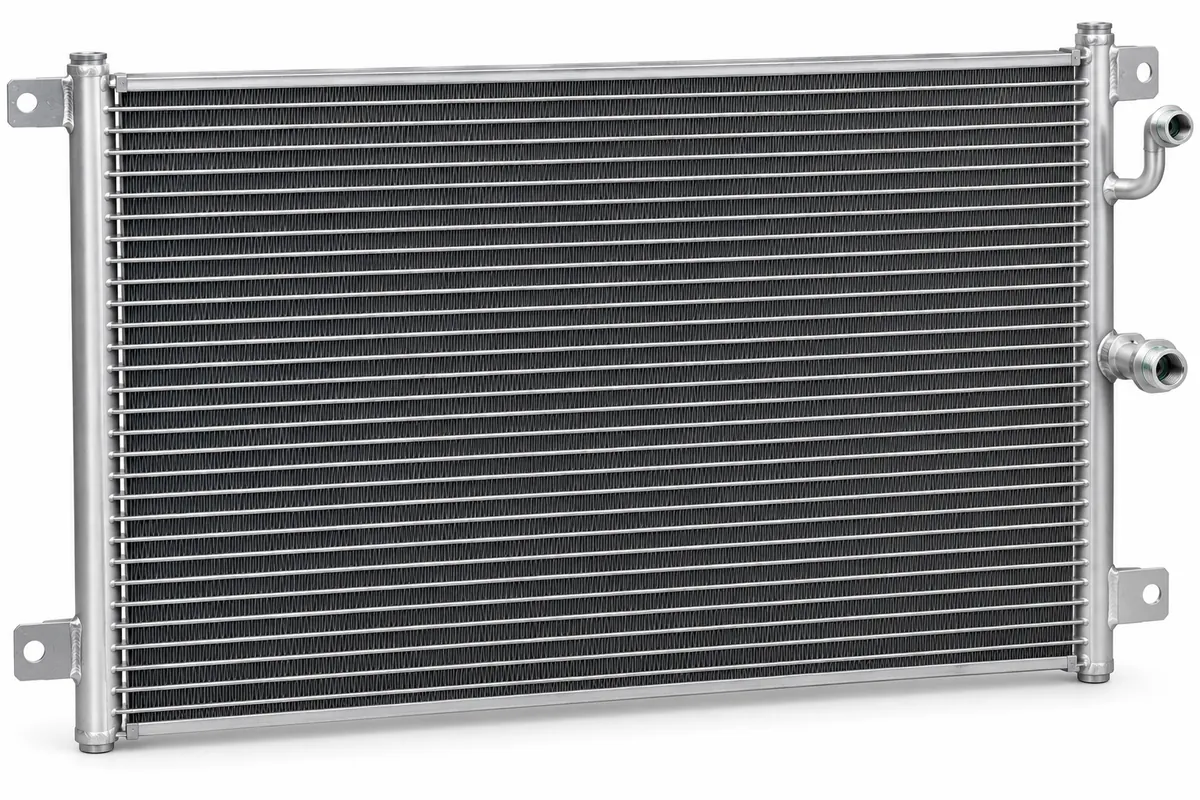
Mobile AC Condenser Inspection in Daytona Beach
A condenser problem can cause poor AC performance, but not every high-pressure or warm-air complaint means the condenser is defective.
Inspection can include checking:
- Condenser fins
- Impact damage
- Refrigerant leaks
- Oil staining
- Corrosion
- Bent or crushed sections
- Airflow through the condenser
- Cooling fan operation
- Refrigerant pressures
- Signs of internal restriction
- Compressor contamination after an internal failure
The goal is to determine whether the condenser itself is damaged, leaking, restricted, or unable to reject heat properly.
What Does a Car AC Condenser Do?
The condenser receives hot, high-pressure refrigerant from the AC compressor.
As outside air moves across the condenser, heat transfers from the refrigerant into the surrounding air.
The refrigerant then changes condition as it moves through the condenser and continues toward the system’s metering device.
The condenser therefore has two important requirements:
- Refrigerant must be able to flow through its internal passages.
- Air must be able to flow through the condenser fins.
A problem with either refrigerant flow or airflow can reduce AC cooling.
Where Is the AC Condenser Located?
Most automotive AC condensers are mounted at the front of the vehicle, usually in front of or close to the engine radiator.
That location allows the condenser to receive substantial airflow while the vehicle is moving.
It also explains why condensers are vulnerable to:
- Stones
- Road debris
- Insects
- Front-end impacts
- Bent fins
- Dirt buildup
- Corrosion
Damage that might never reach the evaporator inside the dashboard can easily affect the condenser at the front of the vehicle.
AC Condenser vs. Radiator
The AC condenser and engine radiator often look similar because both are finned heat exchangers mounted at the front of the vehicle.
But they serve different systems.
AC Condenser
The condenser removes heat from AC refrigerant.
Radiator
The radiator removes heat from engine coolant.
The two components may sit directly next to one another, but a radiator problem and an AC condenser problem are not the same repair.
This distinction matters when diagnosing leaks and airflow problems at the front of the vehicle.
AC Condenser vs. Condenser Fan
The condenser is the heat exchanger.
The fan provides airflow across the condenser when vehicle speed alone does not provide enough airflow.
A failed condenser fan can cause AC problems even when the condenser itself is in good condition.
Possible fan-related symptoms include:
- AC cools while driving but becomes warm at idle
- High refrigerant pressure at low speed
- Poor cooling in traffic
- AC performance improves when vehicle speed increases
Replacing the condenser will not correct a failed cooling fan.
That is why condenser inspection includes checking whether the condenser is receiving adequate airflow.
Signs of a Bad AC Condenser
Possible condenser-related symptoms include:
- AC blowing warm
- AC not cooling as well as it used to
- Refrigerant leak at the front of the vehicle
- Visible oily residue on the condenser
- Bent or crushed condenser
- Corroded condenser
- High AC system pressure
- Reduced cooling at idle
- Abnormally high compressor load
- Condenser damaged after a front-end impact
These symptoms still need to be evaluated because other AC components can produce similar complaints.
Inspecting AC Condenser Fins
The thin metal fins covering the condenser increase surface area and help transfer heat into the passing air.
Those fins can become:
- Bent
- Flattened
- Packed with insects
- Covered with debris
- Corroded
- Damaged by pressure washing or impact
A small number of bent fins usually does not mean the condenser needs replacement.
But severe fin damage across a large area can restrict airflow and reduce the condenser’s ability to reject heat.
Blocked or Clogged Condenser Airflow
A condenser can effectively become “clogged” externally when airflow through the fins is obstructed.
Possible causes include:
- Dirt
- Leaves
- Insects
- Road debris
- Bent fins
- Plastic bags or foreign material
- Damage to the front grille area
If outside air cannot pass through the condenser, refrigerant temperature and pressure can rise.
This can result in poor cooling even though refrigerant is still circulating through the condenser internally.
Internal AC Condenser Restriction
A condenser can also become restricted internally.
This is different from blocked airflow.
Internal restriction affects the movement of refrigerant through the condenser’s passages.
Possible causes can include:
- Compressor debris
- Internal contamination
- Damaged passages
- Severe internal deterioration
An internal restriction can produce abnormal system pressures and poor cooling.
Pressure behavior and system history become important when determining whether an internal restriction is present.
AC Condenser Refrigerant Leaks
The condenser is a common potential source of refrigerant leakage because it is exposed to physical damage at the front of the vehicle.
Leaks can develop from:
- Stone impact
- Corrosion
- Cracked joints
- Damaged tubes
- Failed connections
- Front-end collision damage
A leaking condenser can gradually lower the refrigerant charge until AC performance decreases or the compressor is prevented from operating.
Oil Stains on an AC Condenser
Refrigerant carries AC oil through the system.
When refrigerant escapes from a leaking condenser, a small amount of oil can sometimes escape with it.
That can leave an oily or dirty stain on the condenser surface.
Oil staining can therefore be useful evidence when locating a leak.
However, staining alone should be interpreted carefully because oil or dirt from another nearby component can sometimes contaminate the condenser.
The leak source should be confirmed before replacement.
UV Dye and Condenser Leak Inspection
Some AC systems contain fluorescent dye that becomes visible under the appropriate ultraviolet light.
If the condenser is leaking, dye may be found around:
- Impact points
- Tube joints
- Side tanks
- Fittings
- Damaged sections
UV dye can help identify slow leaks that are not obvious during a simple visual inspection.
It is one diagnostic method among several and should be interpreted along with the system’s condition.
Electronic Refrigerant Leak Detection
An electronic refrigerant leak detector can also be used to help locate refrigerant escaping from the condenser or its connections.
This can be useful for leaks that are not visibly wet with oil or dye.
Because airflow can move refrigerant away from the exact leak point, the surrounding area may need to be checked carefully.
Finding the actual leak location matters because a leaking connection and a leaking condenser core may require different repairs.
Condenser Damage From Road Debris
The condenser’s location makes it particularly vulnerable to stones and other road debris.
A small impact can:
- Bend fins
- Dent a refrigerant tube
- Puncture a passage
- Create a slow refrigerant leak
- Crack a damaged section
Damage may be concentrated in a very small area even when the rest of the condenser looks normal.
When inspecting impact damage, we look for both physical deformation and evidence of refrigerant loss.
Front-End Collision Damage
Even a relatively minor front-end collision can affect the condenser.
Because it is mounted near the front bumper and radiator support, impact can:
- Bend the condenser
- Crack mounting points
- Damage refrigerant lines
- Stress fittings
- Crush internal passages
- Push the condenser into another component
A condenser that looks slightly bent may still need closer inspection if cooling problems or refrigerant leakage began after an impact.
Corroded AC Condensers
Condensers can also deteriorate from corrosion.
Corrosion may attack:
- Tubes
- Side plates
- Fittings
- Lower sections exposed to moisture
- Areas where debris accumulates
Severe corrosion can weaken the metal enough to create a refrigerant leak.
If the condenser is leaking because the material itself has deteriorated, replacement is generally more appropriate than attempting a temporary repair.
AC Pressure and Condenser Performance
Refrigerant pressure can provide important information about condenser performance.
If the condenser cannot reject heat efficiently, high-side pressure can rise.
Possible causes include:
- Restricted airflow
- Failed cooling fan
- Severe fin blockage
- Internal condenser restriction
- Excessive refrigerant charge
- Other AC system faults
High pressure therefore does not automatically condemn the condenser.
The airflow and operating conditions need to be evaluated first.
AC Gets Cold While Driving but Warm at Idle
This symptom often points toward an airflow problem at the condenser.
At road speed, air naturally passes through the front of the vehicle.
At idle, the cooling fan must provide much of that airflow.
If AC performance is good while moving but drops significantly when stopped, we consider:
- Condenser fan operation
- Radiator/cooling fan operation
- Fan speed
- Airflow blockage
- Condenser fin condition
The condenser itself may be completely functional but unable to reject heat because insufficient air is moving through it.
AC Condenser Fans
Depending on the vehicle, condenser airflow may be supplied by:
- A dedicated condenser fan
- One or more radiator cooling fans
- Variable-speed electric fans
- A mechanically driven fan on some designs
Fan diagnosis can involve checking:
- Whether the fan runs when requested
- Fuse condition
- Relay operation
- Fan control module
- Wiring
- Electrical power and ground
- Fan motor condition
Fan repair is different from condenser replacement even though both can produce similar AC symptoms.
Condenser and Compressor Relationship
The compressor sends hot, high-pressure refrigerant directly to the condenser.
If the condenser cannot remove enough heat, compressor discharge pressure can become excessive.
That can increase compressor load and reduce AC performance.
Conversely, an internally failed compressor can contaminate the condenser with debris.
The two components therefore affect each other, but a compressor problem and a condenser problem should still be diagnosed separately.
Compressor Debris Inside the Condenser
A severe compressor failure can send metal particles and other debris through the high-pressure side of the AC system.
The condenser is one of the first major components downstream from the compressor.
Modern parallel-flow condensers contain many small internal passages.
Those passages can trap debris.
Because they can be difficult to clean completely, condenser replacement may be required after certain catastrophic compressor failures.
Does Every Compressor Replacement Need a New Condenser?
No.
A condenser does not automatically need replacement every time a compressor is changed.
The decision depends on:
- Why the compressor failed
- Whether internal debris is present
- Condenser design
- Contamination level
- Manufacturer service requirements
- Whether the condenser can be adequately cleaned
A compressor with an external clutch problem is very different from a compressor that has mechanically destroyed itself internally.
The failure mode matters.
Can an AC Condenser Be Flushed?
Whether a condenser can be effectively flushed depends heavily on its internal design.
Older tube-and-fin designs may allow different service options than modern parallel-flow condensers.
Parallel-flow condensers use numerous small passages that can trap contamination.
If metallic compressor debris is lodged in those passages, flushing may not reliably remove it.
The condenser design and type of contamination need to be considered before deciding whether cleaning is appropriate.
Bent AC Condenser
A condenser can become bent without immediately leaking.
Whether it needs replacement depends on the severity and location of the damage.
Minor cosmetic fin distortion is different from:
- Crushed refrigerant tubes
- Distorted mounting structure
- Severely restricted airflow
- Refrigerant leakage
- Damaged connections
We inspect what has actually been affected before recommending replacement.
Can Bent Condenser Fins Be Straightened?
Minor fin damage can sometimes be carefully corrected if the refrigerant passages themselves are not damaged.
Fin straightening can improve airflow through an otherwise usable condenser.
However, straightening fins will not repair:
- Cracked refrigerant tubes
- Punctures
- Internal restrictions
- Structural damage
- Refrigerant leaks
The repair depends on whether the problem is limited to the thin external fins or involves the pressurized refrigerant passages.
Can a Leaking AC Condenser Be Repaired?
Some condenser damage may appear repairable, but automotive AC condensers operate under substantial pressure and often use very thin aluminum construction.
Whether repair is technically possible depends on:
- Leak location
- Condenser design
- Extent of damage
- Corrosion
- Accessibility
- Reliability of the repair
For many modern automotive condensers, replacement is the preferred solution when the condenser core itself is leaking.
A damaged O-ring or external connection, however, is different from a leak through the condenser core.
AC Condenser Replacement
Once inspection confirms that the condenser needs replacement, the exact procedure varies by vehicle.
A typical repair can include:
- Confirming the condenser fault. We verify physical damage, leakage, severe airflow restriction, or evidence supporting internal condenser failure.
- Recovering the refrigerant. Refrigerant must be properly recovered before opening the sealed system.
- Removing required access components. Grilles, shields, brackets, fans, or other components may need to be moved depending on the vehicle.
- Disconnecting refrigerant lines. Condenser inlet and outlet connections are opened using the appropriate procedure.
- Removing the damaged condenser. The unit is carefully separated from its mounting points and surrounding cooling components.
- Inspecting surrounding components. Mounts, lines, fan assemblies, and related areas are checked for damage.
- Installing the replacement condenser. The new unit is positioned and secured without damaging its fins or refrigerant passages.
- Installing appropriate seals. Refrigerant connection seals are replaced as required.
- Restoring refrigerant-line connections. Lines are correctly attached to the new condenser.
- Reassembling removed components. Fans, brackets, shields, and other components are restored.
- Evacuating the AC system. Air and moisture are removed from the opened refrigerant circuit.
- Checking system integrity. The system is evaluated for leakage before charging.
- Charging the correct refrigerant amount. Refrigerant is added according to vehicle specifications.
- Testing AC operation. System pressures, airflow, vent temperature, and condenser operation are checked.
Why the AC System Must Be Evacuated After Condenser Replacement
Condenser replacement opens the refrigerant system to outside air.
Air and moisture inside the system can interfere with proper AC operation.
After the new condenser is installed, the system is placed under vacuum to remove air and moisture before refrigerant is added.
This step is required even if the original condenser failed only because of external damage.
Refrigerant Recharge After Condenser Replacement
The refrigerant removed before condenser replacement has to be restored after the repair.
The system should be charged with the correct:
- Refrigerant type
- Refrigerant quantity
An undercharged or overcharged system can produce abnormal pressures and poor cooling.
That is why condenser replacement is followed by proper evacuation and charging rather than simply adding refrigerant until the air feels cold.
Condenser Replacement and AC Oil
Some refrigerant oil can remain trapped inside the old condenser.
When a condenser is replaced, the service procedure may require accounting for the oil removed with the component.
The correct oil type and amount depend on the vehicle and AC system.
Too much or too little oil can affect system performance and compressor durability.
Oil quantity should therefore be handled according to the application rather than estimated.
Condenser Replacement and Receiver-Drier
Some condensers incorporate the receiver-drier directly into the assembly.
On those vehicles, replacing the condenser may also replace the drier.
Other vehicles use a separate receiver-drier elsewhere in the system.
Because the drier helps remove moisture and store refrigerant, its service requirements can become important whenever the AC system has been opened or contaminated.
The exact procedure depends on the vehicle.
Parallel-Flow AC Condensers
Many modern vehicles use parallel-flow condensers.
Instead of refrigerant traveling through one simple large tube path, the condenser divides the refrigerant through numerous small passages.
This design is very efficient for heat transfer.
It also means internal contamination can be difficult to remove.
That is why condenser condition becomes especially important after an internally damaged compressor sends debris into the high-pressure side.
AC Condenser Replacement After Compressor Failure
When a compressor has failed internally, condenser replacement may become part of protecting the replacement compressor.
The repair decision can depend on:
- Metallic debris
- Dark or contaminated oil
- Compressor seizure
- Internal compressor damage
- Condenser construction
- System contamination
If debris remains trapped in the condenser and later circulates into the new compressor, the new compressor can fail prematurely.
This is why the cause of the compressor failure matters when servicing the condenser.
Why Inspect the Condenser Before Replacing It?
Several AC problems can create symptoms that resemble condenser failure.
Inspection helps answer the questions that determine the repair.
Is the Condenser Actually Leaking?
A leak near the condenser may instead come from a refrigerant line, fitting, seal, or nearby component.
Is Airflow Restricted?
Bent fins or debris can reduce condenser performance without requiring replacement of an otherwise sound unit.
Are the Cooling Fans Working?
Poor airflow caused by a failed fan can create high pressure even when the condenser is good.
Is There Evidence of an Internal Restriction?
Pressure behavior and system history can point toward restricted refrigerant flow.
Was the Condenser Contaminated by Compressor Failure?
Internal debris can make replacement necessary even if the condenser is not leaking.
Is the Damage Only Cosmetic?
Minor fin damage is not the same as crushed refrigerant passages or a punctured condenser.
Answering these questions prevents a functional condenser from being replaced unnecessarily.
How Much Does Car AC Condenser Replacement Cost?
AC condenser replacement cost varies depending on the vehicle and the reason the condenser failed.
Factors can include:
- Vehicle year, make, and model
- Condenser size and design
- Refrigerant type
- Refrigerant quantity
- Accessibility
- Front-end disassembly required
- Integrated receiver-drier
- Cooling fan arrangement
- Damaged refrigerant fittings
- Compressor contamination
- Additional AC leaks
- Evacuation and recharge requirements
A condenser punctured by a small road-debris impact can require a very different repair from a system contaminated by catastrophic compressor failure.
Call Jimmy’s Mobile Care at (386) 308-2509 with your vehicle information and AC symptoms so we can discuss the appropriate inspection.
Mobile AC Condenser Replacement in Daytona Beach
Jimmy’s Mobile Care provides mobile AC condenser inspection and replacement in Daytona Beach.
If your condenser is leaking, damaged, severely corroded, physically crushed, or suspected of being restricted, we can inspect the component and determine whether replacement is required.
When replacement is appropriate and the repair can be safely completed on-site, we can replace the condenser, restore the refrigerant connections, evacuate the AC system, charge it to specification, and verify system operation.
Schedule AC Condenser Inspection & Replacement in Daytona Beach
A damaged-looking condenser does not automatically need replacement, and high AC pressure does not automatically mean the condenser is defective.
Jimmy’s Mobile Care evaluates the condenser core, fins, refrigerant connections, airflow, fan operation, system pressures, and evidence of contamination before recommending replacement.
Call Jimmy’s Mobile Care at (386) 308-2509 to schedule car AC condenser inspection and replacement in Daytona Beach, FL. Call today and we'll come to your location.