
Car Ignition Switch Diagnostics & Replacement in Daytona Beach, FL
The ignition switch is one of the main electrical control points between the driver and the vehicle’s starting and operating systems. Depending on the vehicle, it can distribute power to accessory circuits, engine-control circuits, the starter-control circuit, and other systems as the key moves through ACC, RUN, and START.
When an ignition switch develops worn electrical contacts, internal resistance, intermittent open circuits, overheating, mechanical binding, or damaged wiring, the vehicle may intermittently lose power, fail to crank, stall, lose accessories, or behave differently depending on key position.
Jimmy’s Mobile Care provides car ignition switch diagnostics and replacement in Daytona Beach, FL. We test the switch and the circuits around it before replacement so a weak battery, starter, starter relay, neutral safety switch, fuse, wiring problem, lock cylinder, immobilizer, or other starting-system fault is not mistaken for a bad ignition switch.
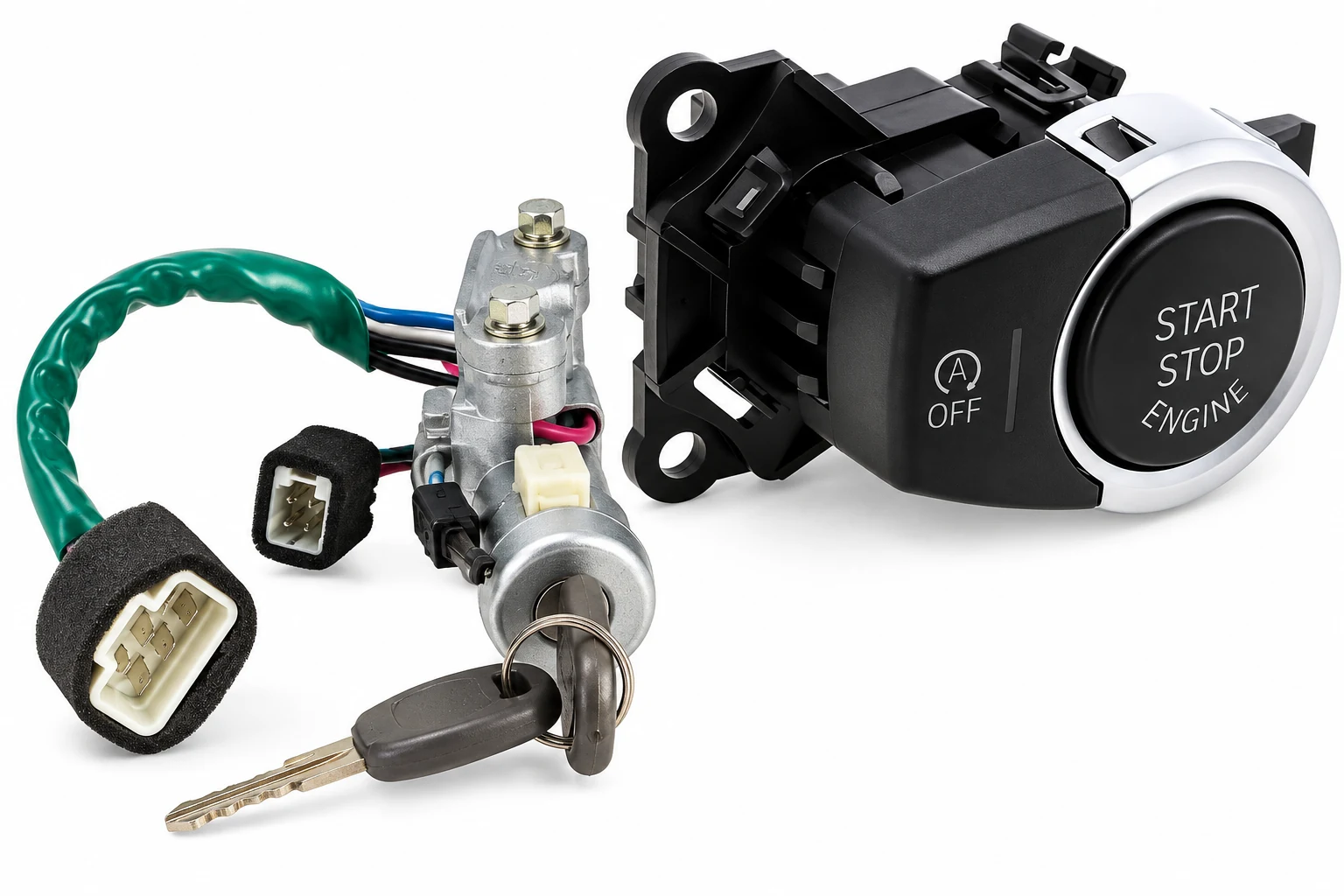
Mobile Ignition Switch Diagnostics in Daytona Beach
An engine that does not start does not automatically need an ignition switch.
Depending on the vehicle and symptoms, ignition-switch diagnosis can include checking:
- Battery voltage
- Battery terminals and cables
- Main power supply to ignition switch
- ACC circuit
- RUN circuit
- START circuit
- Ignition-switch output voltage
- Voltage drop through switch
- Starter-control signal
- Starter relay
- Relevant fuses
- Fusible links
- Neutral safety switch or transmission range input
- Clutch-start switch on manual-transmission vehicles
- Ignition-switch connector
- Steering-column wiring
- Immobilizer or anti-theft status
- Scan-tool data where applicable
- Push-button start inputs on equipped vehicles
The goal is to establish whether the switch itself is failing or whether another part of the start/run circuit is preventing normal operation.
What Is an Ignition Switch?
The ignition switch is an electrical switching device that controls power to various vehicle circuits according to key or start-system position.
On many traditional vehicles, turning the ignition key mechanically operates an electrical switch.
Common positions include:
- LOCK
- OFF
- ACC
- RUN
- START
The switch may be located:
- Directly behind the key cylinder
- Lower on the steering column
- Integrated into a larger ignition assembly
- Electronically controlled in newer vehicles
What Does the Ignition Switch Do?
The ignition switch can provide or control electrical power for several systems.
Depending on vehicle design, these may include:
- Engine-control module
- Ignition coils
- Fuel-system controls
- Instrument panel
- Accessories
- Starter relay
- Starter solenoid control
- HVAC circuits
- Other switched electrical systems
Not every circuit is powered directly through the physical switch. Modern vehicles frequently use relays, control modules, or network commands between the driver’s input and the final electrical load.
Ignition Switch vs. Ignition Lock Cylinder
The ignition switch and ignition lock cylinder are often confused.
Ignition Lock Cylinder
The mechanical portion into which the key is inserted.
It recognizes the physical key and allows the driver to rotate the ignition mechanism.
Ignition Switch
The electrical portion that changes circuit connections as the ignition is moved through its positions.
A key that will not turn may indicate a lock-cylinder or mechanical problem rather than an electrical ignition-switch failure.
Likewise, a key that turns normally does not prove that the electrical switch contacts are working correctly.
Ignition Switch vs. Key Cylinder
The key cylinder provides the mechanical key interface.
The ignition switch controls electrical circuits.
Depending on the vehicle, the two may be:
- Separate components
- Mechanically linked
- Part of a larger assembly
Diagnosis should identify which component is actually faulty before replacement.
Ignition Switch vs. Starter
The ignition switch tells the starting system that the driver wants the engine cranked.
The starter motor physically turns the engine.
A vehicle can have a good ignition switch and a bad starter, or a good starter and a bad ignition switch.
Ignition Switch Fault
May fail to provide the required start command.
Starter Fault
May receive the start command but fail to crank the engine.
Testing the circuit helps separate these conditions.
Ignition Switch vs. Starter Relay
Many vehicles do not send full starter-solenoid current directly through the ignition switch.
Instead, the switch or control module commands a starter relay.
The relay then completes another circuit to the starter solenoid.
A no-crank condition can therefore be caused by:
- Ignition switch
- Starter relay
- Relay-control circuit
- Neutral safety switch
- Starter
- Wiring
The start command should be traced through the circuit.
Ignition Switch vs. Starter Solenoid
The starter solenoid is part of or attached to the starter assembly on many vehicles.
It typically:
- Engages starter drive
- Connects high-current battery power to starter motor
The ignition switch participates in commanding that process but does not perform the same function.
A click from the starter area can indicate that the command reached the solenoid even if the starter motor itself does not crank.
Ignition Switch vs. Neutral Safety Switch
Automatic-transmission vehicles commonly use a neutral safety switch or transmission range system to prevent starting unless the transmission is in:
- Park
- Neutral
A faulty range input can create a no-crank condition that resembles an ignition-switch problem.
For example, a vehicle that will not crank in Park but cranks in Neutral should prompt investigation of the range or neutral-start circuit before the ignition switch is condemned.
Ignition Switch vs. Clutch Safety Switch
Manual-transmission vehicles may require the clutch pedal to be depressed before the starter operates.
A defective clutch-start switch can cause:
- No crank
- Intermittent crank
even when the ignition switch is functioning correctly.
Ignition Switch vs. Battery
A weak battery can produce many symptoms that are mistaken for ignition-switch failure.
These may include:
- No crank
- Clicking
- Dashboard lights going out
- Intermittent electrical behavior
Battery state of charge and cable condition should be established before diagnosing the ignition switch.
Ignition Switch vs. Ignition Coil
Despite the similar name, the ignition switch and ignition coil are very different components.
Ignition Switch
Controls power and operating modes.
Ignition Coil
Generates high voltage for the spark plugs.
An ignition-coil failure usually affects combustion or causes a misfire.
An ignition-switch failure can prevent electrical systems from being powered at all.
Ignition Switch vs. Immobilizer
Modern vehicles often use an immobilizer or anti-theft system.
Even if the ignition switch operates normally, the immobilizer may prevent:
- Starter operation
- Fuel delivery
- Engine operation
depending on the design.
Possible causes include:
- Key transponder problem
- Immobilizer antenna
- Security module
- Key programming issue
A security-related no-start should not be treated as an ignition-switch failure without testing.
Signs of a Bad Ignition Switch
Possible symptoms include:
- No crank when key is turned
- Intermittent no crank
- Vehicle starts only after moving key
- Engine stalls unexpectedly
- Dashboard power cuts in and out
- Accessories fail in certain key positions
- Radio loses power unexpectedly
- Key position feels abnormal
- Vehicle shuts off when key is touched
- Ignition switch becomes hot
- Electrical burning smell near steering column
- Start command disappears intermittently
These symptoms overlap with many electrical faults, so diagnosis should come before replacement.
Car Does Nothing When Key Is Turned
If turning the key produces no crank and no obvious starter response, possible causes include:
- Weak or disconnected battery
- Battery cable problem
- Ignition switch
- Starter relay
- Neutral safety switch
- Clutch switch
- Starter-control wiring
- Immobilizer
- Starter
The correct next step is circuit testing rather than automatically replacing the ignition switch.
Intermittent No-Crank
An ignition switch with worn internal contacts may occasionally fail to send the start command.
The vehicle may:
- Start normally most of the time
- Occasionally do nothing
- Start after key is moved or tried again
However, intermittent faults can also occur in:
- Starter solenoid
- Starter relay
- Neutral safety switch
- Wiring
- Battery connections
The start circuit should be tested while the failure is present whenever possible.
Car Starts After Wiggling the Key
If moving or changing pressure on the key changes the symptom, possible causes include:
- Worn ignition switch
- Lock-cylinder mechanism problem
- Loose actuator linkage
- Damaged electrical connector
This symptom increases suspicion around the ignition assembly, but the exact failed component still needs to be identified.
Car Starts Only if Key Is Held a Certain Way
A vehicle that starts only when the key is held in a specific position may have:
- Worn switch contacts
- Mechanical actuator problem
- Loose switch
- Lock-cylinder wear
The relationship between key position and electrical output should be tested.
Engine Stalls When Key Is Touched
If lightly moving the ignition key causes the engine to shut off, an ignition-switch or mechanical ignition-actuator problem may be present.
The RUN circuit should remain powered continuously once the engine is operating.
An intermittent loss of that circuit can shut down:
- Engine-control module
- Ignition system
- Fuel-control circuits
This can create sudden stalling.
Engine Shuts Off While Driving
A faulty ignition switch can cause a vehicle to stall if it interrupts critical RUN circuits.
However, sudden stalling can also result from:
- Crankshaft position sensor
- Fuel pump
- Electrical power loss
- PCM power relay
- Charging-system failure
- Wiring
Ignition-switch replacement should only follow evidence that switched power is actually being lost.
Dashboard Lights Flicker
Intermittent ignition-switch contacts can sometimes cause dashboard or accessory power to flicker.
Other causes include:
- Battery-terminal problem
- Main ground problem
- Charging-system fault
- Loose connector
- Body-control electrical fault
The circuit losing power should be identified.
Accessories Work but Engine Will Not Crank
If ACC functions normally but START does not, the ignition switch may have a problem specifically in its start circuit.
Other possibilities include:
- Neutral safety switch
- Starter relay
- Starter
- Start-control wiring
ACC operation does not prove that every section of the ignition switch is good because different internal contacts can serve different positions.
Car Cranks but Does Not Start
A crank-no-start is different from a no-crank condition.
If the starter is turning the engine normally, the start-command portion of the ignition switch has already performed at least part of its function.
Possible crank-no-start causes include:
- No fuel pressure
- No ignition spark
- Crankshaft sensor problem
- Immobilizer
- Mechanical timing
- Compression problem
An ignition switch can still cause a crank-no-start on some designs if critical RUN circuits lose power, but it should not be assumed.
No-Crank vs. No-Start
These terms should be kept separate.
No Crank
Starter does not rotate the engine.
Crank-No-Start
Starter rotates engine but engine does not begin running.
This distinction is important because the diagnostic paths are different.
Ignition Switch ACC Position
ACC usually powers selected accessories without powering the complete engine-management system.
Depending on vehicle design, this may include:
- Radio
- Power outlets
- Other accessory circuits
If ACC works but RUN does not, the switch may have an internal contact problem associated with the RUN position.
Ignition Switch RUN Position
RUN powers circuits required while the engine operates.
Possible circuits include:
- Engine-control module
- Ignition system
- Instrument cluster
- Fuel-system controls
- Other vehicle electronics
A loss of RUN power can cause:
- Stall
- No-start
- Dashboard shutdown
The exact circuits vary by vehicle.
Ignition Switch START Position
START requests starter operation.
On older vehicles, the switch may send a direct control signal toward the starter solenoid or relay.
On newer vehicles, turning or pressing START may simply provide an input to a control module, which then decides whether starting conditions are satisfied.
Ignition Switch OFF Position
OFF removes power from many switched circuits.
If accessories remain powered unexpectedly after the ignition is switched off, possible causes include:
- Ignition-switch contacts sticking
- Retained accessory power system
- Relay fault
- Module problem
Modern retained-accessory systems should not be mistaken for a defective switch.
Ignition Switch LOCK Position
LOCK may:
- Disable certain electrical circuits
- Allow key removal
- Engage steering lock on some vehicles
A mechanical steering-lock or key-cylinder problem is different from an electrical switch failure.
Ignition Switch Electrical Contacts
Inside a traditional electrical ignition switch are contacts that connect different circuits depending on switch position.
Over time, contacts can experience:
- Wear
- Arcing
- Heat
- Increased resistance
This can create intermittent or complete loss of electrical continuity.
Worn Ignition Switch Contacts
Worn contacts may work under some conditions but fail under others.
Possible symptoms include:
- Intermittent start
- Voltage drop
- Loss of accessory power
- Stalling
Measuring switch input and output can help identify this type of failure.
Ignition Switch Internal Resistance
A damaged switch may still pass voltage while developing excessive resistance.
Under electrical load, this can create:
- Voltage drop
- Heat
- Poor circuit operation
A simple continuity check with no load may not always reveal the problem.
Voltage testing under operating conditions can be more informative.
Ignition Switch Voltage Drop
Voltage drop testing compares voltage on the input and output sides of a circuit while current is flowing.
Excessive drop through the ignition switch can indicate:
- Worn contacts
- Heat-damaged terminals
- High resistance
Testing should follow the actual vehicle circuit because acceptable values and loads vary.
Ignition Switch Connector
The electrical connector at the switch should be inspected for:
- Burned terminals
- Melted plastic
- Loose pins
- Corrosion
- Heat discoloration
- Poor terminal fit
A new switch should not simply be plugged into a severely damaged connector.
The connector fault must also be corrected.
Melted Ignition Switch Connector
A melted connector can result from:
- Excessive resistance
- Loose terminal
- High current
- Overheated switch contact
If the connector is damaged, replacing only the switch can leave a high-resistance connection in place.
Both sides of the connection should be inspected.
Burning Smell From Steering Column
A burning or overheated electrical smell near the ignition area can be serious.
Possible causes include:
- Overheated ignition switch
- Melted connector
- Wiring short
- Accessory wiring modification
The circuit should be inspected before continued use.
Hot Ignition Switch
Some warmth can occur in electrical components carrying current, but excessive heat can indicate:
- Internal resistance
- Loose connector
- Excessive current draw
A switch that becomes abnormally hot should be inspected for both switch and circuit problems.
Ignition Switch Wiring
Traditional ignition switches may have circuits for:
- Battery input
- Accessory output
- Run output
- Start output
Modern systems can use far more complex arrangements involving:
- BCM
- PCM
- Start-control module
- Steering-column module
Wiring diagrams are especially useful for determining what should be present at each terminal.
Ignition Switch Fuse
Some ignition-related circuits are protected by fuses.
Possible fuse labels may include:
- IGN
- IGN 1
- IGN 2
- START
- ECM
- PCM
Names vary by manufacturer.
A blown fuse should not simply be replaced repeatedly without determining why it opened.
Blown Ignition Fuse
Possible causes include:
- Shorted wiring
- Failed component
- Pinched harness
- Incorrect aftermarket equipment
A blown fuse can create symptoms that appear identical to switch failure.
Fusible Link and Main Power Supply
Some vehicles use:
- Fusible links
- High-amperage fuses
- Main power distribution circuits
to supply the ignition switch or control modules.
If the switch does not receive battery voltage, it cannot provide output regardless of its condition.
Input power should therefore be verified.
Ignition Switch Ground
Traditional mechanical ignition switches often switch positive voltage and may not require a dedicated ground for the basic contact function.
Electronic start assemblies, illuminated key modules, or smart-key systems may use grounds for their electronics.
Testing should follow the specific circuit rather than assuming every ignition switch requires the same wiring.
Testing Ignition Switch Input Voltage
One diagnostic step is verifying that required battery voltage reaches the switch.
If battery power is missing at the input, the problem lies upstream.
Possible causes include:
- Main fuse
- Fusible link
- Wiring
- Power-distribution connection
Replacing the ignition switch would not restore a missing input supply.
Testing Ignition Switch Output
With correct input voltage established, output circuits can be tested in:
- ACC
- RUN
- START
A switch that receives proper input but fails to produce the expected output in a particular position may be faulty.
The circuit should also be checked for loading or downstream shorts.
Continuity Testing an Ignition Switch
When disconnected, some mechanical switches can be tested for continuity between specified terminals in each position.
However, continuity alone may not reveal:
- High resistance
- Heat-related failure
- Fault under load
Vehicle-specific pin identification is essential.
Testing Ignition Switch Under Load
A switch can pass a small test current yet fail when supplying actual circuit load.
Testing under realistic operating conditions can expose:
- Excessive resistance
- Intermittent contact
- Voltage collapse
This can be important for difficult intermittent problems.
Intermittent Ignition Switch Testing
Intermittent failures can be difficult because the vehicle may work normally during inspection.
Useful techniques can include:
- Monitoring switch outputs
- Moving key gently
- Reproducing temperature conditions
- Inspecting connector pin fit
- Checking scan data for ignition status
Parts should not be replaced solely because the symptom could not be reproduced unless other evidence supports the diagnosis.
Ignition Switch Scan Data
On modern vehicles, scan tools may display ignition-state information such as:
- Off
- Accessory
- Run
- Crank request
- Start authorization
This can help determine whether the vehicle’s modules are receiving the expected start request.
The terminology varies by manufacturer.
Start Request Signal
Some modern vehicles use an electronic start-request signal rather than routing significant current through the ignition control.
The start request may travel to:
- BCM
- PCM
- Start-control module
The module then checks conditions such as:
- Park/Neutral
- Security authorization
- Brake pedal
- Clutch pedal
before energizing the starter relay.
Ignition Switch and PCM Power
The engine-control module requires proper power supply to operate.
A faulty RUN circuit can sometimes cause:
- No communication
- No-start
- Stall
However, PCM power may also be controlled through a relay, so the complete power path should be traced.
Ignition Switch and Fuel Pump
The ignition switch does not usually power the fuel pump directly on modern vehicles.
Instead, the ignition state allows the engine-control system to command the fuel-pump relay or control module.
A fuel pump that does not run should therefore be diagnosed through its own control circuit.
Ignition Switch and Instrument Cluster
The instrument panel typically responds when the ignition enters RUN.
A completely dark cluster can suggest loss of switched power, but it can also be caused by:
- Cluster fuse
- Battery connection
- Module communication fault
Cluster behavior is a diagnostic clue, not proof of switch failure.
Ignition Switch and Radio
Radio operation can help determine whether ACC circuits are working.
However, many modern vehicles use retained accessory power controlled by a body-control module.
The radio may continue operating temporarily after the ignition is turned off until a door opens.
That behavior may be completely normal.
Ignition Switch and Power Windows
Power-window operation may also be controlled by:
- Retained accessory power
- BCM
- Door modules
Loss of window operation alone should not be interpreted as ignition-switch failure without circuit testing.
Ignition Switch and Headlights
Most modern headlight circuits are not simply powered directly through the ignition switch.
They may use:
- Relays
- BCM
- Lighting modules
A headlight fault generally requires separate diagnosis.
Ignition Switch and Steering Lock
Some ignition assemblies mechanically or electronically control steering-column locking.
A steering wheel that will not unlock can involve:
- Key cylinder
- Steering-lock mechanism
- Electronic steering lock
This is not necessarily an electrical ignition-switch contact problem.
Key Will Not Turn in Ignition
If the key physically will not rotate, possible causes include:
- Worn key
- Damaged lock cylinder
- Steering lock under tension
- Debris in cylinder
- Internal mechanical failure
This symptom points first toward the mechanical key/lock mechanism rather than the electrical switch.
Key Stuck in Ignition
A key that cannot be removed can be related to:
- Lock cylinder
- Shift interlock
- Park-position recognition
- Mechanical linkage
- Steering lock
The electrical ignition switch may or may not be involved.
Key Turns but Nothing Happens
If the key rotates normally but electrical state does not change, possible causes include:
- Ignition switch
- Mechanical actuator between cylinder and switch
- Switch connector
- Main power feed
Both mechanical movement and electrical output should be checked.
Ignition Switch Actuator
Certain steering-column designs use an actuator rod, gear, rack, or linkage between the lock cylinder and electrical switch.
If this actuator breaks:
- Key may turn
- Electrical switch may not move correctly
Replacing the electrical switch alone would not fix a broken actuator.
Broken Ignition Switch Actuator
Symptoms can include:
- Key turns loosely
- No change in electrical state
- Cannot reach START position electrically
- Switch remains in previous state
The linkage should be inspected on vehicles using this design.
Push-Button Start vs. Ignition Switch
Vehicles with push-button starting do not use a traditional key-operated ignition switch in the same way.
A start button is typically an electronic input to a control system.
Starting may depend on:
- Brake-pedal input
- Key-fob recognition
- Transmission position
- Immobilizer authorization
- Start-control module
- Starter relay
A push-button no-start requires a different diagnostic approach.
Push-Button Start Does Nothing
Possible causes include:
- Weak vehicle battery
- Weak key-fob battery
- Key not recognized
- Brake switch
- Park/Neutral recognition
- Start button
- Immobilizer
- Starter relay
- Starter
The button itself should not be replaced without confirming that its input is missing or incorrect.
Keyless Ignition System
Modern keyless ignition systems may use:
- Proximity key
- RF receiver
- BCM
- Immobilizer
- Electronic steering lock
The driver’s start command is processed electronically rather than through a traditional high-current mechanical switch.
These systems may also require programming or initialization after certain component replacements.
Ignition Switch and Key Programming
Replacing a purely electrical ignition switch on an older vehicle may not require key programming.
Replacing components that contain or communicate with the vehicle’s security system may require:
- Key relearn
- Immobilizer programming
- Module setup
The requirement depends on exactly which component is being replaced.
Does an Ignition Switch Need Programming?
Sometimes, but not always.
A basic mechanical electrical switch generally does not require programming.
Integrated electronic ignition modules, steering-column modules, or smart-key components may.
The vehicle and part should be identified before replacement.
Ignition Switch Replacement With Existing Key
If the electrical switch is separate from the lock cylinder, it may be possible to retain:
- Original key
- Original lock cylinder
This is often preferable because the key does not need to change.
The design varies by vehicle.
Ignition Lock Cylinder Replacement and New Key
If the lock cylinder itself is replaced, key considerations may include:
- New mechanical key
- Re-keying cylinder
- Transponder chip
- Immobilizer programming
That is a different service from replacing only the electrical ignition switch.
Ignition Switch Recalls
Certain vehicle models have had ignition-switch-related safety recalls.
Recall eligibility depends on:
- VIN
- Vehicle year
- Model
- Campaign status
If a vehicle is covered by an active manufacturer recall, recall repair is generally handled through the manufacturer or authorized dealer.
A symptom should still be properly identified rather than assuming every ignition problem is recall-related.
Ignition Switch Replacement
Once testing confirms that the ignition switch itself has failed, replacement generally involves:
- Verify the complaint.
- Confirm battery condition and main electrical supply.
- Confirm the switch is receiving proper input power.
- Verify the failed ACC, RUN, or START output where applicable.
- Rule out starter relay, neutral safety switch, starter, and relevant security problems.
- Identify whether the electrical switch is separate from the lock cylinder.
- Disconnect battery power when required by the service procedure.
- Observe appropriate airbag precautions around the steering column.
- Remove trim panels or steering-column covers needed for access.
- Locate the ignition switch.
- Inspect the switch connector for heat or terminal damage.
- Disconnect the electrical connector.
- Remove switch retaining screws, bolts, or clips.
- Disconnect or align any mechanical actuator if used.
- Compare the replacement switch with the original.
- Position the new switch according to the required key or switch position.
- Engage the actuator correctly.
- Secure the new switch.
- Reconnect the electrical connector.
- Reassemble steering-column trim.
- Reconnect battery when appropriate.
- Verify ACC operation.
- Verify RUN operation.
- Verify START operation.
- Confirm that the engine starts and continues running.
- Verify that the key returns normally from START to RUN.
- Check that accessories switch off correctly.
- Clear or address any applicable diagnostic codes.
The exact procedure varies considerably by vehicle.
Steering-Column Ignition Switch Replacement
Many traditional vehicles mount the ignition system on the steering column.
Access may require removing:
- Lower dash trim
- Steering-column shrouds
- Knee bolster
Some switches are located directly behind the lock cylinder, while others are positioned farther down the column and operated through linkage.
Dash-Mounted Ignition Switch
Certain vehicles use a dash-mounted ignition switch.
These may have a different mechanical arrangement than steering-column switches.
Replacement can involve:
- Bezel removal
- Connector access
- Lock-cylinder handling
The exact procedure depends on design.
Ignition Switch and Airbag Safety
Working around a steering column can place the repair near:
- Driver airbag
- Supplemental restraint wiring
- Clock spring
Battery disconnection and waiting procedures may be required before certain steering-column components are disturbed.
Airbag circuits should not be probed or handled casually.
Ignition Switch Position During Installation
Some replacement switches must be installed with both the:
- Lock cylinder
- Electrical switch
in matching positions.
If the switch is installed out of index, symptoms can include:
- Incorrect key positions
- No START
- Accessories staying powered
- Limited key travel
Positioning instructions should be followed carefully.
New Ignition Switch but Car Still Will Not Crank
If a replacement switch does not correct the problem, possible causes include:
- Starter relay
- Neutral safety switch
- Clutch switch
- Starter
- Wiring
- Battery
- Immobilizer
- Control module
The circuit should be tested rather than replacing another switch.
New Ignition Switch but Car Cranks and Will Not Start
Possible causes include:
- Immobilizer relearn required
- Fuel problem
- Ignition-coil power issue
- Crankshaft sensor
- Incorrect switch installation
- Unrelated engine fault
The actual no-start condition should be diagnosed.
New Ignition Switch but Accessories Stay On
Possible causes include:
- Switch installed out of position
- Mechanical actuator not returning
- Retained accessory power
- Stuck relay
- Module problem
Modern retained-accessory operation should first be distinguished from an actual fault.
New Ignition Switch Feels Different
A new electrical switch can change the mechanical feel slightly if the old component had significant wear.
However, excessive:
- Binding
- Resistance
- Limited key travel
can indicate incorrect switch positioning or an unrelated lock-cylinder problem.
Ignition Switch Replacement Cost
Ignition-switch replacement cost depends on factors such as:
- Vehicle year, make, and model
- Traditional key vs. electronic start
- Switch location
- Steering-column access
- Separate vs. integrated lock cylinder
- Connector damage
- Security-system integration
- Programming requirements
A basic electrical switch can be very different from an integrated electronic ignition or steering-column module.
Call Jimmy’s Mobile Care at (386) 308-2509 with your vehicle information and symptoms so we can determine the appropriate ignition-switch diagnostic service.
Should an Ignition Switch Be Replaced With the Lock Cylinder?
Not automatically.
If:
- Electrical switch has failed
- Lock cylinder turns normally
- Key is in good condition
the electrical switch may sometimes be replaced independently.
If the lock cylinder is:
- Binding
- Broken
- Worn
- Mechanically damaged
the lock-cylinder portion may require separate service.
Should a Starter Be Replaced With the Ignition Switch?
No.
The starter and ignition switch are separate components.
The starter should only be replaced when testing supports a starter fault.
Replacing both simply because the vehicle will not crank risks unnecessary parts replacement.
Should the Starter Relay Be Replaced With the Ignition Switch?
Not automatically.
The relay should be tested independently.
A good starter relay does not require replacement because an ignition switch is being changed.
Ignition Switch Failure From Heavy Keychains
On traditional key-operated ignition systems, excessive weight hanging from the key can place additional load on:
- Lock cylinder
- Mechanical ignition components
The extent of that effect depends on vehicle design.
Keeping unnecessary weight off the key ring is reasonable, but a heavy keychain should not be assumed to be the cause of every ignition-switch failure.
Aftermarket Accessories and Ignition Switch Problems
Improperly installed aftermarket electrical equipment can overload or alter ignition-switched circuits.
Examples may include:
- Remote start
- Alarm
- Audio equipment
- Lighting accessories
- Added electronics
Poor connections or excessive current can create:
- Voltage drop
- Overheating
- Intermittent starting
Aftermarket wiring should be inspected when symptoms began after electrical modifications.
Remote Starter and Ignition Switch
A remote-start system interfaces with circuits normally associated with the ignition switch.
Faulty installation or relay failure in an aftermarket system can sometimes cause:
- No crank
- Intermittent start
- Ignition power problems
The original vehicle circuit and aftermarket additions should be separated during diagnosis.
Why Diagnose an Ignition Switch Before Replacing It?
Many starting and electrical problems can imitate ignition-switch failure.
Does the Switch Receive Battery Power?
If not, the problem is upstream.
Does the START Output Appear When the Key Is Turned?
If it does, the no-crank problem may be farther downstream.
Does the Vehicle Start in Neutral but Not Park?
That points more strongly toward transmission-range or neutral-start control.
Does the Starter Relay Receive a Command?
If it does, the switch may already be doing its job.
Does the Starter Solenoid Receive the Start Signal?
If yes, a starter-related problem becomes more likely.
Are RUN Circuits Losing Voltage?
That can support an ignition-switch or power-distribution problem.
Is the Connector Burned?
A damaged connector may need repair along with or instead of the switch.
Does the Key Cylinder Actually Move the Switch?
A broken actuator can mimic an electrical failure.
Is the Immobilizer Blocking the Start?
Security authorization should be considered on modern vehicles.
Testing these areas helps prevent unnecessary ignition-switch replacement.
Mobile Ignition Switch Diagnostics in Daytona Beach
Jimmy’s Mobile Care provides mobile car ignition switch diagnostics in Daytona Beach for vehicles experiencing:
- No crank
- Intermittent starting
- Loss of accessory power
- Engine stalling
- Dashboard power cutting out
- Vehicle starting only after key movement
- Ignition-switch electrical faults
- Burned ignition-switch connectors
- Suspected ACC, RUN, or START circuit problems
We test the ignition-switch circuit and the related starting-system components needed to determine whether the switch itself is actually defective.
Mobile Ignition Switch Replacement in Daytona Beach
When diagnostics confirm ignition-switch failure and the vehicle design allows the repair to be completed safely on-site, Jimmy’s Mobile Care can replace many traditional automotive ignition switches at your Daytona Beach location.
After replacement, we can verify:
- ACC operation
- RUN operation
- START operation
- Starter response
- Engine operation
- Proper key-position behavior
- Connector condition
- Normal switch return from START
Vehicles with damaged lock cylinders, complex steering-column repairs, electronic steering-lock systems, security-module failures, key-programming requirements, or extensive wiring damage may require additional specialized procedures.
Schedule Car Ignition Switch Diagnostics & Replacement in Daytona Beach
A vehicle that does not crank, stalls unexpectedly, loses accessory power, or only starts after the key is moved may have an ignition-switch problem—but similar symptoms can come from the battery, starter, relay, neutral safety switch, lock-cylinder mechanism, wiring, immobilizer, or other electrical components.
Jimmy’s Mobile Care tests the ignition switch and the relevant ACC, RUN, and START circuits before replacement so the switch is replaced only when the diagnosis supports it.
Call Jimmy’s Mobile Care at (386) 308-2509 to schedule car ignition switch diagnostics and replacement in Daytona Beach, FL. Call today and we'll come to your location.