
Car Thermostat Diagnostics & Replacement in Daytona Beach, FL
The engine thermostat regulates coolant flow between the engine and radiator so the engine can warm up quickly and then maintain the correct operating temperature. When the thermostat sticks open, sticks closed, opens at the wrong temperature, becomes mechanically damaged, or an electronically controlled thermostat develops an electrical fault, the engine may run too cold, overheat, take too long to warm up, produce weak cabin heat, set a check-engine light, or develop unstable coolant-temperature behavior.
Jimmy’s Mobile Care provides car thermostat diagnostics and replacement in Daytona Beach, FL. We evaluate coolant temperature from a cold start through normal warm-up, compare temperature behavior before and after the thermostat opens, inspect coolant level and circulation, review related trouble codes such as P0128, and distinguish a thermostat fault from a bad coolant temperature sensor, low coolant, trapped air, water-pump problem, radiator restriction, cooling-fan fault, or internal engine problem before recommending replacement.
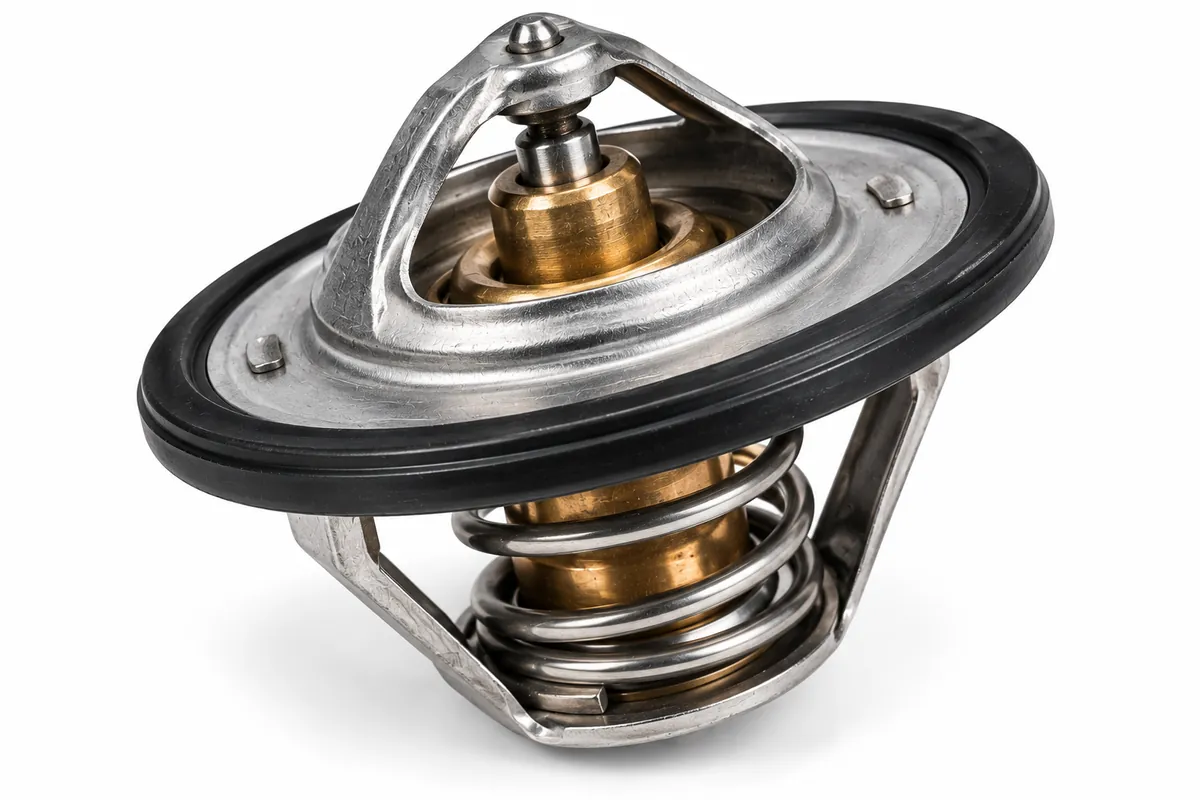
Mobile Car Thermostat Diagnostics in Daytona Beach
A low temperature reading, overheating complaint, or P0128 code does not automatically prove the thermostat is defective.
Depending on the vehicle and symptoms, thermostat diagnosis can include checking:
- Cold-start coolant temperature
- Engine warm-up rate
- Live coolant-temperature data
- Thermostat opening behavior
- Upper radiator hose temperature
- Lower radiator hose temperature
- Radiator inlet and outlet temperatures
- Coolant level
- Cooling-system leaks
- Cooling-fan operation
- Coolant temperature sensor plausibility
- Water-pump circulation
- Heater output
- Stored trouble codes
- Freeze-frame data
- Electronically controlled thermostat circuits where equipped
The purpose is to determine whether the thermostat is actually failing to regulate coolant flow correctly.
What Is a Car Thermostat?
The thermostat is a temperature-controlled valve in the engine cooling system.
It is commonly located:
- In a thermostat housing
- At the engine coolant outlet
- Near the upper radiator hose
- Near the lower radiator hose on some engines
- Integrated into a larger coolant housing or module
Its job is to control when coolant is allowed to circulate through the radiator.
What Does an Engine Thermostat Do?
When the engine is cold, the thermostat generally remains closed or mostly closed so coolant circulation through the radiator is restricted.
This allows the engine to warm up faster.
As coolant temperature rises, the thermostat begins to open.
Once open, it allows more coolant to flow through the radiator so excess heat can be removed.
The thermostat therefore helps the engine maintain a controlled operating-temperature range.
Why Engine Temperature Matters
An engine is designed to operate within a specific temperature range.
If it stays too cold:
- Fuel economy can suffer
- Heater performance may be weak
- Emissions can increase
- Oil may take longer to reach operating temperature
- The PCM may delay some normal operating strategies
If it becomes too hot:
- Coolant can boil
- Engine components can distort
- Head gaskets can fail
- Severe engine damage can occur
The thermostat plays an important role in maintaining that balance.
How a Mechanical Thermostat Works
A conventional thermostat usually contains a wax-based thermal element.
As coolant temperature rises:
- The wax element heats.
- The wax expands.
- The thermostat valve begins to open.
- Coolant flow through the radiator increases.
As coolant temperature falls:
- The wax contracts.
- The thermostat begins closing.
- Radiator flow is reduced.
The thermostat is therefore mechanically responsive to temperature.
Thermostat Opening Temperature
Thermostats are designed to begin opening around a specified temperature.
The exact opening temperature depends on:
- Engine design
- Manufacturer calibration
- Emissions strategy
- Cooling-system design
There is no single correct thermostat temperature for every vehicle.
A replacement thermostat should match the correct vehicle specification.
Thermostat Fully Open Temperature
A thermostat normally begins opening at one temperature and becomes progressively more open as temperature rises.
The temperature at which it becomes fully open may be higher than its initial opening point.
This matters because thermostat operation should be judged by a range, not by one exact instant.
Thermostat vs. Coolant Temperature Sensor
These components do different jobs.
Thermostat
Physically regulates coolant flow.
Coolant Temperature Sensor
Electronically reports coolant temperature to the PCM.
A thermostat can be stuck open while the temperature sensor correctly reports that the engine is running too cold.
A thermostat can be stuck closed while the sensor correctly reports that the engine is overheating.
Replacing the sensor will not repair a mechanical thermostat problem.
Thermostat vs. Water Pump
The thermostat controls coolant flow.
The water pump moves coolant through the engine and cooling system.
A failed water pump can cause:
- Poor circulation
- Overheating
- Heater problems
even when the thermostat is operating correctly.
Thermostat vs. Radiator
The thermostat decides when coolant should flow through the radiator.
The radiator removes heat from the coolant.
A restricted radiator can cause overheating even with a fully open thermostat.
Thermostat vs. Radiator Fan
The thermostat regulates coolant flow.
The radiator fan moves air through the radiator when vehicle speed alone is not enough.
A fan failure can cause overheating:
- At idle
- In traffic
- At low speed
while the thermostat remains functional.
Thermostat vs. Radiator Hose
The thermostat controls flow.
The hoses carry coolant between the engine and radiator.
A hose that is:
- Collapsed
- Restricted
- Leaking
can create cooling problems independent of the thermostat.
Thermostat vs. Coolant Leak
A leaking cooling system can run low on coolant and overheat.
The thermostat may be functioning normally while:
- Hose
- Radiator
- Water pump
- Housing
- Reservoir
- Gasket
is leaking.
Coolant level must be checked before thermostat diagnosis is complete.
Signs of a Bad Thermostat
Possible thermostat symptoms include:
- Engine takes too long to warm up
- Temperature gauge stays unusually low
- Weak cabin heat
- P0128 trouble code
- Engine overheats
- Temperature rises rapidly
- Temperature fluctuates
- Upper radiator hose remains cold during overheating
- Poor fuel economy
- Check-engine light
These symptoms can overlap with other cooling-system problems.
Thermostat Stuck Open
A thermostat stuck open allows coolant to circulate through the radiator too early.
The engine may have difficulty reaching its intended operating temperature.
Possible symptoms include:
- Slow warm-up
- Low temperature gauge reading
- Weak heater output
- Poor fuel economy
- P0128
- Excessively low coolant temperature during highway driving
The engine may still run and drive normally otherwise.
Why a Stuck-Open Thermostat Causes Slow Warm-Up
A cold engine is supposed to retain heat while the thermostat remains closed.
If the thermostat is stuck open:
- Coolant circulates through the radiator immediately
- Heat is removed before the engine reaches operating temperature
This can be especially noticeable:
- In cooler weather
- At highway speeds
Stuck-Open Thermostat and Heater Performance
Cabin heat depends on hot engine coolant flowing through the heater core.
If the engine runs too cool because the thermostat is stuck open, the heater may produce:
- Lukewarm air
- Weak heat
Poor heater output can also result from:
- Low coolant
- Air in system
- Restricted heater core
- HVAC blend-door fault
The thermostat should not be assumed without checking the rest of the system.
Stuck-Open Thermostat and Fuel Economy
When the engine remains below its intended operating temperature, the PCM may maintain a different fuel strategy than it would on a fully warmed engine.
Possible effects include:
- Increased fuel consumption
- Higher emissions
Poor fuel economy alone does not prove the thermostat is stuck open.
Thermostat Stuck Closed
A thermostat stuck closed prevents sufficient coolant flow to the radiator.
This can cause the engine temperature to rise rapidly.
Possible symptoms include:
- Overheating
- High temperature gauge
- Coolant boiling
- Upper radiator hose remaining cooler than expected during overheating
- Pressure buildup
A stuck-closed thermostat can cause serious engine damage if the vehicle continues to operate while overheating.
Why a Stuck-Closed Thermostat Causes Overheating
If the thermostat remains closed after the engine reaches operating temperature:
- Coolant stays primarily within the engine circuit
- Hot coolant cannot flow adequately through the radiator
- Heat cannot be removed efficiently
The temperature may rise quickly.
Can a Thermostat Be Partially Stuck?
Yes.
A thermostat can sometimes:
- Open too late
- Open only partially
- Move inconsistently
A partially restricted thermostat can cause:
- Overheating under load
- Normal temperature at idle
- Temperature fluctuations
- Reduced radiator flow
Diagnosis may require observing temperature behavior over time rather than waiting for a complete failure.
Thermostat Opens Too Early
A thermostat can become weak or mechanically damaged and begin opening at a lower temperature than intended.
Possible results include:
- Slow warm-up
- Engine running too cool
- P0128
This condition can resemble a thermostat that is completely stuck open.
Thermostat Opens Too Late
A thermostat that opens at an excessively high temperature may cause:
- High temperature gauge
- Temperature spikes
- Overheating before coolant begins flowing through radiator
The opening point should be compared with the correct vehicle specification.
Thermostat Sticking Intermittently
Some thermostats may operate normally at times and stick at others.
Possible symptoms include:
- Temperature gauge fluctuates
- Random overheating
- Heater temperature changes
Intermittent cooling problems require careful diagnosis because:
- Air pockets
- Fan faults
- Water-pump problems
can create similar symptoms.
P0128 Coolant Thermostat Code
P0128 generally means the engine coolant temperature did not reach the expected regulated temperature within the PCM’s calculated time or operating conditions.
Common possible causes include:
- Thermostat stuck open
- Thermostat opening too early
- Low coolant
- Coolant temperature sensor reading too low
- Cooling fan running excessively
P0128 does not automatically mean “replace thermostat.”
The warm-up behavior should be verified.
What P0128 Really Means
The PCM knows:
- How cold the engine started
- How long it has been running
- Vehicle operating conditions
- Coolant temperature
If the engine remains colder than expected, the PCM can determine that the cooling system may not be regulating temperature correctly.
The thermostat is a common cause, but it is not the only possible cause.
P0128 and Coolant Temperature Sensor
If the ECT sensor falsely reports the engine as colder than it actually is, the PCM may set P0128 even though the thermostat is functioning.
One useful check is comparing:
- ECT scan data
- Actual engine temperature
before replacing the thermostat.
P0128 and Cooling Fans
A cooling fan that runs continuously when it should not can remove too much heat during warm-up.
Possible causes include:
- Fan relay stuck
- Fan-control module fault
- PCM failsafe strategy
This can contribute to an engine warming too slowly.
The thermostat should not automatically be blamed.
P0128 and Low Coolant
Low coolant can create abnormal temperature behavior.
Before replacing a thermostat for P0128, coolant level and system condition should be verified.
If coolant is low, the reason must be found.
Thermostat and Check-Engine Light
A thermostat can contribute to the check-engine light when the PCM detects:
- Slow warm-up
- Incorrect regulated temperature
- Electrically controlled thermostat fault
The code must be read and interpreted correctly.
Thermostat and Temperature Gauge
A thermostat stuck open can cause the gauge to stay low.
A thermostat stuck closed can cause the gauge to climb toward hot.
However, gauge behavior can also be affected by:
- Coolant temperature sensor
- Instrument cluster
- Low coolant
- Wiring
Scan data should be compared with the gauge when necessary.
Temperature Gauge Stays Low
Possible causes include:
- Thermostat stuck open
- Faulty coolant temperature sensor
- Low coolant
- Gauge or cluster problem
If scan-tool coolant temperature also remains too low during an extended drive, the thermostat becomes more suspicious.
Temperature Gauge Goes Hot Quickly
A rapid temperature rise can be caused by:
- Thermostat stuck closed
- Low coolant
- Water-pump failure
- Trapped air
- Severe cooling-system restriction
The engine should not continue to be driven while overheating.
Temperature Gauge Goes Up and Down
Fluctuating temperature can be associated with:
- Thermostat sticking
- Air pocket
- Low coolant
- Water-pump circulation problem
- Sensor or wiring fault
The temperature pattern must be evaluated carefully.
Thermostat and Actual Engine Overheating
A thermostat is only one possible cause of overheating.
Other possible causes include:
- Low coolant
- Coolant leak
- Water-pump failure
- Radiator restriction
- Cooling-fan problem
- Collapsed hose
- Air trapped in system
- Head-gasket problem
Replacing the thermostat without diagnosis can leave the actual cause unresolved.
Thermostat and Overheating at Idle
If the vehicle overheats mainly:
- At idle
- In traffic
but cools down while driving, a cooling-fan or airflow problem may be more likely than a thermostat.
The fan system should be checked.
Thermostat and Overheating at Highway Speed
If overheating occurs primarily:
- At higher speeds
- Under sustained load
possible causes include:
- Restricted radiator
- Partially opening thermostat
- Weak water pump
- Combustion-gas intrusion
Diagnosis should consider the entire cooling system.
Thermostat and Water Pump Circulation
A water pump with a damaged or slipping impeller may not move coolant effectively.
This can produce symptoms similar to a stuck thermostat.
Possible clues can include:
- Poor heater output
- Overheating
- Lack of expected circulation
The pump must be evaluated separately.
Thermostat and Air in Cooling System
Trapped air can cause:
- Erratic temperature readings
- Poor heater output
- Overheating
- Sudden temperature spikes
Air can become trapped after:
- Cooling-system repair
- Coolant loss
- Improper filling
A thermostat replacement may not correct an air pocket unless the system is properly filled and bled afterward.
Thermostat and Heater Core
The heater core relies on hot coolant.
Poor heater performance can result from:
- Thermostat stuck open
- Low coolant
- Air pocket
- Restricted heater core
The thermostat should not be assumed solely because cabin heat is weak.
Thermostat and Radiator Hose Temperature
Radiator hose temperature can provide useful clues.
During warm-up:
- The engine side gets hot first
- Radiator flow should increase once thermostat opens
A hose that becomes hot immediately after a cold start may suggest early coolant flow.
A hose that remains cold while the engine overheats may suggest restricted flow.
However, hose temperature alone should not be used as the only diagnostic test.
Upper Radiator Hose Test
On many conventional systems, the upper radiator hose remains relatively cool during early warm-up.
When the thermostat opens, hot coolant begins flowing into the radiator and the hose temperature rises.
A sudden increase can indicate thermostat opening.
Vehicle design varies, so hose routing should be identified first.
Lower Radiator Hose Temperature
The lower hose commonly carries cooled coolant from the radiator back toward the engine.
It is often cooler than the upper hose once the cooling system is operating.
The temperature difference can provide clues about radiator heat transfer.
Infrared Thermometer and Thermostat Diagnosis
An infrared thermometer can help compare temperatures at:
- Thermostat housing
- Upper radiator hose
- Radiator inlet
- Radiator outlet
This can help establish whether heat is moving through the cooling system.
However, infrared readings measure surface temperature, not coolant directly.
They should be used as supporting information.
Scan-Tool Coolant Temperature and Thermostat Diagnosis
Live ECT data is extremely useful for observing warm-up behavior.
Starting from a fully cold engine, the temperature should generally:
- Begin near ambient temperature.
- Increase progressively.
- Reach the thermostat-regulated range.
- Stabilize within a normal operating band.
An engine that stops warming far below expected temperature can indicate excessive coolant flow.
Cold-Start Thermostat Test
Starting with a fully cooled engine provides some of the best diagnostic information.
Before startup:
- ECT should be near ambient temperature
After startup:
- Temperature should rise progressively
During this period, radiator heat transfer should remain limited until the thermostat begins opening.
Warm-Up Rate
Warm-up speed depends on:
- Ambient temperature
- Engine size
- Driving conditions
- Heater use
- Fan operation
There is no universal number of minutes that proves a thermostat is good or bad.
The temperature trend and vehicle-specific expectations matter more.
Thermostat and Highway Cooling
A stuck-open thermostat can sometimes be especially noticeable on the highway.
Increased airflow across the radiator can keep coolant temperature unusually low when coolant circulates continuously.
A driver may notice:
- Temperature gauge dropping during highway driving
- Weak heater output
Thermostat and Florida Weather
Warm Daytona Beach weather can make a stuck-open thermostat less obvious than it might be in a colder climate.
Even in warm weather, however, the PCM expects the engine to reach and regulate around its intended operating temperature.
Live-data testing can reveal an engine that is still running too cool.
Thermostat and Cabin Heat in Florida
Weak cabin heat may not be the first symptom noticed in Florida.
A stuck-open thermostat may instead be discovered because of:
- P0128
- Low temperature gauge
- Poor fuel economy
- Slow warm-up data
This makes scan-tool evaluation especially useful.
Thermostat and Engine Fuel Strategy
Engine temperature is important to fuel-management strategy.
If the engine remains too cool, the PCM may maintain a different operating strategy than it would after full warm-up.
The thermostat itself does not command fuel, but it influences actual engine temperature.
Thermostat and Emissions
An engine that does not reach proper temperature can produce higher emissions.
Correct temperature regulation helps the engine and emissions systems operate as designed.
Thermostat and Oil Temperature
Engine oil generally warms along with the engine.
An engine that consistently runs too cool can delay oil warm-up.
The thermostat therefore contributes indirectly to maintaining the engine’s intended thermal conditions.
Electronically Controlled Thermostat
Some modern vehicles use a map-controlled or electronically heated thermostat.
These thermostats combine:
- Mechanical wax element
- Electrical heating element
The PCM can influence when the thermostat opens by energizing the heater.
This allows more precise temperature control under different engine loads.
Map-Controlled Thermostat
A map-controlled thermostat may allow the engine to run:
- Warmer under light load for efficiency
- Cooler under higher load for protection
The PCM controls the thermostat heating element according to programmed strategy.
These systems require both mechanical and electrical diagnosis.
Electrically Heated Thermostat
An electrically heated thermostat still relies on a mechanical thermal element, but the heating element can make it open earlier when the PCM commands it.
Possible faults include:
- Open heater circuit
- Shorted heater
- Wiring problem
- Connector problem
- Mechanical thermostat failure
A thermostat can therefore have an electrical fault even when its mechanical valve is not completely stuck.
Thermostat Heater Circuit Codes
Electronically controlled thermostats can set trouble codes related to:
- Heater circuit
- Control circuit
- Open circuit
- Short circuit
One common example on certain vehicles is:
- P0597
- P0598
- P0599
Exact definitions vary by manufacturer.
P0597 Thermostat Heater Control Circuit Open
P0597 generally relates to an open condition in an electronically controlled thermostat heater circuit.
Possible causes include:
- Thermostat heater
- Wiring
- Connector
- PCM control circuit
Electrical testing should be performed before replacing the thermostat assembly.
P0598 Thermostat Heater Control Circuit Low
A low-circuit condition may result from:
- Short to ground
- Heater fault
- Wiring problem
The electrical circuit should be tested.
P0599 Thermostat Heater Control Circuit High
A high-circuit condition can result from:
- Open circuit
- Short to voltage
- Thermostat heater fault
Again, the exact circuit design should be identified.
BMW Electronic Thermostats
Some BMW engines use electronically controlled thermostats.
A thermostat code on these vehicles can involve:
- Heating element
- Connector
- Wiring
- Mechanical thermostat operation
The thermostat should be diagnosed as both an electrical and cooling-system component.
Thermostat Housing
Many thermostats are installed inside a separate housing.
The housing may be made from:
- Aluminum
- Plastic
- Composite material
A thermostat replacement should include inspection of the housing.
Plastic Thermostat Housing
Plastic housings can become:
- Brittle
- Cracked
- Warped
with age and heat exposure.
If the housing is damaged, replacing only the thermostat may not provide a reliable repair.
Integrated Thermostat Housing
On many modern vehicles, the thermostat is sold as part of a complete housing assembly.
The assembly may contain:
- Thermostat
- Housing
- Coolant fittings
- Sensor
- Electrical heater
In those designs, the entire assembly may require replacement.
Thermostat Housing Leak
Coolant can leak from:
- Housing gasket
- O-ring
- Cracked housing
- Hose connection
- Thermostat seal
A leak should be distinguished from a thermostat that is failing to regulate temperature.
Thermostat Gasket
The thermostat or housing generally uses:
- Gasket
- O-ring
- Molded seal
The seal should normally be replaced when disturbed.
A reused or pinched seal can cause a coolant leak after repair.
Thermostat Installed Backward
Some thermostat designs can physically be installed in the wrong orientation.
Incorrect installation can prevent normal coolant flow or cause poor temperature regulation.
The thermostat should be installed in the specified direction.
Thermostat Jiggle Valve or Bleed Valve
Some thermostats have a small:
- Bleed hole
- Jiggle pin
- Vent valve
This can help air escape during filling and operation.
On certain engines, orientation matters.
The service procedure should be followed.
Wrong Temperature Thermostat
Installing a thermostat with the wrong temperature rating can alter:
- Warm-up behavior
- Operating temperature
- Emissions strategy
- Fuel economy
The correct thermostat should match the manufacturer's specification.
Low-Temperature Thermostat
A lower-temperature thermostat is sometimes used in modified vehicles.
On a stock vehicle, installing one can cause:
- P0128
- Lower-than-intended engine temperature
- Fuel-management issues
A thermostat should not be selected solely because “cooler is better.”
High-Temperature Thermostat
Installing a thermostat that opens later than specified can cause the engine to run hotter than intended.
The correct application matters.
Removing a Thermostat Completely
Running an engine without the thermostat is not a proper repair.
Removing it can:
- Prevent proper temperature regulation
- Cause slow warm-up
- Disrupt coolant-flow strategy
- Create overheating on certain cooling-system designs
The correct thermostat should remain installed.
Can a Bad Thermostat Cause No Heat?
Yes, particularly if it is stuck open and the engine never gets hot enough.
However, no heat can also result from:
- Low coolant
- Air pocket
- Restricted heater core
- HVAC blend-door issue
The cooling system should be diagnosed before thermostat replacement.
Can a Bad Thermostat Cause Overheating?
Yes.
A thermostat stuck closed or failing to open sufficiently can cause overheating.
But overheating is not proof of a thermostat fault because many other cooling-system failures cause the same symptom.
Can a Bad Thermostat Cause P0128?
Yes.
A thermostat that is:
- Stuck open
- Opening too early
is a common cause of P0128.
The code should still be verified with actual warm-up data.
Can a Bad Thermostat Cause Poor Fuel Economy?
A thermostat stuck open can keep the engine cooler than intended.
That may contribute to:
- Increased fuel use
- Delayed warm-up strategy
Other fuel-economy causes should still be considered.
Can a Thermostat Cause Coolant Loss?
The thermostat valve itself does not normally consume coolant.
Coolant loss can occur if:
- Thermostat housing leaks
- Gasket leaks
- Housing cracks
If coolant is disappearing, the actual leak source must be identified.
Can a Thermostat Cause a Coolant Leak?
A thermostat replacement area can leak if:
- Housing is cracked
- Gasket fails
- O-ring deteriorates
The thermostat valve and housing should be treated as separate possible failure points.
Can a Thermostat Cause a Radiator Hose to Collapse?
A collapsed hose generally involves:
- Hose deterioration
- Cooling-system pressure/vacuum behavior
rather than thermostat failure alone.
A restricted thermostat can affect pressure conditions, but the hose itself should be inspected.
Thermostat Bench Testing
A removed mechanical thermostat can sometimes be tested in heated water.
The basic procedure involves:
- Suspending thermostat without letting it rest directly on heated container surface.
- Monitoring water temperature.
- Watching when thermostat begins opening.
- Observing whether it reaches adequate opening.
The result should be compared with the correct specification.
Hot-Water Thermostat Test
A thermostat that:
- Does not open
- Opens very late
- Opens only slightly
- Fails to close after cooling
is suspect.
However, replacing an already removed thermostat is often more practical than relying solely on a bench test, particularly when access required substantial labor.
Thermostat Inspection After Removal
A removed thermostat can be inspected for:
- Broken frame
- Damaged spring
- Corrosion
- Missing seal
- Debris
- Valve stuck open
- Valve stuck closed
Physical evidence can help confirm the failure.
Coolant Contamination and Thermostat Failure
Severely contaminated coolant can contribute to:
- Corrosion
- Deposits
- Mechanical sticking
The cooling system should be evaluated if the removed thermostat shows heavy contamination.
Stop-Leak and Thermostat Problems
Cooling-system stop-leak products can sometimes leave deposits in small passages.
If heavy contamination exists, it may affect:
- Thermostat
- Radiator
- Heater core
The overall cooling system should be inspected rather than focusing only on the thermostat.
Thermostat and Head-Gasket Problems
Combustion gases entering the cooling system can cause:
- Overheating
- Pressure buildup
- Coolant loss
- Air pockets
These symptoms can resemble thermostat trouble.
A new thermostat will not repair a failed head gasket.
Thermostat and Combustion Gas
If the cooling system becomes pressurized unusually quickly after a cold start or repeatedly develops air despite proper bleeding, internal engine leakage may need to be considered.
The thermostat is only one possible part of an overheating complaint.
Thermostat and Water-Pump Impeller Failure
Some water pumps use impellers that can:
- Crack
- Loosen
- Erode
A pump may not leak externally yet still circulate coolant poorly.
This can look like a thermostat that is not opening.
Thermostat and Radiator Restriction
A radiator with internal restriction can prevent adequate cooling even when the thermostat opens normally.
Temperature differences across the radiator can help identify poor heat transfer or flow.
Thermostat and Cooling Fan Diagnosis
If the thermostat opens and coolant reaches the radiator but the engine overheats mainly at low speed, cooling-fan operation becomes important.
The thermostat should not be replaced just because the engine runs hot in traffic.
Thermostat and Pressure Cap
The radiator or expansion-tank pressure cap helps maintain cooling-system pressure.
A weak cap can allow:
- Coolant loss
- Early boiling
This can cause overheating symptoms unrelated to thermostat operation.
Thermostat Replacement
Once diagnostics support thermostat failure, replacement generally includes:
- Verify the complaint and trouble codes.
- Check coolant level.
- Inspect for external leaks.
- Compare cold coolant-temperature data with ambient temperature.
- Monitor warm-up behavior.
- Evaluate thermostat opening behavior.
- Confirm cooling-fan operation where relevant.
- Consider water-pump circulation and radiator condition where necessary.
- Allow the engine to cool completely.
- Relieve cooling-system pressure safely.
- Drain enough coolant to access the thermostat without excessive spillage.
- Remove intake or engine components required for access.
- Disconnect hoses from the thermostat housing where necessary.
- Disconnect the electrical connector on an electronically controlled thermostat where equipped.
- Remove thermostat housing fasteners.
- Remove the housing carefully.
- Remove the old thermostat or integrated assembly.
- Inspect the housing and sealing surfaces.
- Clean old gasket material where appropriate.
- Compare the new thermostat with the original.
- Verify the correct temperature rating and design.
- Install the thermostat in the correct orientation.
- Install a new gasket, O-ring, or seal.
- Reinstall or replace the thermostat housing.
- Tighten mounting bolts to the proper specification.
- Reconnect hoses.
- Reconnect electrical wiring where applicable.
- Refill the cooling system with the correct coolant.
- Bleed trapped air using the correct procedure.
- Start the engine.
- Inspect for coolant leaks.
- Monitor coolant-temperature data during warm-up.
- Verify thermostat opening behavior.
- Verify heater performance.
- Verify radiator-fan operation where appropriate.
- Clear applicable trouble codes.
- Road-test the vehicle when appropriate.
- Recheck coolant level after the system stabilizes.
- Confirm the original complaint does not return.
The exact procedure varies significantly by vehicle.
Why the Engine Must Be Cool Before Thermostat Replacement
The cooling system can remain under pressure when hot.
Hot pressurized coolant can cause serious burns.
The system should be allowed to cool before:
- Removing thermostat housing
- Disconnecting hoses
- Opening cooling-system components
Draining Coolant for Thermostat Replacement
The entire cooling system does not always need to be completely drained.
Enough coolant may need to be removed to bring the level below the thermostat housing.
The exact amount depends on thermostat location.
Correct Coolant Type After Thermostat Replacement
The cooling system should be refilled with coolant that meets the vehicle manufacturer's specification.
Mixing incompatible coolant types can contribute to:
- Deposits
- Corrosion
- Seal deterioration
Coolant color alone is not always enough to determine compatibility.
Bleeding Cooling System After Thermostat Replacement
Air trapped after thermostat replacement can create:
- Overheating
- Unstable temperature
- Poor heater performance
Some vehicles use:
- Bleeder screws
- Vacuum-fill equipment
- Special fill procedures
- Specific engine-speed procedures
Proper bleeding is an important part of the repair.
Vacuum-Filling the Cooling System
Some cooling systems are especially difficult to fill without trapping air.
Vacuum-fill equipment can:
- Evacuate air
- Pull coolant into the system
Whether it is necessary depends on vehicle design and available equipment.
Thermostat Replacement and Coolant Recheck
After the engine completes one or more heat cycles, coolant level may change as trapped air works out of the system.
The coolant level should be rechecked once the engine has cooled.
Thermostat Housing Bolt Torque
Thermostat housings can be damaged by overtightening, especially if made of:
- Plastic
- Composite material
Bolts should be tightened evenly and to the correct specification.
Broken Thermostat Housing Bolt
A broken housing bolt can turn a straightforward repair into a more involved job.
Corrosion and aluminum-thread damage can make removal difficult on older engines.
Thermostat Housing Corrosion
Aluminum housings can develop corrosion around:
- Gasket surface
- Hose connection
- Bolt areas
Heavy corrosion can prevent a reliable seal even with a new thermostat and gasket.
Thermostat Replacement and Hose Inspection
Because thermostat replacement often requires disconnecting coolant hoses, the hoses should be inspected for:
- Cracking
- Swelling
- Soft spots
- Hardened rubber
- Damaged clamps
A deteriorated hose should not automatically be replaced unless its condition warrants it, but it should not be ignored.
Thermostat Replacement and Coolant Sensor
Some thermostat housings contain the engine coolant temperature sensor.
The sensor should not automatically be replaced simply because the thermostat housing is being serviced.
If the sensor is integrated into the replacement housing, it may come as part of the assembly.
Complete Thermostat Housing Assembly
Some applications are designed so the thermostat and housing are replaced together.
This can be appropriate when the assembly includes:
- Sealed thermostat
- Electronic heater
- Plastic housing
- Sensor fittings
The correct replacement configuration should match the original design.
New Thermostat but P0128 Returns
If P0128 returns after thermostat replacement, possible causes include:
- Incorrect thermostat
- Low-temperature thermostat installed
- ECT sensor reading inaccurately
- Low coolant
- Cooling fan running excessively
- Air trapped in system
Another thermostat should not automatically be installed.
New Thermostat but Engine Still Overheats
Possible causes include:
- Air pocket
- Water-pump failure
- Radiator restriction
- Fan problem
- Coolant leak
- Head-gasket or internal engine problem
The cooling system should be reassessed.
New Thermostat but Temperature Still Stays Low
Possible causes include:
- Wrong thermostat
- Thermostat installed incorrectly
- Thermostat defective out of box
- Fan running constantly
- Coolant temperature sensor fault
The actual warm-up curve should be checked again.
New Thermostat but Temperature Fluctuates
Possible causes include:
- Trapped air
- Low coolant
- Water-pump circulation problem
- ECT signal problem
Fluctuation after repair should not be dismissed.
New Thermostat but No Cabin Heat
Possible causes include:
- Air pocket
- Low coolant
- Restricted heater core
- HVAC blend-door fault
The thermostat may be operating correctly.
OEM vs. Aftermarket Thermostats
Thermostat opening temperature, flow characteristics, construction, and housing quality matter.
A poor-quality thermostat can cause:
- Incorrect warm-up
- P0128
- Overheating
- Premature failure
A quality thermostat matched to the correct vehicle application is important.
Cheap Thermostat Problems
A low-quality thermostat may:
- Open too early
- Open too late
- Stick
- Fail to seal correctly
If symptoms begin immediately after replacement, part quality and correct application should be reconsidered.
Used Thermostat
A used thermostat has an unknown history of:
- Heat cycles
- Corrosion
- Mechanical wear
A quality new thermostat is generally the more appropriate replacement.
Thermostat Replacement Cost
Thermostat replacement cost depends on:
- Vehicle year, make, and model
- Thermostat location
- Separate thermostat vs. complete housing
- Electronic thermostat design
- Intake or accessory removal
- Coolant requirements
- Bleeding procedure
- Housing damage
- Diagnostic time
Some thermostats are accessible near the radiator hose connection.
Others are buried beneath:
- Intake components
- Alternator
- Engine accessories
- Complex coolant housings
Call Jimmy’s Mobile Care at (386) 308-2509 with your vehicle information and symptoms so we can determine what is involved in diagnosing and replacing the thermostat.
Why Diagnose a Thermostat Before Replacing It?
The thermostat directly affects engine temperature, but nearly every major cooling-system problem can produce similar symptoms.
Does the Engine Warm Up Too Slowly?
That can support a stuck-open thermostat, particularly when temperature remains below the expected range during driving.
Does the Engine Overheat Before the Radiator Gets Hot?
That can support restricted coolant flow, but the thermostat, water pump, air pockets, and other causes must be considered.
Is Coolant Level Correct?
Low coolant can make thermostat diagnosis unreliable.
Is the Coolant Temperature Sensor Accurate?
A false temperature signal can imitate both cold-running and overheating problems.
Are the Cooling Fans Operating Correctly?
A fan problem can cause overheating or excessive fan operation can delay warm-up.
Is Coolant Circulating?
A failed water pump can mimic a thermostat that is not opening.
Is the Radiator Able to Remove Heat?
A restricted radiator can cause overheating even with a good thermostat.
Is There Air Trapped in the Cooling System?
Air pockets can produce unstable temperature and poor heater performance.
Is the Thermostat Electronically Controlled?
An electronic heater circuit may need electrical testing in addition to mechanical cooling-system diagnosis.
Testing these areas helps prevent unnecessary thermostat replacement and helps identify serious cooling-system problems before engine damage occurs.
Mobile Car Thermostat Diagnostics in Daytona Beach
Jimmy’s Mobile Care provides mobile car thermostat diagnostics in Daytona Beach for vehicles experiencing:
- P0128
- P0597
- P0598
- P0599
- Slow engine warm-up
- Low temperature gauge
- Weak cabin heat
- Engine overheating
- Temperature fluctuations
- Suspected stuck-open thermostat
- Suspected stuck-closed thermostat
- Electronically controlled thermostat faults
- Check-engine light related to cooling-system temperature
We evaluate coolant temperature, warm-up behavior, coolant level, thermostat regulation, cooling fan operation, and related cooling-system conditions before determining whether thermostat replacement is appropriate.
Mobile Car Thermostat Replacement in Daytona Beach
When diagnostics confirm a faulty thermostat and the repair is appropriate for on-site service, Jimmy’s Mobile Care can replace many automotive thermostats and thermostat housings at your Daytona Beach location.
After replacement, we can verify:
- Correct thermostat installation
- Correct thermostat orientation
- Proper gasket or O-ring sealing
- No coolant leaks
- Correct coolant level
- Proper cooling-system bleeding
- Normal engine warm-up
- Expected thermostat opening behavior
- Stable operating temperature
- Heater operation
- Cooling-fan operation where appropriate
- No immediate return of the original fault
Some thermostat repairs require substantial disassembly, specialized coolant-filling procedures, or additional equipment. Vehicle design must therefore be considered when determining whether the entire repair is appropriate for mobile service.
Schedule Car Thermostat Diagnostics & Replacement in Daytona Beach
A P0128 code, low temperature gauge, weak heater, overheating complaint, or fluctuating coolant temperature does not automatically mean the thermostat should be replaced.
The same symptoms can result from a bad coolant temperature sensor, low coolant, trapped air, cooling-fan problem, weak water pump, restricted radiator, leaking thermostat housing, or internal engine fault.
Jimmy’s Mobile Care evaluates actual cooling-system behavior before replacing the thermostat so the repair addresses the real cause rather than simply replacing a part based on a code or temperature-gauge symptom.
Call Jimmy’s Mobile Care at (386) 308-2509 to schedule car thermostat diagnostics and replacement in Daytona Beach, FL. Call today and we'll come to your location.