
Car Mass Air Flow Sensor Diagnostics & Replacement in Daytona Beach, FL
The mass air flow sensor helps the engine computer determine how much air is entering the engine. That information is used to calculate fuel delivery, ignition strategy, engine load, and other operating decisions. When the MAF sensor becomes contaminated, electrically faulty, inaccurate, or its signal no longer matches actual airflow, the engine may run lean, rich, hesitate, idle poorly, lack power, stall, or turn on the check-engine light.
Jimmy’s Mobile Care provides car mass air flow sensor diagnostics and replacement in Daytona Beach, FL. We test MAF data, electrical circuits, intake integrity, and related engine-management information before recommending replacement so an intake leak, fuel-pressure problem, throttle-body issue, MAP sensor fault, oxygen-sensor feedback problem, wiring fault, or mechanical engine condition is not mistaken for a bad MAF sensor.
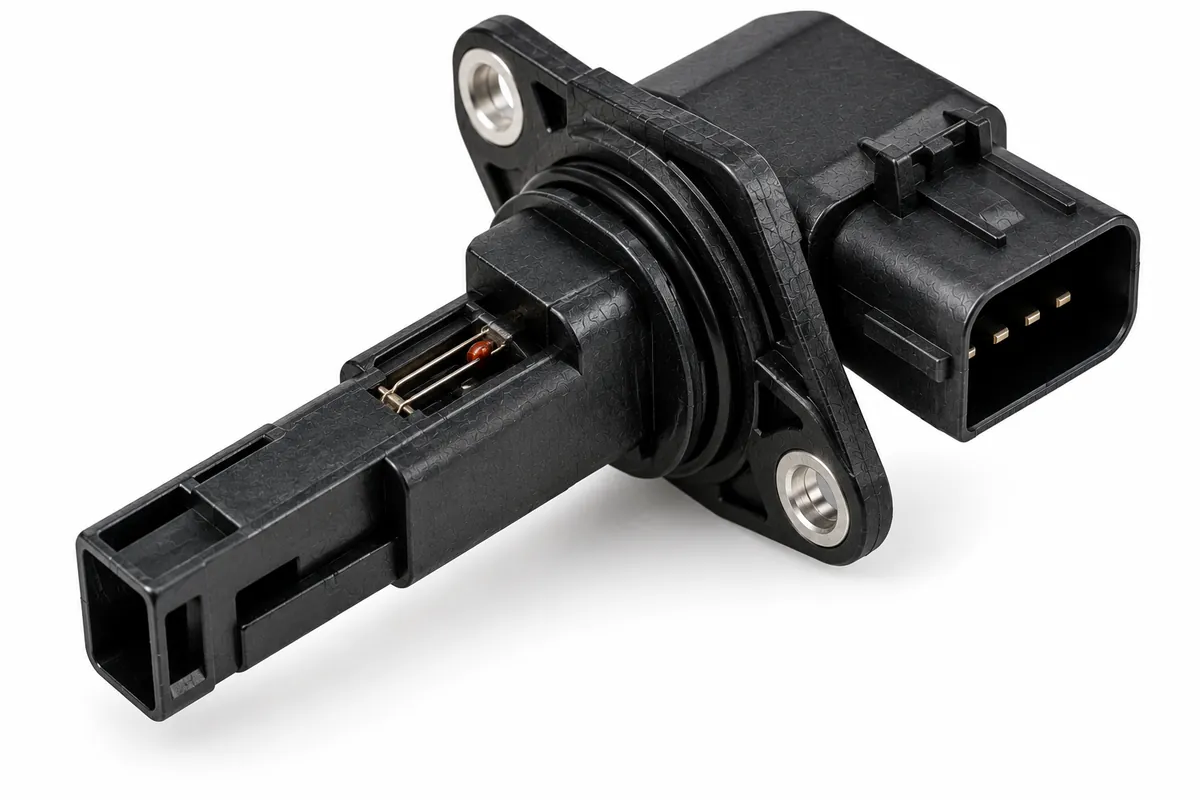
Mobile Mass Air Flow Sensor Diagnostics in Daytona Beach
A MAF-related trouble code does not automatically mean the sensor itself has failed.
Depending on the vehicle and symptoms, diagnosis can include checking:
- Mass air flow readings
- Grams per second
- Voltage output
- Frequency output where applicable
- Digital MAF data
- Sensor power supply
- Sensor ground
- Signal circuit
- Connector condition
- Wiring condition
- Intake ducting
- Air-filter housing
- Air leaks after the MAF sensor
- Engine RPM
- Calculated load
- Fuel trims
- Oxygen-sensor data
- MAP sensor data
- Throttle position
- Engine coolant temperature
- Fuel pressure where necessary
- Misfire information
- Trouble codes and freeze-frame data
The goal is to determine whether the MAF sensor is actually measuring airflow incorrectly or whether another engine problem is causing abnormal data.
What Is a Mass Air Flow Sensor?
A mass air flow sensor, commonly called a MAF sensor, measures the amount of air entering the engine.
It is usually mounted in the intake tract between the:
- Air filter
- Throttle body
The sensor reports airflow information to the engine-control module so it can calculate how much fuel should be injected.
What Does a MAF Sensor Do?
The engine needs to know how much air is entering before it can calculate the correct amount of fuel.
The MAF sensor helps the computer determine:
- Air mass
- Engine load
- Fuel quantity
- Ignition strategy
- Transmission behavior on some vehicles
The sensor does not directly control fuel injectors by itself. It supplies information that the engine computer uses with other inputs.
MAF Sensor vs. MAP Sensor
The MAF sensor and MAP sensor are different.
MAF Sensor
Measures air mass entering the engine.
MAP Sensor
Measures pressure inside the intake manifold or another pressure reference.
Some vehicles use:
- MAF only
- MAP only
- Both MAF and MAP
When both are present, the computer may compare their information for plausibility.
A MAP problem should not automatically be treated as a MAF failure.
MAF Sensor vs. Oxygen Sensor
The MAF sensor measures incoming air before combustion.
The oxygen sensor measures oxygen content in the exhaust after combustion.
MAF Sensor
Helps determine how much fuel should initially be delivered.
Oxygen Sensor
Provides feedback about whether combustion is resulting in a rich or lean exhaust condition.
A faulty MAF can influence oxygen-sensor readings, but an oxygen-sensor code does not automatically mean the MAF is bad.
MAF Sensor vs. Throttle Position Sensor
The throttle position sensor indicates throttle opening.
The MAF sensor measures actual airflow.
A throttle can be open significantly while airflow remains limited because of:
- Engine speed
- Load
- Restriction
These two sensors provide different information.
MAF Sensor vs. Intake Air Temperature Sensor
Some MAF assemblies include an intake air temperature sensor.
Other vehicles use a separate IAT sensor.
The intake air temperature sensor measures:
- Air temperature
The MAF sensor measures:
- Air mass
A combined assembly can therefore contain more than one sensing function.
How a MAF Sensor Measures Air
Different MAF designs use different technologies.
Common designs include:
- Hot-wire MAF
- Hot-film MAF
- Digital MAF
- Frequency-output MAF
The engine computer interprets the signal according to the system design.
Hot-Wire MAF Sensor
A hot-wire MAF uses a heated sensing element.
As intake air passes across the element, it removes heat.
The electronics increase current to maintain the element at the intended temperature.
That electrical demand corresponds to the mass of air passing through the sensor.
Hot-Film MAF Sensor
A hot-film MAF uses a heated film or sensing surface rather than a traditional exposed wire.
The operating principle is similar:
- More airflow removes more heat
- Sensor electronics respond
- Signal changes with air mass
Contamination can affect heat transfer and distort the reading.
Digital MAF Sensor
Some modern MAF sensors communicate airflow information digitally.
The scan tool may show a calculated airflow value rather than a simple analog voltage.
Testing procedure depends on the vehicle and sensor design.
Frequency-Output MAF Sensor
Some MAF sensors produce a frequency signal.
As airflow changes, the frequency changes.
These sensors should not be diagnosed using only the voltage expectations of an analog MAF.
The signal type must be identified first.
Mass Air Flow Sensor Units
Scan tools often display MAF readings in:
- Grams per second
- Pounds per minute
- Other calculated airflow units
Grams per second, abbreviated g/s, is very common.
The expected value depends on:
- Engine displacement
- RPM
- Load
- Volumetric efficiency
- Engine condition
There is no one correct grams-per-second value for every engine.
MAF Grams Per Second at Idle
At idle, airflow should generally be relatively low and stable.
A rough rule of thumb sometimes used for a warm naturally aspirated engine is that idle airflow in grams per second may be roughly related to engine displacement in liters, but that is only a diagnostic guideline.
Actual values vary with:
- Engine design
- Idle speed
- Accessory load
- Altitude
- Camshaft design
- Forced induction
The reading should be evaluated in context rather than condemned from one generic number.
MAF Reading With Engine Off
With the engine not running, actual intake airflow should be essentially absent.
Depending on:
- Sensor design
- Scan-tool scaling
- Filtering
- Electronic offset
the displayed value may not always show a perfectly literal zero.
An abnormal key-on reading should therefore be compared with the vehicle’s normal strategy and other data rather than judged from one universal value.
MAF Reading at Higher RPM
As engine speed and load increase, airflow should generally rise.
A sensor that:
- Stays nearly flat
- Drops out
- Responds too slowly
- Reports implausibly low airflow
may require further testing.
The expected amount depends on engine displacement, load, and whether the engine is naturally aspirated or boosted.
MAF Reading Under Load
A MAF problem may be more obvious under acceleration than at idle.
A contaminated or degraded sensor can sometimes report reasonably at low airflow but become inaccurate as flow increases.
This can contribute to:
- Hesitation
- Lack of power
- Lean fuel trims
- Misfire under load
Live data during controlled acceleration can be more informative than an idle reading alone.
Signs of a Bad Mass Air Flow Sensor
Possible symptoms include:
- Check-engine light
- Rough idle
- Hesitation
- Poor acceleration
- Lack of power
- Stalling
- Hard starting
- Rich running
- Lean running
- Poor fuel economy
- Black exhaust smoke
- Engine surging
- Misfire
- Reduced throttle response
These symptoms overlap with many other engine-management problems.
The MAF sensor should be tested before replacement.
Check-Engine Light and MAF Sensor
A faulty or implausible MAF signal can cause the engine computer to store trouble codes.
Possible MAF-related codes include:
- P0100
- P0101
- P0102
- P0103
- P0104
These codes identify a circuit, range, or performance problem.
They do not automatically prove that the sensor itself needs replacement.
P0100 MAF Circuit Malfunction
P0100 generally indicates an electrical or functional fault involving the MAF circuit.
Possible causes include:
- Sensor
- Connector
- Wiring
- Power supply
- Ground
The circuit should be tested before replacing the sensor.
P0101 MAF Range or Performance
P0101 commonly indicates that MAF data does not agree with what the engine computer expects based on other operating conditions.
Possible causes include:
- Contaminated MAF
- Air leak
- Intake restriction
- Incorrect sensor
- Wiring
- Engine mechanical condition
This is especially important because P0101 is often a plausibility problem rather than a simple open or shorted circuit.
P0102 MAF Circuit Low
A low-signal code can result from:
- Sensor failure
- Signal short to ground
- Missing power
- Wiring problem
- Connector fault
The electrical circuit should be checked.
P0103 MAF Circuit High
A high-signal code can result from:
- Signal short to voltage
- Sensor fault
- Wiring problem
- Connector issue
The sensor should not be condemned until the circuit is verified.
P0104 Intermittent MAF Circuit
An intermittent MAF code may point toward:
- Loose connector
- Broken wire
- Sensor dropout
- Vibration-sensitive connection
Intermittent wiring faults can mimic an internally failing sensor.
MAF Sensor and P0171 Lean Code
P0171 usually indicates that Bank 1 is operating too lean or the computer is adding excessive fuel to compensate.
A MAF that underreports airflow can contribute to a lean correction because the computer may command too little fuel.
However, P0171 can also be caused by:
- Vacuum leak
- Intake leak after MAF
- Low fuel pressure
- Fuel injector problem
- Exhaust leak
- Other air-metering problem
P0171 does not automatically justify MAF replacement.
MAF Sensor and P0174
P0174 indicates a lean condition on Bank 2.
If both banks show similar positive fuel trims, possible common causes include:
- MAF underreporting
- Intake leak
- Low fuel pressure
A single-bank lean condition may point more strongly toward a bank-specific problem.
Fuel-trim patterns help narrow the diagnosis.
MAF Sensor and Rich Codes
A MAF that overreports airflow can cause the computer to command more fuel than necessary.
Possible symptoms include:
- Negative fuel trims
- Rich running
- Fuel odor
- Poor economy
Rich operation can also come from:
- Excessive fuel pressure
- Leaking injector
- Purge problem
- Incorrect temperature input
The MAF is only one possibility.
MAF Sensor and Fuel Trims
Fuel trims are one of the most useful tools when evaluating MAF accuracy.
Positive Fuel Trim
The computer is adding fuel.
Possible reasons include:
- Unmetered air
- MAF underreporting
- Low fuel delivery
Negative Fuel Trim
The computer is subtracting fuel.
Possible reasons include:
- MAF overreporting
- Excessive fuel delivery
- Rich-running condition
Fuel trims should be evaluated at different:
- RPM
- Load conditions
because the pattern can help separate an intake leak from a MAF calibration problem.
Fuel Trim at Idle vs. Higher RPM
A vacuum leak often has a greater percentage effect at idle because total airflow is low.
If positive fuel trims are very high at idle but improve substantially as RPM rises, an intake or vacuum leak may be more likely.
If fuel trims remain similarly abnormal across a broad load range, MAF calibration or fuel-delivery issues may deserve greater attention.
This is a diagnostic pattern, not an absolute rule.
MAF Sensor and Vacuum Leak
A vacuum leak after the MAF sensor allows air into the engine that was not measured.
The engine computer may then deliver fuel based on less air than is actually entering.
Possible results include:
- Lean fuel trims
- Rough idle
- P0171
- P0174
The MAF may be functioning correctly while the leak makes its data appear inconsistent with exhaust feedback.
Intake Leak After MAF Sensor
Common leak points can include:
- Cracked intake boot
- Loose clamp
- Split hose
- PCV hose
- Vacuum line
- Intake-manifold gasket
Any air entering after the MAF sensor is unmetered.
These leaks should be checked before replacing a sensor for a lean condition.
Intake Leak Before MAF Sensor
A leak before the MAF may not create the same unmetered-air problem because the incoming air may still pass through the sensor.
However, it can allow:
- Dirt
- Hot engine-bay air
- Water
into the intake system.
Air-filter housing and duct integrity should still be checked.
Cracked Intake Boot
Flexible intake ducts can crack, especially in accordion-style sections.
A crack downstream of the MAF can open more as:
- Engine moves
- Throttle opens
This can produce intermittent or load-sensitive lean symptoms.
The entire duct should be inspected, including hidden underside sections.
MAF Sensor and Air Filter
A severely restricted air filter can reduce airflow and engine performance.
An incorrectly installed or damaged air filter can also allow contaminants to reach the MAF.
However, a dirty air filter does not automatically mean the MAF sensor is bad.
The intake system should be considered as a whole.
Oiled Air Filter and MAF Sensor
Some reusable air filters use oil as part of their filtration system.
Excessive oil or contamination can potentially deposit material on certain MAF sensing elements.
If the sensor is contaminated, its response may become inaccurate.
The filter should be serviced correctly to avoid over-oiling.
Dirty MAF Sensor
MAF contamination can come from:
- Dust
- Oil vapor
- Filter residue
- Dirt
- Intake deposits
A contaminated hot wire or film may not transfer heat correctly.
This can distort the airflow signal even if the electrical circuit remains intact.
Can a MAF Sensor Be Cleaned?
Sometimes.
If the problem is surface contamination rather than internal electrical failure, careful cleaning may restore normal response.
However, cleaning will not repair:
- Failed electronics
- Broken sensing element
- Internal circuit fault
- Damaged connector
Cleaning should only be performed using a product appropriate for MAF sensors.
MAF Sensor Cleaner
Dedicated MAF sensor cleaner is formulated to evaporate rapidly without leaving harmful residue.
The sensor element is delicate.
It should generally not be:
- Scrubbed
- Brushed
- Touched
- Wiped
Physical contact can damage the sensing element.
Can Brake Cleaner Be Used on a MAF Sensor?
Using brake cleaner, carburetor cleaner, or other aggressive solvents is not recommended unless the sensor manufacturer specifically approves it.
Some solvents can:
- Damage plastics
- Leave residue
- Harm sensor coatings
A cleaner specifically intended for MAF sensors is the safer choice.
Can You Touch a MAF Sensor Wire?
The sensing element can be extremely delicate.
Touching it can:
- Contaminate it
- Bend it
- Break it
Cleaning should be performed without physical contact whenever possible.
MAF Sensor Contamination From Oil Vapor
Engine ventilation systems can expose the intake tract to oil vapor.
Some oil film over time may contribute to contamination.
If heavy oil accumulation is present, the source should be investigated rather than repeatedly cleaning the sensor.
MAF Sensor Wiring
Depending on design, a MAF sensor may have circuits for:
- Power
- Ground
- Signal
- Intake air temperature
- Additional reference circuits
The exact pinout varies.
Wiring diagrams should be used rather than assuming wire function from color alone.
MAF Sensor Power Supply
The sensor must receive the correct electrical supply.
Depending on the system, this may be:
- Battery voltage
- Regulated reference voltage
If power is missing, the sensor cannot operate correctly.
Replacing the sensor will not repair an open fuse or broken supply wire.
MAF Sensor Ground
A poor sensor ground can distort the output.
Possible causes include:
- Corroded splice
- Loose ground
- High-resistance wire
- Damaged connector
Ground quality should be checked under appropriate operating conditions.
MAF Sensor Signal Wire
The signal wire carries airflow information back to the engine computer.
Problems can include:
- Open circuit
- Short to ground
- Short to voltage
- High resistance
- Intermittent connection
The signal should respond appropriately as airflow changes.
MAF Sensor Connector
The connector should be checked for:
- Corrosion
- Loose terminals
- Bent pins
- Oil intrusion
- Broken lock tab
- Heat damage
A replacement sensor can still perform poorly if terminal contact is unreliable.
MAF Sensor Wire Wiggle Test
If the fault is intermittent, carefully moving the harness while watching live data may reveal:
- Signal dropout
- Sudden airflow changes
- Engine reaction
The harness should not be pulled aggressively or damaged during testing.
MAF Sensor Voltage
Some analog MAF sensors produce a voltage that increases as airflow rises.
The actual expected range depends on the sensor.
A generic voltage value should not be applied to every vehicle.
Testing should use:
- Vehicle-specific information
- Known-good data
- Plausibility against engine operation
MAF Sensor Frequency
Some sensors represent airflow as a changing frequency rather than a simple voltage.
An oscilloscope or frequency-capable meter may be useful for evaluating the signal.
A frequency-based sensor should not be condemned because its voltage does not behave like a hot-wire analog sensor.
Oscilloscope Testing a MAF Sensor
An oscilloscope can reveal:
- Signal response
- Dropouts
- Noise
- Frequency change
- Intermittent faults
This is especially useful when the sensor passes static checks but fails during rapid throttle changes.
MAF Sensor Response Test
A good MAF sensor should respond smoothly as airflow changes.
During acceleration, the signal should generally:
- Rise promptly
- Track engine load
- Avoid unexplained dropouts
A delayed or erratic response can suggest contamination, sensor degradation, wiring trouble, or actual changes in airflow.
Snap-Throttle MAF Test
A quick throttle opening can sometimes be used to observe whether the MAF responds rapidly.
However, this should not be interpreted from one universal peak value.
Engine displacement, throttle strategy, and vehicle design all affect the result.
MAF Sensor Plausibility
One of the most important diagnostic questions is:
Does the MAF reading make sense for the engine’s operating condition?
The reading can be compared with:
- RPM
- Throttle position
- Engine displacement
- MAP
- Calculated load
- Fuel trims
- Oxygen-sensor response
A sensor can remain electrically connected while producing inaccurate information.
Calculated Engine Load and MAF
The engine computer may use MAF data to calculate engine load.
An inaccurate MAF can therefore affect:
- Fueling
- Transmission shift strategy
- Throttle response
An implausibly low or high calculated load can be one clue in MAF diagnosis.
MAF Sensor and Throttle Body
A dirty or malfunctioning throttle body can affect actual airflow.
Possible symptoms include:
- Poor idle
- Hesitation
- Reduced airflow
The MAF may correctly report the lower or irregular airflow.
A MAF reading should not be called faulty merely because engine performance is poor.
MAF Sensor and Electronic Throttle Control
Modern electronic throttle systems coordinate:
- Accelerator pedal input
- Throttle angle
- Airflow
- Engine load
When these values disagree significantly, the engine computer may store plausibility faults.
The actual cause could be in:
- MAF
- Throttle body
- Accelerator pedal sensor
- Intake system
Data should be compared rather than replacing components by code alone.
MAF Sensor and MAP Sensor Correlation
When a vehicle uses both MAF and MAP sensors, their data can be compared against:
- RPM
- Throttle opening
- Engine load
If one sensor reports information inconsistent with the others, further testing can help identify the inaccurate input.
Neither sensor should be assumed faulty without establishing which reading is implausible.
MAF Sensor and Oxygen-Sensor Data
Oxygen sensors provide feedback after combustion.
If the MAF consistently underestimates airflow, the oxygen sensors may report lean exhaust and the computer may increase fuel trims.
If the MAF consistently overestimates airflow, the oxygen sensors may indicate rich operation and the computer may subtract fuel.
This relationship is useful diagnostically.
MAF Sensor and Coolant Temperature
A false engine coolant temperature reading can alter commanded fueling.
For example, if the computer believes the engine is much colder than it actually is, it may command additional fuel.
That can produce rich operation even when the MAF is functioning correctly.
MAF Sensor and Fuel Pressure
Low fuel pressure can cause a lean condition even if measured airflow is accurate.
High or excessive fuel pressure can cause rich operation.
Fuel delivery should be considered before blaming MAF data for every fuel-trim problem.
MAF Sensor and Fuel Injectors
Restricted injectors can create lean cylinders.
Leaking injectors can create rich cylinders.
A MAF sensor measures total incoming air and cannot identify an individual injector problem.
Cylinder-specific symptoms should be diagnosed accordingly.
MAF Sensor and Misfire
A severely inaccurate MAF can contribute to a mixture condition that causes misfire.
However, misfires are also commonly caused by:
- Spark plugs
- Ignition coils
- Injectors
- Compression problems
- Vacuum leaks
A P030x code does not prove a MAF failure.
MAF Sensor and Rough Idle
A bad or contaminated MAF can contribute to rough idle if the airflow signal causes incorrect fueling.
But rough idle can also come from:
- Vacuum leak
- Dirty throttle body
- Misfire
- Engine mount
- Fuel problem
- Compression fault
Live data and fuel trims help separate these possibilities.
MAF Sensor and Stalling
Incorrect airflow information can sometimes contribute to:
- Stall when coming to stop
- Stall after starting
- Unstable idle
However, stalling can have many causes, including:
- Throttle body
- Crankshaft sensor
- Fuel pressure
- Charging voltage
The sensor should be verified before replacement.
MAF Sensor and Hesitation
Hesitation during acceleration can occur if the MAF signal does not increase accurately with incoming air.
The engine may temporarily receive an incorrect fuel command.
Other causes include:
- Ignition problem
- Fuel-pressure problem
- Throttle fault
- Transmission issue
The symptom should be tested under the conditions where it occurs.
MAF Sensor and Lack of Power
A severely underreporting or implausible MAF signal may reduce performance.
Some vehicles may enter a fallback or reduced-power strategy.
However, lack of power can also result from:
- Restricted exhaust
- Low fuel pressure
- Turbocharger problem
- Throttle restriction
- Engine mechanical problem
MAF data should be compared with other evidence.
MAF Sensor and Poor Fuel Economy
A MAF that overreports airflow can contribute to excessive fuel delivery.
A contaminated sensor can also cause correction through fuel trims.
Poor economy alone is not enough to identify the MAF because many other conditions affect fuel consumption.
MAF Sensor and Black Smoke
Very rich operation can produce black exhaust smoke.
A severely inaccurate airflow signal is one possible cause.
Other possibilities include:
- Leaking injector
- Excessive fuel pressure
- Incorrect temperature input
The actual rich condition should be diagnosed.
MAF Sensor and Hard Starting
A substantially incorrect MAF signal can sometimes affect starting quality, but many vehicles use additional start-up strategies.
Hard starting can also result from:
- Weak battery
- Fuel-pressure loss
- Crankshaft sensor
- Injector leakage
- Engine temperature input
The MAF should not be replaced solely because the engine is difficult to start.
Can a Bad MAF Cause a No-Start?
On many vehicles, a failed MAF does not cause a complete no-start because the engine computer can use substitute or fallback strategies.
A severe electrical fault or vehicle-specific control strategy may produce different behavior.
A crank-no-start should therefore not be assumed to be a MAF problem.
Unplugging the MAF Sensor
One common diagnostic observation is that an engine may run differently when the MAF is unplugged.
The engine computer may substitute estimated airflow values based on other sensors.
If the engine runs better with the MAF disconnected, that can increase suspicion of:
- Incorrect MAF data
- Wiring problem
but it does not conclusively prove the sensor itself is bad.
The substituted strategy may simply mask another problem such as an intake leak.
Car Runs Better With MAF Unplugged
Possible explanations include:
- MAF signal is inaccurate
- Sensor contamination
- Wiring fault
- Intake leak causing fuel-calculation problems
- Computer entering a more favorable fallback strategy
Further testing is still appropriate before replacement.
Car Will Not Run With MAF Connected
If the engine runs with the MAF disconnected but stalls with it connected, the sensor signal may be implausible.
However, check:
- Connector wiring
- Intake ducting
- Other related sensor data
before concluding the sensor is internally defective.
Car Runs Worse With MAF Unplugged
That can be normal.
The engine computer may lose its primary airflow measurement and operate using estimated values.
A change in running quality simply proves that the computer noticed the missing MAF input.
MAF Sensor Cleaning vs. Replacement
Cleaning may be appropriate when:
- Sensor is visibly contaminated
- Electrical circuit is intact
- Signal is plausible but sluggish
Replacement is more appropriate when:
- Internal sensor electronics fail
- Signal drops out
- Sensor remains inaccurate after proper cleaning
- Sensing element is damaged
Diagnosis should determine which condition is present.
When MAF Cleaning Does Not Work
If cleaning does not restore correct operation, possible reasons include:
- Internal electronic failure
- Damaged hot wire/film
- Wiring fault
- Intake leak
- Incorrect diagnosis
Repeatedly spraying the sensor is not a substitute for testing.
MAF Sensor Replacement
Once diagnostics confirm that the sensor itself is faulty, replacement commonly involves:
- Verify the complaint and trouble codes.
- Review freeze-frame and live data.
- Inspect intake ducting for leaks.
- Check the air-filter housing and filter installation.
- Verify sensor power and ground where appropriate.
- Check connector and wiring condition.
- Confirm the MAF signal is inaccurate or defective.
- Turn the ignition off.
- Locate the MAF sensor in the intake tract.
- Disconnect the electrical connector carefully.
- Remove retaining screws, clamps, or housing fasteners.
- Remove the old sensor or complete sensor housing.
- Inspect the intake opening for debris.
- Compare the replacement sensor with the original.
- Verify airflow direction and orientation.
- Install the new sensor without touching the sensing element.
- Install the seal or gasket correctly if used.
- Tighten retaining hardware appropriately.
- Reconnect the electrical connector.
- Inspect the intake duct and clamps again.
- Start the engine.
- Monitor MAF data.
- Check fuel trims.
- Verify idle quality.
- Road-test when appropriate.
- Confirm the original fault does not return.
The exact procedure varies by vehicle and sensor design.
MAF Sensor Direction
Many MAF sensors are designed to measure airflow in one direction.
The housing may include:
- Arrow
- Flow mark
- Specific mounting orientation
Installing the sensor backward can produce incorrect readings.
MAF Sensor Housing
Some vehicles use a replaceable sensing element.
Others require replacement of the complete:
- Sensor housing
- Air-meter assembly
The correct service part should match the vehicle design.
MAF Sensor Seal or O-Ring
Some MAF assemblies use a seal between the sensor and intake housing.
A damaged or missing seal can allow:
- Air leakage
- Dirt intrusion
The sealing surface should be checked during replacement.
MAF Sensor Screws
Certain sensors use specialized fasteners such as:
- Torx
- Security Torx
The correct tool should be used to prevent fastener damage.
OEM vs. Aftermarket MAF Sensors
MAF calibration is critical.
A sensor can physically fit and plug in while producing slightly different airflow data.
For this reason, replacement quality matters.
Options may include:
- Original equipment
- OEM supplier
- Quality aftermarket
- Economy aftermarket
A poor-quality or incorrectly calibrated MAF can create:
- Fuel-trim problems
- P0101
- Driveability issues
even when the sensor appears new.
Bosch MAF Sensor
Bosch supplies MAF sensors for many vehicles.
If Bosch is the original or correct application supplier, a Bosch replacement may be appropriate.
The important factor is exact vehicle compatibility rather than brand name alone.
Denso MAF Sensor
Denso supplies airflow sensors for many applications as well.
As with any replacement, the correct:
- Calibration
- Connector
- Housing
- Part number
must match the vehicle.
Delphi MAF Sensor
Delphi also manufactures MAF sensors for various vehicles.
A replacement should be selected by correct application and specification rather than assuming every sensor from one manufacturer is interchangeable.
Cheap MAF Sensor Problems
An inexpensive sensor that is poorly calibrated can create problems such as:
- Lean trims
- Rich trims
- P0101
- Hesitation
- Unstable idle
If symptoms begin immediately after MAF replacement, replacement-part accuracy should be considered.
Used MAF Sensor
A used sensor may work, but its:
- Contamination level
- Mileage
- Calibration history
- Previous failure exposure
are unknown.
A quality new sensor is generally a more predictable repair.
MAF Sensor Relearn
Some vehicles may adapt fuel and airflow calculations over time.
After replacement, the vehicle may:
- Relearn idle
- Recalculate fuel trims
Certain manufacturers may specify an adaptation reset or relearn procedure.
Not every vehicle requires a special relearn.
Clearing MAF Codes After Replacement
Stored codes can be cleared after the repair when appropriate.
More importantly, the vehicle should be monitored to ensure:
- MAF data is plausible
- Fuel trims improve
- Codes do not return
Clearing a code without verifying the repair proves nothing.
New MAF Sensor but P0101 Returns
If P0101 returns after replacement, possible causes include:
- Intake leak
- Incorrect replacement sensor
- Wiring problem
- Air-filter or intake restriction
- MAP correlation problem
- Engine mechanical issue
Another MAF should not automatically be installed.
New MAF Sensor but Lean Codes Remain
If P0171 or P0174 remain, possible causes include:
- Vacuum leak
- Intake duct leak
- Low fuel pressure
- Injector restriction
- Exhaust leak
The sensor may have been correctly replaced while another lean condition remains.
New MAF Sensor but Engine Still Runs Rough
Possible causes include:
- Misfire
- Ignition-coil problem
- Spark plug
- Injector problem
- Vacuum leak
- Compression issue
A MAF replacement cannot correct unrelated cylinder-specific faults.
New MAF Sensor Reads Wrong
Possible causes include:
- Wrong part
- Poor aftermarket calibration
- Sensor installed backward
- Intake leak
- Wiring issue
- Incorrect scan-data interpretation
The installation and actual operating data should be rechecked.
MAF Sensor Replacement and Battery Disconnect
Battery disconnection is not always required solely to replace a MAF sensor.
The vehicle-specific service procedure should be followed.
Unnecessary battery disconnection can sometimes erase:
- Learned settings
- Clock
- Window initialization
- Other memory functions
MAF Sensor Replacement Cost
Mass air flow sensor replacement cost depends on:
- Vehicle year, make, and model
- Sensor design
- Sensor-only vs. complete housing
- Part quality
- Intake access
- Diagnostic time
- Wiring or connector repair
A straightforward sensor replacement is very different from diagnosing an intermittent wiring or air-leak problem.
Call Jimmy’s Mobile Care at (386) 308-2509 with your vehicle information and symptoms so we can determine the appropriate diagnostic service.
Why Diagnose a MAF Sensor Before Replacing It?
MAF symptoms overlap with many other engine faults.
Does the Sensor Have Proper Power and Ground?
A new MAF cannot correct a wiring supply problem.
Does the Signal Change With Airflow?
A stuck or erratic reading requires further investigation.
Does the Reading Make Sense for RPM and Load?
Plausibility is more important than blindly comparing one generic number.
Are Fuel Trims Lean at Idle but Better at Higher RPM?
That pattern may point toward an intake or vacuum leak.
Is Air Entering After the MAF?
Unmetered air can make a good MAF appear inaccurate.
Is Fuel Pressure Correct?
Low fuel supply can create a lean condition even when airflow measurement is accurate.
Are There Misfires?
A cylinder-specific ignition or injector fault should not be blamed on the MAF.
Does MAP Data Agree With Engine Load?
Correlation between sensors can help identify an implausible reading.
Does Cleaning Change the Reading?
Improvement after proper cleaning can indicate contamination.
Is the Replacement Sensor Correctly Calibrated?
A poor-quality sensor can create the same symptoms as the original problem.
Testing these areas helps prevent unnecessary MAF replacement.
Mobile MAF Sensor Diagnostics in Daytona Beach
Jimmy’s Mobile Care provides mobile mass air flow sensor diagnostics in Daytona Beach for vehicles experiencing:
- P0100
- P0101
- P0102
- P0103
- P0104
- P0171
- P0174
- Rough idle
- Hesitation
- Lack of power
- Stalling
- Poor fuel economy
- Lean or rich fuel trims
- MAF signal problems
- Suspected MAF contamination
We inspect MAF data, intake integrity, electrical circuits, and related engine information to determine whether the sensor itself is actually faulty.
Mobile Mass Air Flow Sensor Replacement in Daytona Beach
When diagnostics confirm that the MAF sensor itself has failed and replacement is appropriate, Jimmy’s Mobile Care can replace many mass air flow sensors at your Daytona Beach location.
After replacement, we can verify:
- Correct sensor installation
- Proper airflow direction
- Connector condition
- Plausible MAF readings
- Improved fuel trims where applicable
- Normal idle and throttle response
- No immediate return of the original MAF fault
If the real problem involves intake leaks, fuel pressure, wiring, engine mechanical condition, or another sensor, those issues must be addressed rather than replacing the MAF unnecessarily.
Schedule Car Mass Air Flow Sensor Diagnostics & Replacement in Daytona Beach
A check-engine light, lean code, rough idle, hesitation, or lack of power does not automatically mean the mass air flow sensor is bad.
The same symptoms can result from an intake leak, vacuum leak, low fuel pressure, throttle-body problem, MAP sensor, oxygen-sensor feedback, ignition problem, injector fault, wiring problem, or engine mechanical condition.
Jimmy’s Mobile Care evaluates the MAF sensor in relation to actual engine airflow, fuel trims, electrical integrity, and related sensor data before replacement so the part is replaced only when the diagnosis supports it.
Call Jimmy’s Mobile Care at (386) 308-2509 to schedule car mass air flow sensor diagnostics and replacement in Daytona Beach, FL. Call today and we'll come to your location.