
Car AC Recharge in Daytona Beach, FL
If your car AC is blowing warm or no longer cooling as well as it used to, the refrigerant charge may be low. But automotive AC refrigerant does not normally get “used up” like gasoline or engine oil. When a system has lost a meaningful amount of refrigerant, there is usually a reason.
Jimmy’s Mobile Care provides car AC recharge in Daytona Beach, FL, including evaluation of AC pressures and cooling performance, refrigerant recovery and evacuation when required, and charging the system with the correct type and specified amount of refrigerant.
Rather than simply adding refrigerant until the vents feel colder, we evaluate the system so the final charge is appropriate for the vehicle.
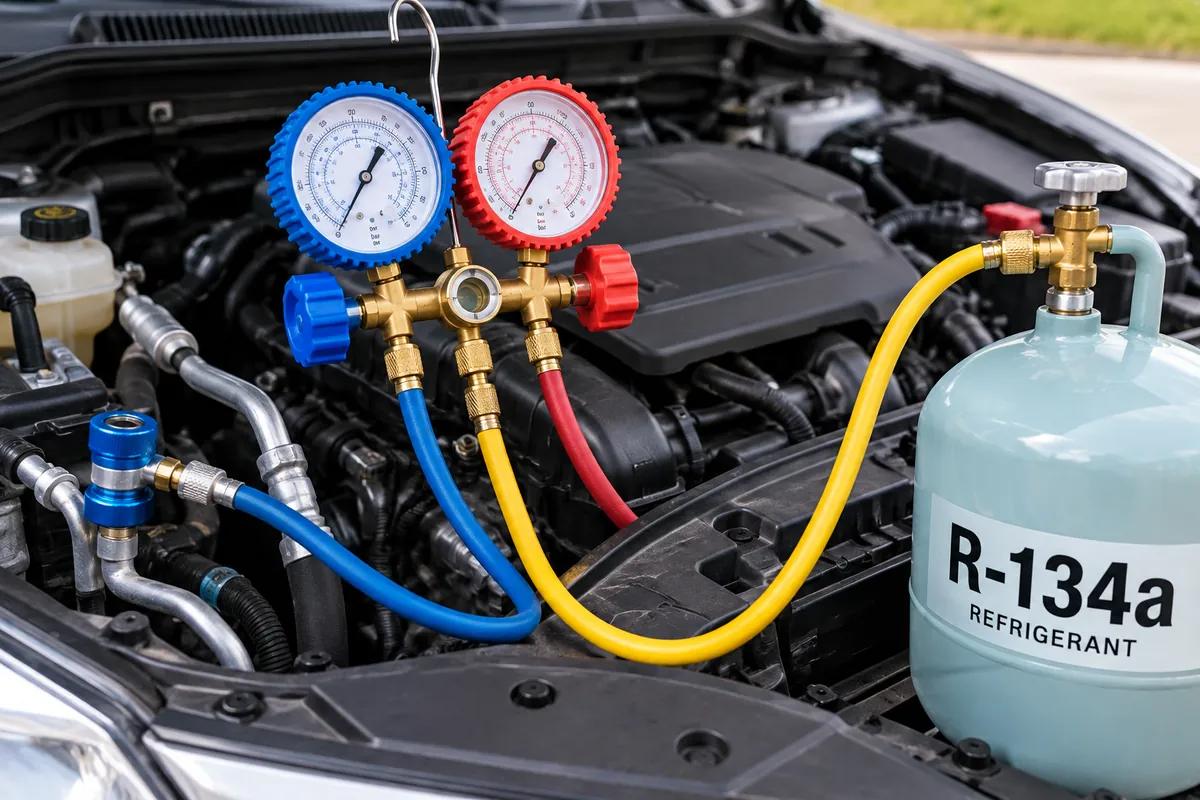
Mobile Car AC Recharge in Daytona Beach
A proper automotive AC recharge involves more than connecting a can of refrigerant to a service port.
Depending on the condition of the system, service can include:
- Checking AC cooling performance
- Identifying the refrigerant type
- Reading high-side and low-side pressures
- Evaluating compressor operation
- Checking vent temperature
- Looking for evidence of refrigerant loss
- Recovering existing refrigerant when required
- Measuring the amount recovered
- Evacuating air and moisture from the system
- Checking whether the system maintains vacuum
- Charging refrigerant by specified quantity
- Rechecking system pressures
- Confirming cooling performance after charging
The goal is to restore the correct refrigerant charge without using additional refrigerant to hide an underlying AC problem.
What Is a Car AC Recharge?
An AC recharge restores the refrigerant in an automotive air-conditioning system to the proper amount.
The refrigerant continuously circulates through components including the:
- AC compressor
- Condenser
- Expansion valve or orifice tube
- Evaporator
- Refrigerant hoses and lines
It moves heat from inside the passenger compartment to the outside of the vehicle.
The quantity of refrigerant in that closed circuit is critical.
If the charge becomes too low—or too high—the AC system may not operate correctly.
Does Car AC Refrigerant Run Out?
Not under normal operation.
An automotive AC system is intended to be sealed.
The refrigerant circulates through the system repeatedly rather than being consumed during operation.
If enough refrigerant has disappeared to noticeably affect cooling, possible causes include leakage from:
- AC condenser
- Evaporator
- Compressor
- Refrigerant hose
- Refrigerant line
- O-ring
- Service-port valve
- Component connection
- Shaft seal
- Other refrigerant seal
This is why a vehicle that repeatedly needs refrigerant should be checked for leakage rather than simply recharged over and over.
Signs Your Car AC May Need a Recharge
Possible symptoms of a low refrigerant charge include:
- AC blowing warmer than normal
- Cooling that has gradually become weaker
- AC cools somewhat but not enough
- Compressor cycling differently than normal
- Compressor not being allowed to operate because pressure is too low
- Low refrigerant pressure
- Cooling performance changing with engine speed or operating conditions
These symptoms do not prove the refrigerant is low.
Compressor, condenser, expansion valve, evaporator, electrical, or HVAC airflow problems can produce similar complaints.
The pressures and system operation need to be evaluated.
AC Recharge vs. AC Repair
An AC recharge restores the correct refrigerant quantity.
An AC repair corrects the reason the system is not functioning properly.
Sometimes a recharge is all that is required as part of a properly serviced system.
Other times, the recharge is only one step following a repair such as:
- Condenser replacement
- Compressor replacement
- Evaporator replacement
- AC hose replacement
- Expansion valve replacement
- Orifice tube replacement
- Refrigerant leak repair
If a component has failed or refrigerant is escaping, adding refrigerant alone does not repair that failure.
Checking AC Pressures Before Recharging
Refrigerant pressure provides useful information about the operating condition of the AC system.
Automotive AC systems have both:
- High-pressure side
- Low-pressure side
When the system is operating, the compressor creates a pressure difference between them.
Pressure readings can help identify:
- Low refrigerant conditions
- Abnormally high pressure
- Compressor performance issues
- Refrigerant restrictions
- Condenser airflow problems
- Other abnormal operating conditions
Gauge readings need to be interpreted with ambient temperature, compressor operation, and system design.
Pressure alone does not tell us exactly how much refrigerant is inside the system.
Static AC Pressure
When the AC system has been off long enough for pressures to equalize, the high and low sides should generally move toward the same static pressure.
Static pressure can help indicate whether refrigerant is present, but it does not tell us whether the system contains the correct refrigerant charge.
A system can show pressure while still being significantly undercharged.
This is one reason an accurate recharge cannot be based on a single gauge reading.
Low-Side and High-Side AC Pressure
Once the compressor is operating, high-side and low-side pressures provide a much clearer picture of system behavior.
The low side reflects conditions returning toward the compressor from the evaporator.
The high side reflects refrigerant that has been compressed and is moving through the condenser side of the system.
Unusual pressure relationships may indicate more than low refrigerant.
For example, abnormal readings can result from:
- Weak compressor
- Restricted expansion device
- Poor condenser airflow
- Excessive refrigerant
- Low refrigerant
- Internal system restriction
That is why we evaluate pressures before assuming the system simply needs more refrigerant.
Measuring Refrigerant Charge
The most reliable way to establish the correct refrigerant charge after evacuation is to charge the AC system with the specified refrigerant quantity.
Vehicle manufacturers specify how much refrigerant the system is designed to contain.
That information is commonly listed on an under-hood label or in service information.
Depending on the vehicle, the specified charge may be given in:
- Ounces
- Pounds
- Grams
- Kilograms
The final refrigerant amount should follow the vehicle specification rather than being estimated only from gauge pressure.
Why We Don't Charge an AC System Until the Gauge “Looks Right”
AC pressures change with:
- Outside temperature
- Engine speed
- Cooling fan operation
- Cabin heat load
- Blower speed
- Refrigerant type
- Compressor design
That means the same refrigerant quantity can produce different pressure readings under different conditions.
Using pressure alone to decide when to stop adding refrigerant can result in an undercharged or overcharged system.
When the system has been properly evacuated, refrigerant quantity is best established by weight according to the vehicle specification.
R-134a AC Recharge
R-134a has been widely used in automotive AC systems for many years.
Vehicles designed for R-134a have specific:
- Refrigerant charge quantities
- Service fittings
- Oils
- Components
- Service requirements
The correct quantity varies from one vehicle to another.
Two cars using R-134a do not necessarily take the same amount of refrigerant.
The vehicle specification determines the correct charge.
R-1234yf AC Recharge
Many newer vehicles use R-1234yf refrigerant.
R-1234yf systems require equipment and service procedures appropriate for that refrigerant.
R-1234yf should not simply be treated as though it were R-134a.
The system's refrigerant label and specifications need to be identified before service begins.
Jimmy’s Mobile Care determines which refrigerant the vehicle was designed to use before charging the system.
R-134a vs. R-1234yf
R-134a and R-1234yf are different refrigerants.
A vehicle's AC system is engineered around a particular refrigerant and corresponding service requirements.
They should not be casually mixed or substituted.
Before performing an AC recharge, we identify what the vehicle requires.
This protects:
- AC performance
- Compressor lubrication
- Service equipment
- Future AC repairs
- Correct system operation
Older R-12 AC Systems
Some older vehicles were originally equipped with R-12 refrigerant.
These systems require different considerations from modern R-134a or R-1234yf vehicles.
An older vehicle may:
- Still have an original refrigerant configuration
- Have previously been converted
- Contain replacement fittings or components
- Require specialized service considerations
The refrigerant currently in the system and the way the vehicle has been configured need to be identified before service.
An older AC system should not automatically be charged as though it were a modern R-134a system.
Why Refrigerant Type Matters
Using the wrong refrigerant can create serious problems.
Refrigerant type affects:
- System pressures
- Compressor operation
- Lubricant compatibility
- Service equipment
- Component design
- Charging procedures
The correct refrigerant is therefore determined by the vehicle—not by whichever can happens to be available.
AC Refrigerant Recovery
If the system contains refrigerant and needs to be opened, corrected, or accurately recharged, the existing refrigerant may need to be recovered with appropriate equipment.
Recovery removes refrigerant from the system so it can be serviced without intentionally releasing it into the atmosphere.
It also allows the amount removed to be considered when diagnosing charge-related problems.
For example, recovering substantially less refrigerant than the specified charge can support evidence that the system was undercharged.
AC Evacuation
After a refrigerant system has been opened or emptied, it needs to be evacuated before charging.
Evacuation places the system under vacuum.
This serves several purposes.
It helps remove:
- Air
- Moisture
- Non-condensable gases
Those materials do not belong inside the refrigerant circuit.
Why Air Inside an AC System Is a Problem
Air does not behave like the refrigerant the system was designed to circulate.
Air trapped inside the system can contribute to:
- Abnormal pressures
- Reduced cooling
- Increased compressor workload
- Inaccurate diagnostic readings
A system that has been opened should therefore not simply be filled with refrigerant without first removing the air.
Why Moisture Must Be Removed
Moisture inside an AC system can be especially problematic.
It can:
- Interfere with refrigerant operation
- React with refrigerant oil
- Contribute to corrosion
- Freeze at an expansion valve or orifice tube
- Create intermittent refrigerant restrictions
Vacuum evacuation helps boil moisture out of the system at reduced pressure.
This is why evacuation is an important part of a proper AC recharge after the refrigerant circuit has been opened.
AC Evacuation and Recharge
An evacuate and recharge service typically means the system is:
- Recovered as required.
- Placed under vacuum.
- Evaluated for its ability to maintain vacuum.
- Charged with the correct refrigerant type.
- Filled with the specified refrigerant quantity.
- Operated and tested afterward.
This is substantially different from simply adding refrigerant through the low-side service port.
Vacuum Hold Check
After the AC system has been evacuated, observing whether it maintains vacuum can help identify certain significant leaks.
If vacuum is lost rapidly, the system should not simply be charged as though nothing is wrong.
However, a vacuum hold test is not capable of proving that every AC system is completely leak-free.
Some very small leaks or pressure-dependent leaks may require other diagnostic methods.
It is one useful step in evaluating system integrity.
AC Recharge After a Refrigerant Leak Repair
When an AC leak has been repaired, the system generally requires evacuation and recharge before normal operation can be evaluated.
The sequence can include:
- Completing the leak repair
- Replacing applicable seals
- Evacuating the system
- Checking system integrity
- Charging the specified refrigerant amount
- Operating the AC
- Rechecking cooling performance
- Inspecting the repaired area as appropriate
The recharge restores the refrigerant that was removed or lost, but the repair itself addresses the source of the leak.
Why Repeated AC Recharging Is a Warning Sign
If an AC system cools after a recharge and then becomes warm again, refrigerant is likely being lost or another unresolved problem exists.
Repeatedly adding refrigerant creates a cycle:
- Refrigerant becomes low.
- AC performance decreases.
- Refrigerant is added.
- AC cools again.
- Refrigerant escapes.
- The problem returns.
At that point, the next step should generally involve locating the cause rather than continuing to top off the system.
Can a Small Refrigerant Leak Cause the AC to Work for Months?
Yes.
Leak rates vary considerably.
A very small leak may take a long time to lower the charge enough for the driver to notice.
A larger leak may cause cooling to disappear much more quickly.
The time between recharges can provide useful information, but it does not identify the leak location by itself.
Leaks can occur throughout the refrigerant circuit.
AC Recharge and Refrigerant Leak Detection
When refrigerant loss is suspected, leak diagnosis may involve methods such as:
- Visual inspection
- Oil-residue inspection
- UV dye
- Electronic refrigerant leak detection
- Inspection of service ports and fittings
- Pressure-related testing where appropriate
Possible leak areas include:
- Compressor
- Condenser
- Evaporator
- AC hoses
- Refrigerant lines
- O-rings
- Service valves
The separate AC Refrigerant Leaks service page covers leak diagnosis in greater depth.
Why a Recharge May Not Make the AC Cold
If the refrigerant charge is correct but the AC still isn't cold, adding more refrigerant is unlikely to help.
Other possible causes include:
- Compressor not pumping correctly
- Compressor control problem
- Failed condenser fan
- Restricted condenser
- Expansion valve problem
- Restricted orifice tube
- Evaporator problem
- Blower airflow problem
- Blend-door problem
- Temperature-control fault
The refrigerant quantity is only one part of the AC system.
Correct charge does not compensate for a failed component.
Overcharged Car AC System
Too much refrigerant can be just as problematic as too little.
An overcharged system can produce:
- Excessive high-side pressure
- Reduced cooling
- Increased compressor load
- Compressor cycling or shutdown
- Abnormal system operation
Adding extra refrigerant does not make the AC colder.
Automotive systems are designed to operate with a specific refrigerant quantity.
Why “More Freon” Does Not Mean Colder AC
The goal is not to fill the AC system with as much refrigerant as possible.
The goal is the correct charge.
Refrigerant quantity affects:
- Evaporator performance
- Condenser performance
- Compressor operation
- System pressures
Once the designed charge is exceeded, performance can worsen rather than improve.
Undercharged Car AC System
Too little refrigerant can also cause problems.
Possible effects include:
- Poor cooling
- Low suction pressure
- Compressor protection shutdown
- Inadequate oil circulation
- Evaporator not being properly fed
If the system is undercharged, we also need to consider why the refrigerant became low.
AC Refrigerant and Compressor Lubrication
Refrigerant oil circulates with refrigerant through much of the AC system.
This oil helps lubricate the compressor.
Operating a system with a severely low refrigerant charge can affect oil circulation and potentially increase compressor wear.
That is another reason a significantly leaking AC system should not simply be ignored until cooling disappears completely.
Does an AC Recharge Include Compressor Oil?
Not automatically.
Refrigerant and compressor oil perform different jobs.
The system requires a specific oil type and appropriate oil quantity.
Oil may need to be considered when:
- A component has been replaced
- A significant amount of oil escaped with refrigerant
- The system has been flushed
- Compressor replacement has occurred
- Another major AC repair has been performed
Adding oil unnecessarily can also create problems.
Oil should not simply be added during every recharge without considering what the system actually requires.
AC Recharge After Compressor Replacement
A compressor replacement normally requires more than simply adding refrigerant.
Depending on the repair, service can include:
- Correct compressor oil preparation
- Contamination evaluation
- Replacement of related components where required
- System evacuation
- Leak checking
- Specified refrigerant charge
- Pressure and temperature verification
The recharge is the final part of restoring the sealed refrigeration circuit after the mechanical repair has been completed.
AC Recharge After Condenser Replacement
Replacing a condenser opens the refrigerant circuit.
After installation, the system normally needs:
- Correct seals
- Evacuation
- Integrity checking
- Specified refrigerant charge
- Pressure and cooling verification
The same principle applies to other repairs that open the AC system.
AC Recharge After Evaporator Replacement
Evaporator replacement also requires the refrigerant circuit to be opened.
After the new evaporator and seals are installed, the system needs proper evacuation and charging before cooling performance can be assessed.
Because evaporator replacement can involve extensive labor, leak-free refrigerant connections are especially important before the vehicle is fully returned to service.
AC Recharge After Expansion Valve or Orifice Tube Replacement
The metering device is part of the sealed refrigerant circuit.
Whether the vehicle uses an expansion valve or orifice tube, opening the system for replacement requires restoring proper refrigerant conditions afterward.
That includes:
- Evacuation
- Correct refrigerant charge
- Pressure testing
- Cooling-performance evaluation
Correct charge is especially important when evaluating whether the new metering device is functioning normally.
Car AC Service Ports
Automotive AC systems have service connections used for pressure measurement and refrigerant service.
Typically there are:
- Low-side service port
- High-side service port
They are located on different pressure sections of the refrigerant circuit.
Service-port valve cores and seals can themselves develop leaks.
If leakage is found at a service port, repeatedly installing another cap or adding refrigerant does not necessarily correct the underlying valve problem.
Low-Side Service Port
The low-side service port is located on the lower-pressure section of the AC circuit.
It is commonly used during refrigerant service and pressure diagnosis.
Its exact location varies by vehicle.
The port should be positively identified rather than selected merely because it is easier to reach.
High-Side Service Port
The high-side service port allows measurement of pressure on the compressed refrigerant side of the system.
Looking at both sides provides significantly more diagnostic information than reading only the low-side pressure.
A low-side-only gauge cannot show the complete pressure relationship across the AC system.
Why We Check Both Sides of the AC System
Two different AC problems can produce similar low-side readings but dramatically different high-side behavior.
Looking at both pressures helps evaluate:
- Compressor performance
- Condenser heat rejection
- Metering-device behavior
- Refrigerant charge
- Possible restrictions
This helps separate a simple charge problem from a mechanical or airflow problem.
Vent Temperature After an AC Recharge
After charging, vent temperature can help verify actual cooling performance.
The final temperature depends on conditions such as:
- Outside temperature
- Humidity
- Blower speed
- Recirculation setting
- Engine speed
- Vehicle interior temperature
In Daytona Beach, high ambient heat and humidity can put a substantial load on the AC system.
Vent temperature should therefore be evaluated alongside system pressures and operating conditions rather than against one universal number.
AC Recharge in Hot Daytona Beach Weather
Automotive AC works hardest during Florida heat.
When a vehicle has been sitting in the sun, the AC system must remove heat from:
- Cabin air
- Seats
- Dashboard
- Glass
- Interior panels
High outside temperature also affects refrigerant pressures.
This makes proper system charge, condenser airflow, and compressor performance particularly important.
A marginally functioning AC system may become much more noticeable during the hottest Daytona Beach weather.
How Long Does an AC Recharge Last?
A correctly repaired and sealed AC system should not require routine refrigerant additions on a fixed schedule simply because time has passed.
How long a recharge lasts depends largely on whether the system is retaining its refrigerant.
If the charge becomes low again, there is likely an unresolved leak or other service issue that should be investigated.
Does My Car Need an AC Recharge Every Year?
Normally, refrigerant should not need to be added every year simply as routine maintenance.
If enough refrigerant disappears annually to affect cooling, the system may have a leak.
The appropriate response is to determine why the charge is dropping.
Routine annual topping-off can mask a problem without repairing it.
Can You Recharge an AC System With a Leak?
Adding refrigerant to a leaking system may temporarily restore cooling, but it does not repair the leak.
How quickly the system loses cooling again depends on the severity of the leak.
If leakage is known or suspected, identifying and repairing the source provides a more complete solution than repeatedly recharging the system.
Why DIY Recharge Cans Can Make Diagnosis Harder
A recharge can that adds an unknown amount of refrigerant makes it difficult to know the actual system charge afterward.
Some consumer products may also contain additives or leak-sealing compounds.
Problems can arise from:
- Overcharging
- Incorrect refrigerant
- Unknown refrigerant quantity
- Misreading a low-side-only gauge
- Adding refrigerant to a system with another fault
- Introducing products that complicate future service
An AC system should be charged according to its requirements, not simply until a gauge enters a colored area.
Refrigerant With Stop-Leak Additives
Some recharge products include sealants intended to slow refrigerant leakage.
These products are not the same as repairing the component that is leaking.
Sealants can also create service complications depending on the product and system.
Jimmy’s Mobile Care focuses on diagnosing the refrigerant loss and repairing the actual failed component rather than using sealant as a substitute for mechanical repair.
How Much Does a Car AC Recharge Cost?
Car AC recharge cost varies based on the vehicle and the service required.
Factors can include:
- Refrigerant type
- Refrigerant quantity
- R-134a vs. R-1234yf system
- Amount of refrigerant remaining
- Whether recovery is required
- Whether evacuation is required
- Leak diagnosis
- System condition
- Additional AC problems
- Previous refrigerant contamination or improper charging
A straightforward recharge is different from an AC system that is empty because of a significant leak or has been contaminated by previous repairs.
Call Jimmy’s Mobile Care at (386) 308-2509 with your vehicle information and AC symptoms so we can determine what type of AC service is appropriate.
Our Car AC Recharge Process
The exact procedure depends on the condition of the vehicle, but a complete recharge service can include:
- Identify the refrigerant. We determine the refrigerant type specified for the vehicle.
- Review the AC complaint. We determine whether cooling gradually weakened, disappeared suddenly, or changed after another repair.
- Check system operation. Compressor operation, airflow, and relevant AC controls are evaluated.
- Check refrigerant pressures. High-side and low-side readings help show how the system is operating.
- Consider refrigerant loss. If the charge appears low, we consider whether leak diagnosis is required.
- Recover existing refrigerant when appropriate. Remaining refrigerant is removed using appropriate service equipment.
- Evacuate the system. Air and moisture are removed when the service requires evacuation.
- Evaluate vacuum integrity. The system can be checked for its ability to maintain vacuum.
- Charge the specified refrigerant quantity. The correct refrigerant is added according to vehicle specifications.
- Operate the AC system. The compressor and cooling system are allowed to stabilize.
- Recheck high-side and low-side pressures. We verify that the refrigerant circuit is behaving appropriately.
- Check vent temperature. Actual cooling performance is evaluated.
- Consider additional diagnosis if performance remains abnormal. A correct refrigerant charge should not be used to conceal another AC failure.
Why Diagnose Before Adding Refrigerant?
Before adding refrigerant, several questions should be answered.
Is the Refrigerant Actually Low?
Warm air alone does not prove an undercharged system.
Why Is It Low?
A sealed AC system should not repeatedly lose large amounts of refrigerant.
Is the Compressor Operating Properly?
A compressor fault will not be fixed by adding refrigerant.
Is Condenser Airflow Adequate?
High pressure caused by poor airflow can worsen if refrigerant is added unnecessarily.
Is There a Refrigerant Restriction?
An expansion valve or orifice-tube problem can produce abnormal pressures that resemble a charge problem.
Which Refrigerant Does the Vehicle Use?
R-134a, R-1234yf, and older systems require different considerations.
How Much Refrigerant Does the Vehicle Require?
The specified charge—not guesswork—determines the proper amount.
These checks help turn an AC recharge into a controlled service rather than a temporary experiment.
Mobile Car AC Recharge in Daytona Beach
Jimmy’s Mobile Care brings car AC recharge service directly to your Daytona Beach location.
If your AC has gradually lost cooling, is blowing warmer than it should, or needs to be evacuated and recharged after an AC repair, we can evaluate the system and determine the appropriate refrigerant service.
When a low charge is confirmed, we can address the recharge using the correct refrigerant and vehicle-specific charge requirements while also identifying when refrigerant loss suggests that additional leak diagnosis is needed.
Schedule a Car AC Recharge in Daytona Beach
A car AC system should contain the correct refrigerant—not simply more refrigerant.
Jimmy’s Mobile Care evaluates system pressures and cooling operation, identifies the correct refrigerant, and determines whether the vehicle needs a recharge or whether another AC problem should be addressed first.
Call Jimmy’s Mobile Care at (386) 308-2509 to schedule a car AC recharge in Daytona Beach, FL. Call today and we'll come to your location.