
Car AC Expansion Valve Diagnostics & Replacement in Daytona Beach, FL
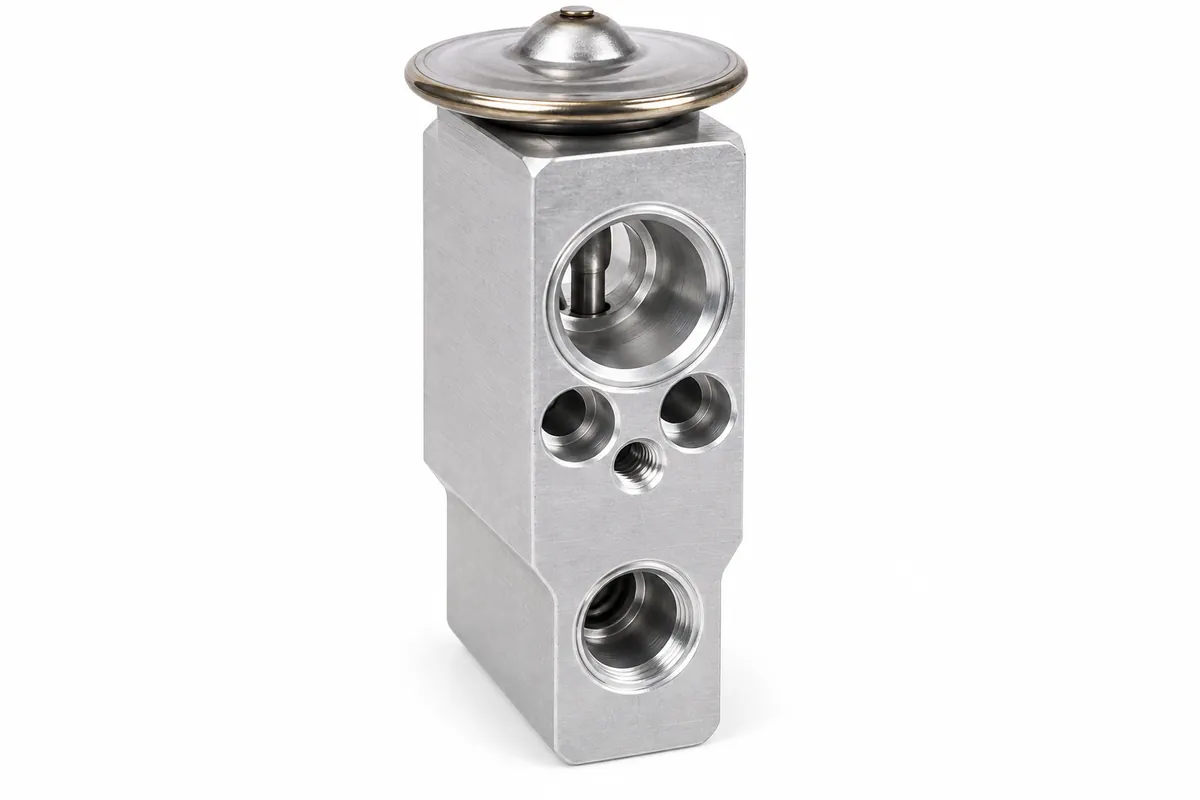
The AC expansion valve controls how much high-pressure refrigerant enters your vehicle's evaporator. It creates the pressure drop needed for the refrigerant to absorb heat inside the HVAC system while regulating refrigerant flow according to AC operating conditions.
A faulty expansion valve can cause poor cooling, abnormal refrigerant pressures, evaporator icing, or an AC system that cools inconsistently. But those symptoms can also result from incorrect refrigerant charge, compressor problems, airflow issues, or other AC faults.
Jimmy’s Mobile Care provides car AC expansion valve diagnostics and replacement in Daytona Beach, FL. We evaluate refrigerant pressures, temperatures, cooling performance, and valve behavior before determining whether the expansion valve actually needs replacement.
Mobile AC Expansion Valve Diagnostics in Daytona Beach
An expansion valve is a refrigerant-metering device. Diagnosing one requires looking at what happens to the refrigerant before and after the valve and how the evaporator responds.
Depending on the vehicle and symptoms, diagnosis can include:
- High-side refrigerant pressure
- Low-side refrigerant pressure
- Refrigerant line temperatures
- Evaporator temperature
- Vent temperature
- Refrigerant charge condition
- Compressor operation
- Expansion valve inlet and outlet behavior
- Evaporator icing
- Evidence of refrigerant restriction
- AC performance under changing operating conditions
The objective is to determine whether the valve is controlling refrigerant flow correctly rather than replacing it solely because the AC isn't cold.
What Does an AC Expansion Valve Do?
The expansion valve sits at an important transition point in the refrigeration circuit.
High-pressure refrigerant approaches the valve from the condenser side of the system.
The expansion valve meters that refrigerant into the evaporator.
As refrigerant passes through the valve, its pressure drops dramatically.
That pressure reduction allows the refrigerant entering the evaporator to absorb heat from the air passing through the HVAC case.
The valve therefore has two closely related jobs:
Create the required pressure drop.
Control how much refrigerant enters the evaporator.
Too little or too much refrigerant flow can both interfere with AC performance.
AC Expansion Valve, Thermal Expansion Valve, and TXV
Several names are commonly used for this component.
You may see it described as:
- AC expansion valve
- Air conditioner expansion valve
- Thermal expansion valve
- Thermostatic expansion valve
- TXV
- AC TXV
These generally refer to the same type of refrigerant-metering device.
“TXV” is simply a common abbreviation for thermal or thermostatic expansion valve.
This page specifically covers automotive AC systems using an expansion-valve-type metering device.
Where Is the AC Expansion Valve Located?
The expansion valve is located immediately before the evaporator in the refrigerant circuit.
Its physical location varies by vehicle.
It may be:
- At the firewall
- Attached to the evaporator inlet and outlet
- Inside or near the HVAC housing
- Accessible from the engine compartment
- Located behind interior trim or dashboard components
Accessibility has a major effect on replacement labor.
On some vehicles the valve can be reached relatively easily at the firewall.
On others, substantial interior or HVAC disassembly may be required.
Expansion Valve vs. Evaporator
The expansion valve and evaporator work directly together, but they perform different jobs.
Expansion Valve
The expansion valve meters refrigerant entering the evaporator and creates the pressure drop.
Evaporator
The evaporator absorbs heat from cabin air.
A faulty expansion valve can make a good evaporator appear to perform poorly because the evaporator isn't receiving refrigerant under the correct conditions.
That is why poor evaporator temperature does not automatically mean the evaporator core itself is defective.
Expansion Valve vs. Orifice Tube
Automotive AC systems generally use a refrigerant-metering device before the evaporator.
Depending on system design, that device may be an:
- Expansion valve
- Orifice tube
They perform related refrigerant-metering functions but operate differently and are serviced differently.
A vehicle designed with an orifice tube should not be treated as though it has a conventional TXV simply because both systems create a pressure drop before the evaporator.
Jimmy’s Mobile Care has a separate service page for AC orifice tubes.
This page specifically covers AC expansion valves and TXV systems.
How a Thermal Expansion Valve Controls Refrigerant
A thermal expansion valve does more than provide a fixed opening.
It responds to evaporator operating conditions and changes refrigerant flow accordingly.
The valve's job is to feed enough refrigerant into the evaporator for effective heat absorption while preventing inappropriate refrigerant flow back toward the compressor.
As AC load changes, the required refrigerant flow can change as well.
For example, the evaporator may experience very different heat loads when:
- The interior is extremely hot
- The vehicle has already cooled down
- Blower speed changes
- Outside temperature changes
- Cabin humidity changes
The TXV adjusts refrigerant flow as those conditions change.
Signs of a Bad AC Expansion Valve
Possible expansion-valve symptoms include:
- AC blowing warm
- Weak cooling
- Intermittent cooling
- Abnormal high-side pressure
- Abnormal low-side pressure
- Evaporator icing
- Frost near the valve or refrigerant line
- Cooling that changes unexpectedly
- Refrigerant starvation at the evaporator
- Excessive refrigerant flow through the evaporator
These symptoms still need diagnosis because they can overlap with other AC problems.
Restricted AC Expansion Valve
One possible TXV failure is excessive restriction.
If the valve cannot allow enough refrigerant into the evaporator, the evaporator becomes starved.
Possible indications can include:
- Abnormally low low-side pressure
- Reduced cooling
- Temperature change concentrated around the restriction
- Frost near the restriction
- Insufficient refrigerant flow through the evaporator
But low refrigerant charge can produce some similar pressure behavior.
That distinction is critical.
A restricted expansion valve and an undercharged AC system are not the same repair.
Expansion Valve Stuck Closed
A valve that is completely or nearly closed can severely restrict refrigerant entering the evaporator.
The compressor may continue attempting to move refrigerant while very little reaches the low side.
Depending on operating conditions, this can produce a pronounced pressure imbalance.
The evaporator may receive too little refrigerant to provide normal cooling.
Before condemning the valve, however, we need to determine whether another restriction or incorrect refrigerant condition is producing similar symptoms.
Expansion Valve Stuck Open
An expansion valve can also fail in a position that allows excessive refrigerant flow.
Instead of starving the evaporator, the valve can overfeed it.
Possible effects can include:
- Abnormally high low-side pressure
- Poor cooling
- Incorrect evaporator operation
- Improper refrigerant condition leaving the evaporator
- Reduced ability to control superheat
A valve stuck open therefore behaves very differently from a restricted valve.
“Bad expansion valve” isn't one single pressure pattern.
The way the valve failed matters.
AC Expansion Valve and Superheat
A thermal expansion valve is designed to control evaporator refrigerant flow in relation to superheat.
Superheat describes the temperature of refrigerant vapor above its saturation temperature at the measured pressure.
In practical terms, it helps indicate whether refrigerant leaving the evaporator has fully changed into vapor and how much additional heat that vapor has absorbed.
A TXV attempts to maintain appropriate refrigerant feeding of the evaporator.
Too little refrigerant can leave the evaporator starved.
Too much can create the risk of inappropriate refrigerant condition at the evaporator outlet.
This is one reason pressure and temperature information can be more useful than simply looking for frost.
Expansion Valve Sensing Bulb
Traditional thermostatic expansion valves may use a sensing bulb associated with the evaporator outlet.
The bulb responds to outlet temperature and influences valve operation.
Its installation matters.
Problems can occur if the bulb is:
- Loose
- Incorrectly positioned
- Poorly attached
- Improperly insulated where insulation is required
- Damaged
A sensing problem can affect refrigerant control even if the mechanical valve itself isn't internally blocked.
The exact configuration depends on the vehicle and valve design.
Block-Type AC Expansion Valves
Many automotive systems use a compact block-style expansion valve mounted directly at the evaporator connections.
Refrigerant passages through the block handle both the incoming refrigerant being metered into the evaporator and the refrigerant leaving the evaporator.
These valves are common because they provide a compact package at the evaporator.
When replacing a block-style TXV, correct installation and sealing at each refrigerant connection are essential.
Frost at the Expansion Valve
Frost near an expansion valve can provide diagnostic information, but it does not automatically prove that the valve is defective.
Refrigerant pressure naturally drops across the metering device, so temperature also changes significantly in this area.
Abnormal frost patterns can be associated with:
- Restricted refrigerant flow
- Incorrect refrigerant charge
- Moisture freezing at a restriction
- Other AC system conditions
We interpret frost along with pressures and temperatures rather than using it as the sole reason for replacement.
Moisture and Expansion Valve Restriction
Moisture inside an AC system can create unusual metering-device problems.
At the expansion point, temperatures can become low enough for moisture to freeze.
Ice can temporarily restrict refrigerant flow.
As the system stops operating and warms, the ice can melt and the restriction may disappear.
That can create an AC problem that:
- Works normally at first.
- Gradually loses cooling.
- Stops cooling properly.
- Begins working again after sitting.
This can resemble an intermittent expansion valve failure.
Moisture contamination therefore needs to be considered when symptoms repeatedly appear and disappear.
Debris Inside an AC Expansion Valve
Contamination can also restrict the small refrigerant passages inside the expansion valve.
Possible sources include:
- Internal compressor wear
- Desiccant contamination
- Debris from previous component failure
- Improper AC system service
- Internal deterioration
Finding debris at the valve can be important because replacing only the TXV may not solve the larger contamination problem.
The source of the debris needs to be considered.
Compressor Failure and Expansion Valve Contamination
A compressor that fails internally can distribute metal and other debris through the refrigerant system.
That contamination can eventually reach the metering device.
If debris obstructs the TXV, refrigerant flow can become restricted.
In that situation, the expansion valve problem may be a result of the compressor failure, not an independent failure.
The repair plan therefore needs to address system contamination rather than simply installing another valve.
Diagnosing the Expansion Valve With AC Pressures
High-side and low-side pressures are important diagnostic clues.
A severely restricted expansion valve may contribute to:
- Low low-side pressure
- Abnormal high-side pressure
- Reduced evaporator refrigerant flow
An overfeeding valve can create a different pressure relationship.
But gauge readings have to be interpreted with:
- Ambient temperature
- Refrigerant charge
- Compressor operation
- Condenser airflow
- Blower operation
- System design
There is no single pressure reading that universally proves an expansion valve has failed.
Expansion Valve vs. Low Refrigerant
This is one of the most important diagnostic distinctions on this page.
Both a restricted expansion valve and a low refrigerant charge can starve the evaporator.
Both can produce:
- Poor cooling
- Low suction pressure
- Abnormal temperature behavior
But the repairs are completely different.
If the refrigerant is low because the system has a leak, replacing the expansion valve will not correct it.
We evaluate the refrigerant condition and other evidence before deciding that the TXV is restricting flow.
Expansion Valve vs. Compressor Problem
A weak compressor and a faulty expansion valve can both produce abnormal system pressures and poor cooling.
The difference is where the system loses its ability to create and control refrigerant flow.
The compressor is responsible for circulating and compressing refrigerant.
The expansion valve meters refrigerant entering the evaporator.
Diagnosis looks at the overall pressure relationship to determine whether the compressor is failing to pump or the metering device is controlling flow incorrectly.
Expansion Valve vs. Condenser Restriction
A restriction on the high-pressure side can also affect AC pressures.
A restricted condenser and a restricted expansion valve occur at different points in the refrigerant circuit.
Temperature changes across components and pressure behavior can help locate where refrigerant flow is being restricted.
Replacing the TXV without determining the location of the restriction can leave the original AC problem unchanged.
Expansion Valve and Evaporator Icing
A TXV problem can contribute to abnormal evaporator temperature.
However, an evaporator that freezes is not automatically proof of a failed expansion valve.
Other causes can include:
- Evaporator temperature sensor fault
- Airflow restriction
- Blower problem
- Refrigerant condition
- HVAC control problem
If the evaporator is icing, we determine what is causing the temperature to become abnormal rather than automatically replacing the valve.
Why Vent Temperature Alone Cannot Diagnose a TXV
A thermometer at the center vent tells us how effectively the system is cooling the cabin air.
It does not identify which AC component is responsible when cooling is poor.
Warm vent temperature can result from:
- Low refrigerant
- Compressor problem
- Condenser airflow problem
- Expansion valve problem
- Evaporator problem
- HVAC blend-door problem
Vent temperature is useful when evaluating overall AC performance, but expansion-valve diagnosis requires additional information.
Intermittent Expansion Valve Problems
An expansion valve may not fail consistently.
Possible intermittent behavior can result from:
- Internal sticking
- Moisture freezing
- Contamination moving through the valve
- Temperature-related valve behavior
- Sensing problems
This can create an AC system that alternates between normal cooling and warm air.
When symptoms are intermittent, observing pressures and temperatures while the problem is actually occurring can be particularly valuable.
AC Expansion Valve Replacement
Once diagnosis supports expansion-valve failure, replacement varies considerably by vehicle.
A typical repair can include:
- Confirming the metering fault. We evaluate AC pressures, temperatures, refrigerant condition, and system operation before replacement.
- Recovering the refrigerant. Refrigerant must be properly recovered before opening the AC system.
- Locating the expansion valve. Access can be under the hood, at the firewall, or within the HVAC area depending on vehicle design.
- Removing components required for access. Covers, lines, trim, or other parts may need to be moved.
- Disconnecting the refrigerant lines. Connections to the TXV are carefully opened.
- Removing the old expansion valve. The valve is separated from the evaporator or refrigerant connections.
- Inspecting the removed valve and connections. Evidence of contamination or debris can affect the rest of the repair.
- Installing the correct replacement valve. The new TXV must match the vehicle's AC system.
- Replacing applicable seals. O-rings or other refrigerant seals are renewed as required.
- Restoring refrigerant connections. Lines are properly connected without damaging the valve or evaporator fittings.
- Reassembling access components. Anything removed to reach the valve is restored.
- Evacuating the AC system. Air and moisture are removed from the opened refrigerant circuit.
- Checking system integrity. The system is checked for leakage before charging.
- Charging the specified refrigerant quantity. The correct refrigerant amount is restored.
- Testing AC operation. Pressures, temperatures, vent cooling, and overall system behavior are rechecked.
The repair is not complete merely because a new TXV has been installed. The system must demonstrate that refrigerant is being controlled properly afterward.
Expansion Valve O-Rings and Seals
The TXV connects to pressurized refrigerant passages.
Those connections must remain leak-free after replacement.
Applicable O-rings or seals need to be:
- Correctly sized
- Compatible with the refrigerant and oil
- Properly positioned
- Lubricated as required
- Installed without damage
A pinched or incorrect O-ring can create a refrigerant leak immediately after an otherwise successful valve replacement.
Why the AC System Must Be Evacuated After TXV Replacement
Replacing the expansion valve opens the sealed refrigerant circuit.
Atmospheric air and moisture can enter while the valve is removed.
The system therefore needs to be evacuated before refrigerant is restored.
This is especially relevant to a metering device because moisture inside the system can itself contribute to restriction problems.
Installing a new TXV without properly evacuating the opened system can undermine the repair.
Recharging After Expansion Valve Replacement
After evacuation and leak checking, the system must receive the specified amount of refrigerant.
Correct charge is particularly important when evaluating a new expansion valve.
If the system is undercharged or overcharged after replacement, pressures can remain abnormal and make the new valve appear to be malfunctioning.
The refrigerant charge should therefore be restored according to vehicle specifications before final performance evaluation.
Expansion Valve Replacement and AC Oil
Some refrigerant oil may be lost when AC connections are opened.
The amount and type of oil required depend on the vehicle and the work performed.
Excessive oil can reduce AC performance.
Insufficient oil can affect compressor lubrication.
Oil should therefore be handled according to the system specification rather than automatically adding an arbitrary amount every time an expansion valve is replaced.
Should the Receiver-Drier Be Replaced With the Expansion Valve?
That depends on the vehicle, reason for TXV failure, how long the system has been open, and applicable service procedure.
The receiver-drier or other desiccant component helps control moisture within the refrigerant circuit.
If contamination or moisture contributed to the expansion-valve problem, the condition of the system's moisture-control component becomes particularly important.
It should not be assumed that every TXV replacement requires exactly the same additional parts.
Why a New Expansion Valve May Not Fix the AC
If the original diagnosis was wrong, installing a new TXV can leave the AC performing exactly as it did before.
Poor cooling can remain because of:
- Refrigerant leak
- Incorrect refrigerant charge
- Weak compressor
- Compressor control problem
- Condenser airflow problem
- Internal condenser restriction
- Evaporator airflow problem
- Temperature sensor fault
- HVAC door problem
- System contamination
That is why we diagnose the refrigerant circuit before replacing the valve.
Can an AC Expansion Valve Be Cleaned?
If contamination has entered a TXV, attempting to clean the small internal metering mechanism may not provide a reliable repair.
The valve is responsible for precise refrigerant control.
If internal contamination or mechanical failure has been confirmed, replacement is generally more appropriate than relying on an uncertain cleaning procedure.
More importantly, the source of contamination should be identified so the replacement valve does not become restricted again.
How Much Does Car AC Expansion Valve Replacement Cost?
Expansion valve replacement cost varies considerably depending on where the valve is located and how much disassembly is required to reach it.
Factors can include:
- Vehicle year, make, and model
- Expansion valve design
- Valve accessibility
- Engine-compartment vs. HVAC-case location
- Interior disassembly required
- Refrigerant type and quantity
- Refrigerant recovery and recharge
- O-rings and seals
- AC oil requirements
- System contamination
- Additional AC faults discovered during diagnosis
A TXV mounted openly at the firewall can be a very different repair from one requiring significant HVAC or dashboard access.
Call Jimmy’s Mobile Care at (386) 308-2509 with your vehicle information and AC symptoms so we can discuss the appropriate diagnostic service.
Why Diagnose the AC Expansion Valve Before Replacing It?
TXV symptoms overlap with several other AC failures.
Diagnosis helps answer the questions that determine the repair.
Is the Refrigerant Charge Correct?
A low charge can starve the evaporator and resemble a restricted valve.
Is the Compressor Pumping Properly?
A weak compressor can create abnormal pressures without any TXV failure.
Is the Valve Restricting Refrigerant?
Pressure and temperature behavior can indicate insufficient flow through the metering point.
Is the Valve Allowing Too Much Refrigerant Through?
A stuck-open or improperly controlling TXV produces a different condition from a restricted valve.
Is There Contamination?
Debris or moisture can restrict the valve and may indicate a larger system problem.
Is the Evaporator Actually the Problem?
The valve feeds the evaporator, so a metering fault can make a good evaporator appear defective.
Is the Condenser Rejecting Heat Properly?
High-side problems elsewhere in the system can alter pressures at the expansion valve.
Determining how refrigerant is behaving on both sides of the valve helps identify whether the TXV is actually responsible.
Mobile AC Expansion Valve Diagnostics & Replacement in Daytona Beach
Jimmy’s Mobile Care provides mobile AC expansion valve and TXV diagnostics in Daytona Beach.
If your AC has abnormal pressures, poor cooling, intermittent cooling, evaporator icing, or evidence of a refrigerant restriction, we can evaluate the system and determine whether the expansion valve is controlling refrigerant correctly.
When diagnosis confirms a failed TXV and the replacement procedure is suitable for mobile service, we can replace the valve, install the appropriate refrigerant seals, evacuate the system, restore the specified refrigerant charge, and verify AC performance.
Schedule AC Expansion Valve Diagnostics & Replacement in Daytona Beach
An expansion valve can restrict refrigerant, overfeed the evaporator, stick intermittently, or become contaminated—but several other AC problems can create similar symptoms.
Jimmy’s Mobile Care evaluates the pressure and temperature behavior of the refrigerant circuit before determining whether the TXV actually requires replacement.
Call Jimmy’s Mobile Care at (386) 308-2509 to schedule car AC expansion valve diagnostics and replacement in Daytona Beach, FL. Call today and we'll come to your location.