
Car Radiator Fan Diagnostics & Replacement in Daytona Beach, FL
The radiator fan helps move air through the radiator when natural airflow is not enough to control engine temperature. It is especially important when the vehicle is idling, moving slowly, sitting in traffic, or operating the AC.
If the radiator fan motor, relay, fuse, wiring, control module, temperature input, or fan assembly fails, the engine may run hot or overheat even though the radiator itself is in good condition.
Jimmy’s Mobile Care provides car radiator fan diagnostics and replacement in Daytona Beach, FL. We test the cooling-fan system before replacing parts so a bad relay, blown fuse, wiring problem, sensor issue, control fault, or another cooling-system problem is not mistaken for a failed fan motor.
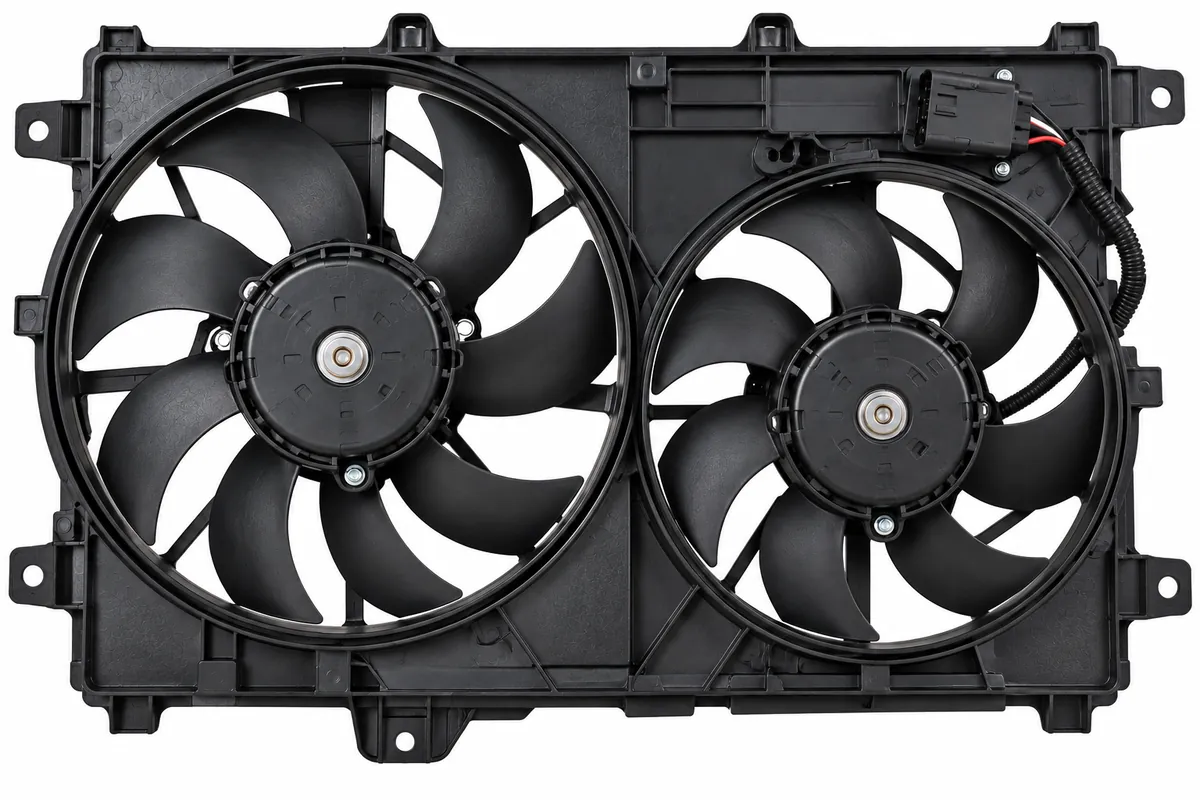
Mobile Radiator Fan Diagnostics in Daytona Beach
Cooling-fan diagnosis should determine both whether the fan operates and whether the vehicle is commanding it correctly.
Depending on the vehicle and symptoms, testing can include:
- Radiator fan operation
- Cooling-fan motor
- Fan speed
- Fan direction
- Power supply
- Ground circuit
- Cooling-fan fuse
- Cooling-fan relay
- Fan-control module
- Engine coolant temperature data
- AC-related fan command
- Wiring and connectors
- Voltage drop
- Low-speed fan operation
- High-speed fan operation
- Fan blade condition
- Fan shroud condition
The objective is to identify whether the problem is in the fan itself or in the circuit responsible for controlling it.
What Does a Radiator Fan Do?
The radiator removes heat from engine coolant as air passes through the radiator core.
When the vehicle is moving at sufficient speed, air naturally moves through the front of the vehicle.
When the vehicle is:
- Idling
- Moving slowly
- Sitting in traffic
there may not be enough natural airflow.
The radiator fan then pulls or pushes air through the heat exchangers to maintain cooling.
On many modern vehicles, the fan also helps cool the AC condenser mounted in front of the radiator.
Electric Radiator Fans
Most modern passenger vehicles use one or more electric cooling fans.
An electric fan system may include:
- Fan motor
- Fan blade
- Shroud
- Fuse
- Relay
- Fan-control module
- Wiring
- Engine-control module inputs
Some systems simply switch the fan on and off.
Others can operate the fan at:
- Low speed
- Medium speed
- High speed
- Continuously variable speed
The diagnostic approach depends on the type of system installed.
Radiator Fan vs. Cooling Fan
The terms radiator fan and cooling fan are commonly used interchangeably.
Depending on the vehicle, the fan may serve both:
- Engine radiator
- AC condenser
Some vehicles use two separate electric fans, while others use one larger fan assembly.
The exact configuration needs to be identified before testing.
Radiator Fan vs. Condenser Fan
Some vehicles use:
- One fan primarily associated with the radiator
- Another fan primarily associated with the AC condenser
Other vehicles use both fans together as part of one coordinated cooling strategy.
A fan that appears to be an “AC fan” may also contribute to engine cooling.
Likewise, a radiator fan may be commanded on when the AC is operating.
That is why both engine temperature and AC operating conditions can matter during diagnosis.
Signs of a Bad Radiator Fan
Possible cooling-fan symptoms include:
- Engine overheats while idling
- Temperature rises in traffic
- Vehicle cools down once moving
- Radiator fan does not run
- Fan runs only sometimes
- Fan runs only at high speed
- Fan runs continuously
- AC becomes warm while stopped
- Fan makes grinding or rattling noise
- Fan turns slowly
- Fan blade wobbles
- Fan blows fuse repeatedly
- Fan motor becomes very hot
These symptoms help narrow the problem but do not automatically prove that the fan motor needs replacement.
Engine Overheats at Idle but Not While Driving
This is one of the most common patterns associated with insufficient radiator airflow.
At road speed, vehicle movement forces air through the radiator.
At idle, the cooling fan must provide much of that airflow.
If the temperature climbs while stopped but drops once the vehicle is moving, possible causes include:
- Radiator fan not running
- Fan running too slowly
- Only one of two fans operating
- Low-speed fan circuit failure
- Fan-control problem
- Restricted radiator or condenser airflow
This operating pattern makes cooling-fan testing especially important.
Car Overheats in Traffic
Stop-and-go driving can expose a weak fan system because natural airflow is limited.
Possible problems include:
- Failed fan motor
- Weak fan motor
- Relay failure
- Control-module problem
- Wiring resistance
- Temperature-sensor input problem
- Fan blade damage
A cooling system that works normally on the highway can still overheat badly in traffic if the electric fan system is not working correctly.
Radiator Fan Does Not Turn On
If the fan never operates, several components need to be considered.
Possible causes include:
- Failed fan motor
- Blown fuse
- Failed relay
- Open wiring
- Poor ground
- Faulty fan-control module
- Incorrect coolant-temperature signal
- Control-module fault
The fan should not be replaced until the electrical command and power supply have been checked.
Radiator Fan Runs Slowly
A cooling fan can still turn while failing to move enough air.
Possible causes include:
- Weak fan motor
- Voltage drop
- Poor ground
- High-resistance connector
- Damaged fan blade
- Fan-control problem
A fan that spins slowly may not provide sufficient airflow under demanding conditions.
Its speed and electrical supply should be evaluated rather than assuming that any visible rotation means the system is working properly.
Radiator Fan Runs Intermittently
Intermittent fan operation can result from:
- Worn motor brushes
- Heat-sensitive fan motor
- Relay contacts
- Loose connector
- Wiring damage
- Fan-control module
- Command issue
The fan may work when cold and stop once the engine compartment becomes hot.
Testing during the failure is especially useful.
Radiator Fan Runs All the Time
A fan that runs continuously can also indicate a fault.
Possible causes include:
- Engine running hot
- AC pressure demand
- Faulty coolant-temperature signal
- Relay stuck closed
- Fan-control module fault
- Engine-control strategy after a stored fault
Some vehicles intentionally run the fan after engine shutdown or under certain AC conditions.
Continuous operation should therefore be evaluated in the context of the vehicle's control strategy.
Radiator Fan Runs After the Engine Is Turned Off
This can be normal on some vehicles.
The cooling system may continue operating the electric fan after shutdown to manage:
- Engine heat soak
- Turbocharger temperature
- AC system pressure
- Under-hood temperature
However, a fan that runs excessively long and drains the battery may indicate:
- Stuck relay
- Fan-module problem
- Incorrect temperature input
- Electrical fault
The actual operating strategy needs to be considered before calling it a failure.
Cooling Fan and AC Operation
When the AC is operating, the condenser must release heat from the refrigerant.
Because the condenser is commonly positioned in front of the radiator, the electric cooling fans may run to move air across both heat exchangers.
If the fan system fails, you may notice:
- AC is cold while driving
- AC becomes warmer at idle
- AC pressure rises while stopped
- Engine temperature rises with AC on
A fan problem can therefore affect both engine cooling and AC performance.
AC Cold While Driving but Warm at Idle
This symptom can point toward inadequate condenser airflow.
When driving, natural airflow may allow the AC to cool normally.
When stopped, the system depends much more heavily on electric fans.
Possible causes include:
- Radiator/condenser fan not running
- Weak fan motor
- One fan in a dual-fan system not operating
- Fan-control problem
The AC system should still be evaluated properly because refrigerant and compressor problems can produce similar symptoms.
Dual Radiator Fan Systems
Many vehicles use two electric cooling fans.
The fans may operate:
- Together
- Separately
- At different speeds
- Under different temperature or AC conditions
One fan can fail while the other continues operating.
That can make the system appear functional while airflow is actually reduced.
Both fans should be checked.
Low-Speed and High-Speed Fan Operation
Some cooling systems use multiple operating speeds.
For example:
- Low speed during moderate cooling demand
- High speed when engine temperature or AC pressure rises
A system can lose one speed while retaining another.
Symptoms may include:
- Fan appears to work
- Engine still overheats under certain conditions
- Fan suddenly operates only when temperature becomes very high
Testing the available fan speeds can expose a relay, resistor, module, or motor problem that would otherwise be missed.
Radiator Fan Relay
A fan relay allows the vehicle's control system to switch the higher electrical current required by the fan motor.
A failed relay can cause:
- Fan never turns on
- Intermittent fan operation
- Fan stuck on
- Loss of one fan speed
Relay testing may involve checking:
- Control signal
- Power supply
- Relay output
- Terminal condition
Replacing the fan motor will not correct a relay that is failing to supply power.
Cooling Fan Fuse
The fan motor can draw substantial electrical current.
The circuit is therefore protected by one or more fuses.
A blown fuse can stop fan operation completely.
However, simply replacing a blown fuse without determining why it opened can be a mistake.
Possible causes include:
- Shorted fan motor
- Seized fan
- Damaged wiring
- Short circuit
If the new fuse fails again, the underlying electrical fault needs diagnosis.
Radiator Fan Motor
The electric motor turns the cooling-fan blade.
Internal wear can eventually cause:
- Slow operation
- Intermittent operation
- No operation
- Excessive current draw
- Noise
- Seizure
A failed motor may be available separately on some vehicles.
On others, the manufacturer supplies the fan as a complete assembly with:
- Motor
- Blade
- Shroud
- Electronics
The appropriate replacement depends on the vehicle.
Radiator Fan Motor Current Draw
Current draw can provide useful information about motor condition.
Excessive current may indicate:
- Internal motor wear
- Mechanical binding
- Seized bearings
- Damaged fan blade contacting the shroud
Abnormally low current with poor or no operation can suggest:
- Internal electrical failure
- High resistance
- Low supply voltage
Current readings should be interpreted together with voltage and fan behavior.
Testing Power at the Radiator Fan
If a fan does not operate, checking whether electrical power reaches the motor helps separate a motor failure from a control-circuit problem.
If proper power and ground are present but the fan does not operate, the motor becomes more suspect.
If power is missing, diagnosis moves upstream toward components such as:
- Fuse
- Relay
- Fan-control module
- Wiring
- Engine-control command
Cooling Fan Ground Circuit
The fan motor needs a low-resistance ground circuit.
A poor ground can cause:
- Slow fan speed
- Intermittent operation
- Excessive heat
- No operation
A connection may look clean but still develop enough resistance under load to reduce fan performance.
Voltage-drop testing can help identify this type of fault.
Voltage Drop in the Cooling Fan Circuit
A fan motor may receive some voltage but still not receive enough usable power under load.
Voltage can be lost across:
- Corroded connectors
- Damaged wiring
- Relay contacts
- Ground connections
A weak fan may therefore be caused by the electrical path rather than by the fan motor itself.
Testing under operating load is more meaningful than simply checking for voltage with the fan disconnected.
Radiator Fan Connector Problems
Cooling-fan connectors carry significant electrical current and operate in a hot engine compartment.
Problems can include:
- Melted connector
- Heat-damaged terminal
- Loose terminal tension
- Corrosion
- Burned pins
- Broken wiring
A damaged connector can create resistance that slows the motor and generates even more heat.
The connector should be inspected when a fan motor has failed or overheated.
Melted Radiator Fan Connector
A melted connector can indicate excessive resistance or excessive motor current.
Simply installing a new motor while reusing a severely damaged connector can result in another failure.
The electrical connection needs to be restored correctly as part of the repair.
Radiator Fan Control Module
Some vehicles use an electronic fan-control module rather than simple relays.
The module may control fan speed based on commands from the engine computer.
Inputs can include:
- Engine coolant temperature
- AC pressure
- Vehicle speed
- Engine operating conditions
A control-module failure can prevent proper fan operation even when the fan motor itself is good.
Variable-Speed Radiator Fans
Modern vehicles may use pulse-width modulation or another electronic method to vary cooling-fan speed.
Instead of simply being ON or OFF, the fan may operate anywhere within a range.
This means diagnosis may require checking:
- Power
- Ground
- Command signal
- Scan-tool data
- Actual fan response
Directly applying power without understanding the system design is not appropriate for every modern fan.
Engine Coolant Temperature Sensor and Fan Operation
The engine-control module often relies on the coolant-temperature sensor to determine when additional cooling airflow is needed.
If the sensor signal is incorrect, the fan may:
- Turn on too late
- Run constantly
- Fail to turn on as expected
The temperature reported by the vehicle should be compared with actual operating conditions.
A fan should not be replaced simply because it was not commanded on by a system receiving bad temperature information.
Radiator Fan and Temperature Gauge
The dashboard temperature gauge and cooling-fan strategy may use the same temperature information or related inputs.
If the gauge behaves abnormally and the fan also operates incorrectly, the temperature-sensing circuit deserves attention.
However, gauge behavior varies by manufacturer and is not a substitute for live temperature data.
Cooling Fan Command With a Scan Tool
On supported vehicles, diagnostic equipment may be able to:
- View fan command
- View coolant temperature
- View AC pressure
- Command fans on for testing
An active command test can be particularly useful.
If the computer commands the fan but the fan does not respond, the problem is likely in:
- Fan motor
- Power circuit
- Ground circuit
- Relay
- Fan module
- Wiring
If no command is issued when one should be expected, sensor inputs and control logic need closer attention.
Radiator Fan and Thermostat Problems
A thermostat and cooling fan perform different functions.
The thermostat controls coolant circulation based on temperature.
The fan controls airflow across the radiator.
A thermostat stuck closed can cause overheating even if the fan is working perfectly.
Likewise, a failed fan can cause overheating even with a good thermostat.
The two problems should be diagnosed separately.
Radiator Fan vs. Radiator Problem
A vehicle can overheat because the radiator cannot transfer heat effectively or because insufficient air is moving through it.
Possible radiator problems include:
- Internal restriction
- External blockage
- Damaged core
Possible fan problems include:
- Motor failure
- Electrical failure
- Weak airflow
- Incorrect fan control
The operating conditions under which overheating occurs can help distinguish between them.
Radiator Fan vs. Water Pump Problem
The water pump moves coolant.
The radiator fan moves air.
Both are required for proper cooling.
A failed water pump can cause overheating even while the radiator fan operates normally.
A failed fan can cause overheating even when coolant circulation is excellent.
Proper diagnosis considers both coolant flow and airflow.
Radiator Fan Blade Damage
Fan blades must remain:
- Intact
- Balanced
- Secure
- Correctly positioned
Damage can include:
- Cracked blades
- Missing blade sections
- Warping
- Contact with shroud
- Loose attachment
A damaged blade can reduce airflow and create vibration.
Because the fan can rotate at high speed, significant blade damage should not be ignored.
Radiator Fan Wobble
A fan that visibly wobbles may have:
- Damaged blade
- Loose fan attachment
- Worn motor bearing
- Bent assembly
Wobble can eventually cause:
- Shroud contact
- Noise
- Motor wear
- Blade failure
The motor and blade assembly should be evaluated together.
Radiator Fan Grinding Noise
Grinding or rough mechanical noise can indicate:
- Worn fan-motor bearing
- Fan blade contacting shroud
- Debris trapped in fan
- Damaged motor
The fan should be inspected before continued operation damages the blade, shroud, or wiring.
Radiator Fan Rattling Noise
A rattling fan may have:
- Loose blade
- Cracked shroud
- Damaged mounting
- Foreign debris
- Worn motor bearing
Noise that changes when the fan turns on is a useful clue that the cooling-fan assembly should be inspected.
Fan Shroud
The fan shroud helps direct airflow through the radiator instead of allowing the fan to pull air from around the sides.
A cracked, missing, or incorrectly installed shroud can reduce cooling efficiency.
The shroud can also prevent the rotating blade from contacting surrounding components.
Shroud condition should be checked when the fan assembly is serviced.
Debris in the Radiator Fan
Leaves, plastic, road debris, or other objects can become trapped near the cooling fan.
This can:
- Block the blade
- Damage the fan
- Blow a fuse
- Overload the motor
- Create noise
Before condemning an electrical component, the fan should be checked for physical obstruction.
Fan Spinning in the Wrong Direction
Correct airflow direction matters.
An incorrectly wired or incorrect aftermarket fan may rotate in the wrong direction and move much less air through the radiator than intended.
The fan should move air in the direction required by the vehicle's design.
This is especially important after non-original cooling-fan modifications.
Puller vs. Pusher Cooling Fans
An electric fan can be designed as a:
Puller Fan
Mounted behind the radiator and pulls air through the core.
Pusher Fan
Mounted in front and pushes air through the core.
Original vehicle systems are designed around a specific airflow arrangement.
Installing or configuring a fan incorrectly can reduce cooling performance.
Radiator Fan Replacement
Once testing confirms that the fan motor or assembly has failed, replacement can generally include:
- Confirm the fan fault. We verify whether the motor, electrical circuit, control system, or another component is responsible.
- Disconnect battery power where appropriate.
- Gain access to the fan assembly. Covers, intake ducts, radiator supports, or other components may need to be moved.
- Disconnect the fan electrical connector.
- Inspect the connector and wiring. Melted terminals, corrosion, and damaged wires are identified before the new fan is installed.
- Remove fan mounting hardware.
- Remove the fan or fan-shroud assembly carefully.
- Compare the replacement assembly. Motor, connector, blade, shroud, mounting points, and rotation requirements are verified.
- Inspect surrounding components. Radiator, condenser, hoses, and wiring are checked for anything that could interfere with the new fan.
- Install the replacement fan assembly.
- Reconnect wiring and mounting hardware.
- Restore any removed components.
- Operate the engine and AC as appropriate.
- Verify fan activation.
- Verify available fan speeds where applicable.
- Check for vibration, noise, and blade interference.
- Verify engine temperature remains stable.
A fan replacement should restore both electrical operation and proper airflow.
Fan Motor Replacement vs. Complete Fan Assembly
On some vehicles, the fan motor can be replaced separately.
On others, the replacement may come as a complete assembly containing:
- Fan motor
- Fan blade
- Shroud
- Control electronics
The best repair depends on:
- Vehicle design
- Parts availability
- Condition of blade and shroud
- Integrated control components
- Labor required
A worn-out assembly should not necessarily be separated into individual parts if the remaining components are also damaged.
Single-Fan vs. Dual-Fan Replacement
If a vehicle uses two fans and one fails, both fans should be tested.
It is not always necessary to replace both.
If one motor has failed and the other:
- Operates at proper speed
- Has normal current draw
- Is physically sound
the good fan may remain in service.
However, some vehicles supply both fans only as one complete assembly.
Does Radiator Fan Replacement Require Draining Coolant?
Often, no.
An electric fan assembly is generally mounted outside the sealed cooling system.
If sufficient access exists, it may be replaced without opening:
- Radiator
- Hoses
- Coolant circuit
However, some vehicle designs may require removal or movement of cooling-system components for access.
The exact procedure depends on the vehicle.
Does Radiator Fan Replacement Require AC Refrigerant Service?
Usually, no.
The fan is generally serviced without opening the AC refrigerant circuit.
However, the condenser may be positioned very close to the fan assembly.
Care must be taken not to damage:
- Condenser
- Refrigerant lines
- Connections
If the vehicle's construction requires refrigerant-system disassembly for access, additional equipment and procedures would be necessary.
Why a New Radiator Fan Might Still Not Work
Installing a new fan does not fix a problem elsewhere in the fan-control circuit.
Possible causes include:
- Blown fuse
- Bad relay
- Damaged connector
- Missing power
- Poor ground
- Fan-control module
- Temperature-sensor problem
- Wiring fault
- Missing control command
This is why electrical testing should come before replacement whenever possible.
Why a Radiator Fan Fuse Keeps Blowing
Repeated fuse failure can indicate excessive electrical current or a short circuit.
Possible causes include:
- Seized fan motor
- Internally shorted motor
- Damaged wiring
- Melted connector
- Wire contacting ground
Installing increasingly larger fuses is not a proper repair.
The cause of excessive current needs to be identified.
Cooling Fan Replacement Cost
Radiator fan replacement cost depends on the vehicle and fan design.
Factors can include:
- Vehicle year, make, and model
- Single vs. dual fan
- Motor-only vs. complete assembly
- Integrated fan-control module
- Accessibility
- Fan shroud design
- Connector damage
- Relay or wiring repairs
- Diagnostic time
A simple standalone motor can be a very different repair from a complete electronically controlled dual-fan module.
Call Jimmy’s Mobile Care at (386) 308-2509 with your vehicle information and overheating or fan symptoms so we can discuss the appropriate diagnostic service.
Why Diagnose the Radiator Fan Before Replacing It?
A cooling fan depends on multiple components working together.
Is the Fan Receiving Power?
If not, the motor may be completely functional.
Does the Fan Have a Good Ground?
High resistance can cause slow or intermittent operation.
Is the Fuse Good?
A blown fuse can indicate either a simple circuit interruption or a larger electrical problem.
Is the Relay Working?
A failed relay can prevent power from reaching the fan.
Is the Computer Commanding the Fan?
A sensor or control problem can prevent activation.
Does the Fan Run at the Correct Speed?
A weak motor may turn but still fail to provide enough airflow.
Are Both Fans Working?
One failed fan in a dual-fan system can substantially reduce cooling capacity.
Is the Problem Actually the Radiator?
Poor heat transfer can cause overheating even with strong fan airflow.
Is the Problem Actually Coolant Circulation?
A thermostat or water-pump problem can create overheating that the fan cannot correct.
Diagnosing these areas helps prevent replacing a fan assembly when the real fault lies elsewhere.
Mobile Radiator Fan Diagnostics in Daytona Beach
Jimmy’s Mobile Care provides mobile car radiator fan diagnostics in Daytona Beach for vehicles experiencing:
- Overheating at idle
- Overheating in traffic
- Fan not turning on
- Intermittent fan operation
- Weak fan speed
- Fan noise
- Fan running continuously
- AC cooling poorly while stopped
We test the fan motor and the electrical and control circuits responsible for operating it.
Mobile Radiator Fan Replacement in Daytona Beach
When diagnostics confirm fan-motor or fan-assembly failure and the repair is appropriate for mobile service, Jimmy’s Mobile Care can replace the radiator fan at your Daytona Beach location.
After replacement, we verify:
- Fan activation
- Proper rotation
- Fan speed
- Electrical connections
- Clearance
- Noise and vibration
- Cooling-system response
The goal is to restore proper airflow through the radiator and condenser rather than simply replacing a part because the engine overheated.
Schedule Car Radiator Fan Diagnostics & Replacement in Daytona Beach
An engine that overheats while idling does not automatically need a radiator.
The problem may be the fan motor, relay, fuse, wiring, fan-control module, temperature input, or another part of the cooling system.
Jimmy’s Mobile Care diagnoses the cooling-fan system before replacement so the actual failure can be identified.
Call Jimmy’s Mobile Care at (386) 308-2509 to schedule car radiator fan diagnostics and replacement in Daytona Beach, FL. Call today and we'll come to your location.